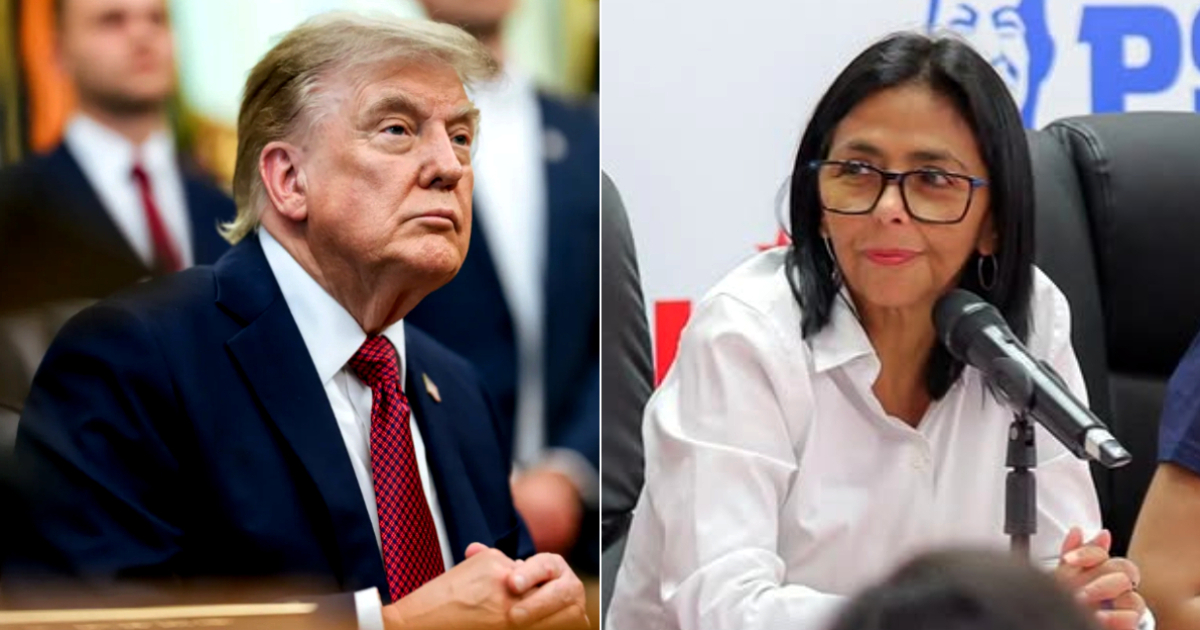
The Venezuelan government led by Delcy Rodríguez was invited as a special country to the G20 ministerial meetings on "energy abundance" that began this Monday in Houston, Texas, as confirmed in statements to Fox Business by the U.S. Secretary of the Interior, Doug Burgum.
Venezuela is not a member of the group, but its presence reflects the new energy axis that Washington seeks to build in the Western Hemisphere following the capture of Nicolás Maduro.
The meeting, which runs until Wednesday, gathers delegations from the 20 largest economies in the world—among them China, India, Japan, Germany, Canada, and Saudi Arabia—and was convened under the U.S. presidency of the G20, whose main summit is scheduled to take place in Miami in December.
Venezuela was invited to the energy forum in Houston despite not being part of the bloc, which the agency EFE interprets as a sign of the diplomatic shift engaged by Caracas since the beginning of the year.
Asked by Fox Business, Burgum explained the strategic aim of the meeting: "We have all the G20 countries here, in addition to Venezuela. The goal is to shift the geopolitical center of oil away from the Middle East —with all these uncertainties regarding disruptions in the Middle East— to the Western Hemisphere."
According to a report from Bloomberg, the Venezuelan delegation is led by the Minister of Hydrocarbons Paula Henao and the Executive Vice President of PDVSA, Jovanny Martínez. Neither will participate in the closed formal ministerial sessions, but they will engage in bilateral meetings, parallel events, and industry forums.
The rapprochement between Washington and Caracas accelerated following Maduro's capture by U.S. forces on January 3, 2026.
At the end of August, Trump announced a historic oil agreement with Venezuela that grants 100-year concessions on 17 Venezuelan oil fields to the company North American Blue Energy Partners (NABEP), with estimated reserves of 65 billion barrels.
Under this agreement, the Pentagon's Office of Strategic Capital acquired a 35% stake in the parent company of NABEP, and the U.S. secured the right to purchase 20% of the production at cost price. Rodríguez described the agreement as a "historic milestone."
The Houston meeting takes place at a time of high tension in global energy markets. Since the U.S. and Israel attacked Iran in February 2026, Brent crude has surpassed $100 per barrel, and the price of diesel in the U.S. reached a record average of $6.20, according to the American Automobile Association, compared to the $3.70 recorded before the conflict.
That pressure on prices complicates supply in Europe and generates a growing political cost for Trump, whose Republican Party fears a defeat in the legislative elections of November 2026. Burgum emphasized that the debate in Houston "will revolve around increasing production and refining, not shutting it down, as happened during Biden's presidency."
The presence of Russian officials at the event also caused discomfort among Ukraine's European allies, who had already expressed their disappointment when the Russian Finance Minister, Antón Siluánov, appeared at a G20 meeting two weeks ago.
Washington's strategy of prioritizing access to energy resources over traditional geopolitical considerations deepens tensions with its partners in the Atlantic bloc.
Related videos:
Filed under: