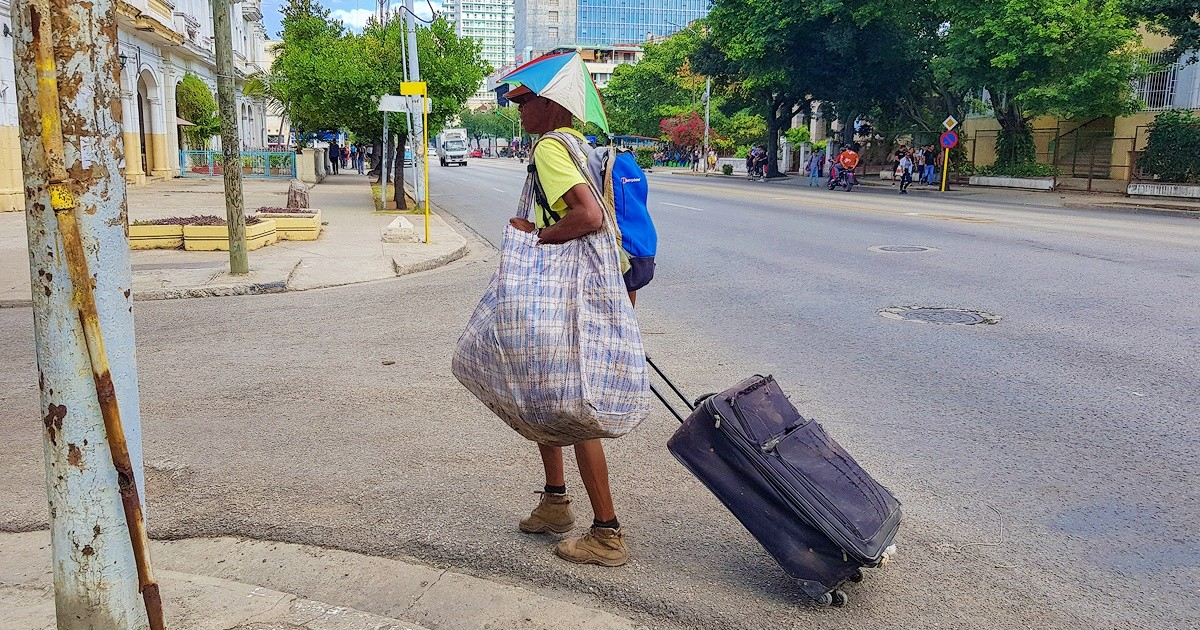
The historian and doctor of Historical Sciences Ivette García González, former full professor at the University of Havana, published this Sunday on her Facebook profile a raw analysis of present-day Cuba titled "What is the new reality we are living?" in which she concludes that poverty and vulnerability have ceased to be characteristics of minority groups and have become the condition of the average citizen.
García González's thesis is not that the ills of the island are unprecedented, but that they have reached a qualitatively different dimension. Power outages, food shortages, hospital collapse, garbage accumulation, everyday corruption, and repression have existed for decades; what is truly new, he argues, is the magnitude and accumulation of their effects.
"All the negativity that already existed is now worse, with additional elements depending on the context and imagination of the people," writes the academic, who also identifies a phenomenon that she considers equally serious: "All the vices of the parasitic and exploitative state are present in the infected society: psychosocial effects."
This "contamination" of the social fabric is expressed, according to García González, in everyday behaviors: the driver who vents his frustration by mistreating passengers on a bus, the market vendor who cheats with the scale and the change, or the official who complicates a simple procedure only to charge for facilitating it. In his view, these are manifestations of the same abusive power that the State exerts from above, echoed downwards by those who hold even the slightest amount of authority.
Another structural change he points out is the disappearance of the social pyramid. "The social pyramid that we used to say was inverted in the nineties has vanished; today it has only two levels: those at the top with their privileged connections, and those at the bottom," he asserts. This binary structure—privileged individuals of the regime versus the rest—frames his most compelling statement: "The vulnerable in Cuba are no longer a segment; they are not a minority. They are the majority of the people, the ordinary citizens. What can we say about those who are unjustly imprisoned for exercising their rights and dissenting from the government? Many who gave everything believing in the utopia."
The available data supports this diagnosis. The Cuban Observatory of Human Rights reported in August 2026 that extreme poverty affects 94% of the Cuban population, and noted that eight out of ten Cubans had skipped breakfast, lunch, or dinner at least once in the previous six months due to lack of money or food.
In terms of repression, Prisoners Defenders recorded 1,339 political prisoners in August, a new historical record, while the Cuban Observatory of Conflicts documented 1,415 protests just in July 2026.
García González also denounces the systematic use of euphemisms to disguise the crisis: "revolution in education" hides the lack of teachers; "special period" softened the deepest crisis; "proletarian internationalism" justified interference in other countries; "army of white coats" covers up the export of cheap professional labor; and "comrade who assists you" is the title given by the regime to the oppressor assigned to monitor the citizen.
The text this Sunday is the latest in a series of reflections that the academic has published throughout 2026. On September 3rd, she suggested that protests must be translated into an organized strategy, warning that otherwise the cycle of "crisis-protests-withdrawal" would repeat indefinitely. On August 21st, she declared the reformist cycle exhausted and described the package of 176 economic measures announced by the government in June 2026 as "fraudulent change."
In his analysis this Sunday, García González acknowledges in Cubans "an incredible capacity for endurance (not for fighting but for withstanding) and an optimism and trust in the authorities that breaks any sociopsychological framework." However, he believes that this very ability to endure is part of the problem: it has allowed the regime to perpetuate itself.
His conclusion leaves no room for ambiguity: "At this point, definitely, the only solution is the end of the totalitarian regime that brought us here and continues to exist, and the transition to democracy."
Related videos:
Filed under: