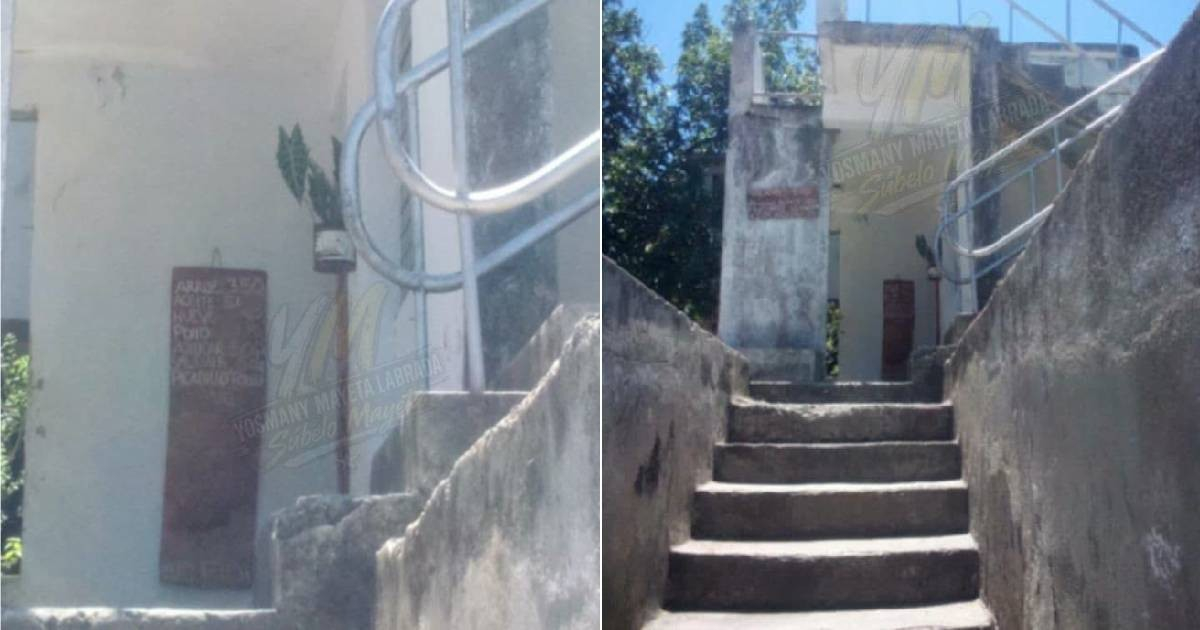
An old family medical office in Santiago de Cuba has been transformed into a residence, with a sign on its walls announcing the sale of basic products such as rice, oil, eggs, chicken, sugar, and ground meat.
The photographs, published this Tuesday by the independent journalist Yosmany Mayeta Labrada, capture in images the collapse of a program that the Cuban regime presented for decades as one of its major health achievements.
"There are images that explain a crisis without the need for grand speeches," wrote Mayeta Labrada when she published the photographs.
What the images show is not an isolated case. In the comments on the post, a resident of Santiago de Cuba described a similar situation in the Rajayoga neighborhood: "There is a clinic next to a makeshift store that set up a clothing sales point, and that clinic hasn't been operational for years, but people live there on two floors. These are the revolutionary achievements without words."
The deterioration of the program is due to a structural health crisis that has worsened in recent years. According to data from the National Office of Statistics and Information published by the independent media elTOQUE, between 2010 and 2022, 37 family medical practices closed in Cuba, along with 63 hospitals, 187 maternity homes, and 45 dental clinics.
The official media outlet Tribuna de La Habana itself acknowledged at the beginning of 2025 that in the Havana municipality of Diez de Octubre, "many clinics were closed and turned into homes" and that "not all clinics have a doctor."
The Cuban Institute for the Freedom of Expression and the Press documented in 2025 a "visible deterioration" of medical offices in Havana, with facilities that "look more like abandoned houses." In Pinar del Río, one office was closed because it "lacked the necessary conditions," forcing patients to travel more than 10 kilometers to the nearest polyclinic. In Villa Clara, health authorities acknowledged in 2026 that more than half of the offices were in "fair or poor condition."
Behind the abandonment of sanitary spaces lies a paradox that Mayeta Labrada points out with precision: "One crisis ends up occupying the space left by another."
Cuba is facing an unprecedented health crisis along with a housing deficit that exceeded 929,000 homes in 2026, with 35% of the housing stock in fair or poor condition. The construction plan for 2025 was only fulfilled at 22%. Vacant clinics are thus becoming an emergency solution for health sector workers who have nowhere to live.
At the same time, the country lost more than 30,000 doctors between 2021 and 2024, dropping from 106,131 to 75,364 registered professionals. The Minister of Public Health, José Ángel Portal Miranda, admitted before Parliament in July 2025 to an "unprecedented structural crisis," with barely 30% of the essential medication list available, and in February 2026 stated to the AP agency that the system was "on the verge of collapse."
The question raised by Mayeta Labrada directly targets the State: "How did a system that presented the Family Doctor as an achievement end up losing community spaces while doctors, nurses, and patients bear the consequences?"
"Before, it was a place to check your blood pressure, receive a consultation, or consult the local doctor. Today, even the walls tell a different story," the journalist concludes.
Related videos:
Filed under: