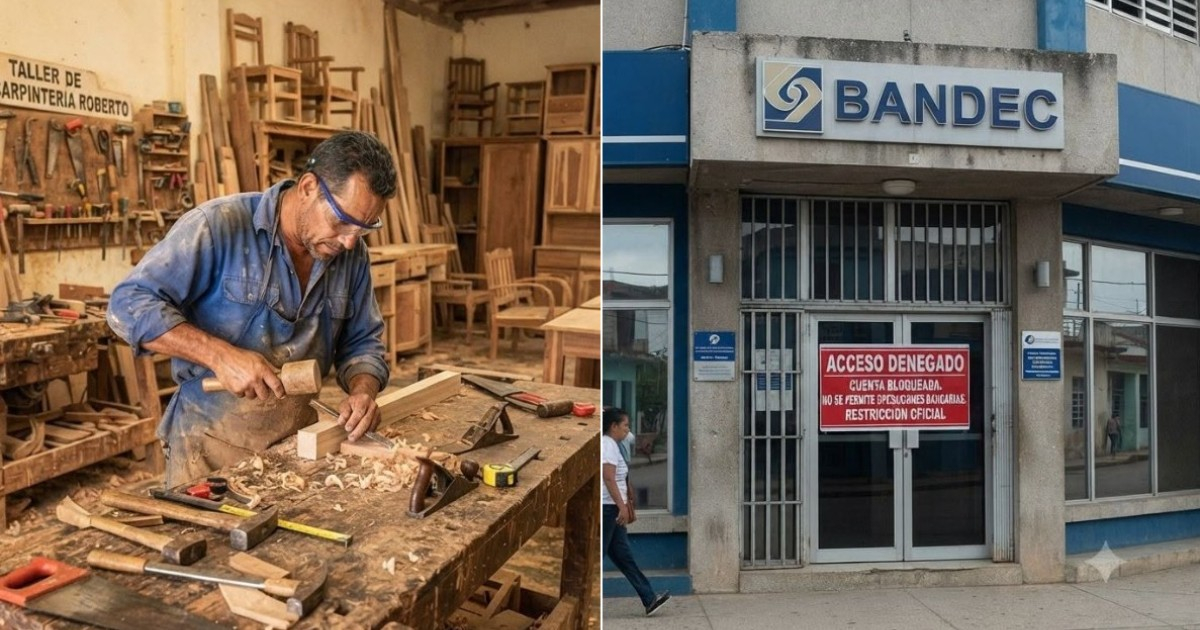
The Cuban writer Liudys Carmona Calaña, residing on the Isle of Youth, published a complaint on in which she recounts how her husband, an artist registered with the Cultural Goods Fund, is unable to withdraw the cash that ETECSA deposited into his BANDEC account as payment for the production of furniture for the telecommunications company’s establishments.
The man fulfilled a legal contract with ETECSA, and the payment was deposited at the BANDEC branch in the special municipality. However, when he went to withdraw the money, the bank executives shut the door on him with a bureaucratic argument: that he is not a self-employed worker and that he belongs to a state entity.
"Working honestly, signing a legal contract, fulfilling obligations with a state company like ETECSA by creating furniture for its establishments at a considerable value... What good is it if, when it comes time to get paid, the bank shuts its doors on you?" wrote Carmona Calaña.
The justification offered by the bank was that there is "a resolution that only benefits those who trade in favor of the people," a statement that the author of the complaint dismantles with a direct question: if ETECSA operates for the people, who benefits from her husband's work?
"Why can't a legally established creator have access to their own money, which is the bread for their family and the capital for continuing to produce? Legitimate money, earned through their hard work, meant for new investments to keep working and for supporting our family. Money that they did not steal from anyone," the woman questioned.
What angers Carmona Calaña the most is that the management of BANDEC acknowledges the contradiction without any shame, yet does nothing to resolve the issue.
"The bank executives calmly acknowledge the reality: they are fully aware that entrepreneurs and suppliers only accept cash on the street, and that to resolve issues, we are pushed to resort to the informal market, where they charge between 35% and 40% commission for converting a transfer to cash. It's complete madness!" he denounced.
And he criticized the government when talking about "national production and productive linkages," because in practice, the system itself stifles the worker, forcing him into illegality because "the bank denies him his own money."
The post sparked a wave of outraged comments. "Your husband's case is due to a law made by someone sitting comfortably at a desk with a full belly and no thought for the people. It's that simple," wrote a user.
Another pointed out: "In the end, it's all a business where only they benefit, which is why they create the law... because behind it lies the trick that goes straight into their pockets."
A third comment was more striking: "Everything is a hindrance, and what’s saddest of all is that those who truly work and fight for their families have no rights at all, not even to have their money in hand."
"The Cuban regime is a system designed to rob the people, and its entities, companies, and ministries are parasitic entities that feed off the sacrifices of others," stated a user.
"There are so many obstacles imposed on artists, entrepreneurs, and self-employed workers that they feel suffocated," concluded a self-employed individual.
Situations like those of this artisan from Pinero highlight the failure of enforced banking in Cuba.
In the Isle of Youth, an article published in July by the official newspaper Victoria acknowledged this, describing a landscape of "anxiety and helplessness" among the residents.
According to the outlet, bank branches only disbursed up to 2,000 pesos per transaction, whereas the previous limit was 5,000 CUP. Meanwhile, private businesses responded with phrases such as "I don't accept transfers," "I've reached my daily limit," or "due to the power outage, I am not receiving messages and cannot confirm."
Due to banking restrictions, the parallel market for converting transfers to cash has become established nationwide, with commissions ranging from 30% to 50% depending on the province. In Santiago de Cuba, it was reported that when transferring 1,000 pesos, only 600 are received in cash.
In provinces like Sancti Spíritus, less than 10% of private businesses regularly accept transfers.
The official press has acknowledged the failure of transfer payments, attributing it to the cash shortage, power outages, and insufficient banking infrastructure.
Related videos:
Filed under: