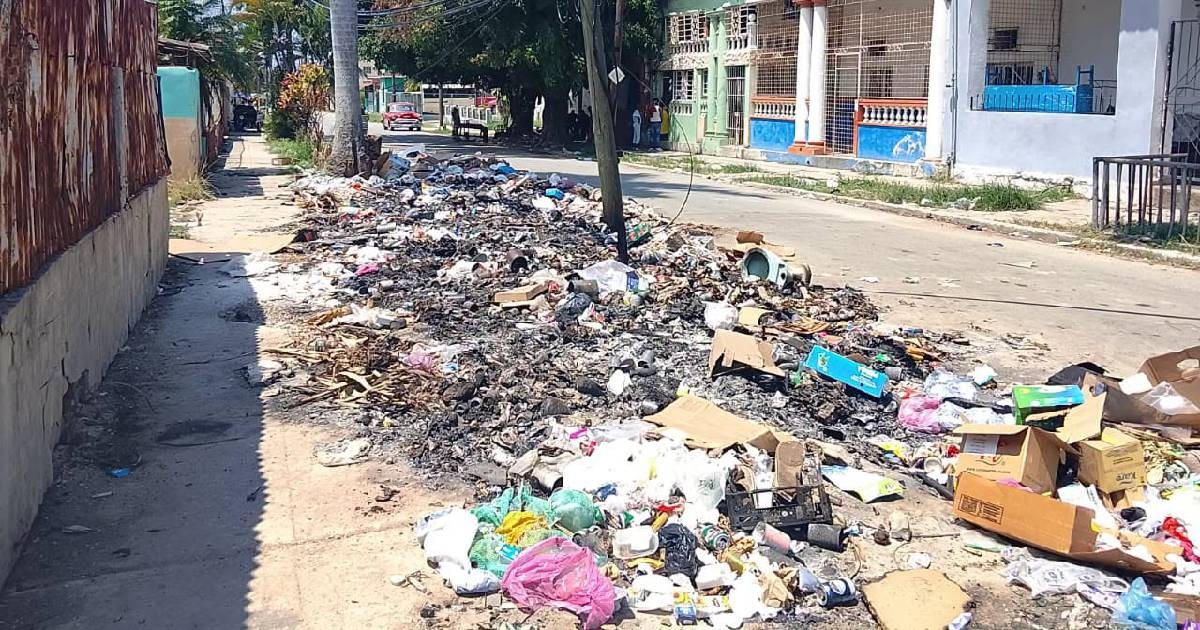
The Telecommunications Company of Cuba (ETECSA) urged citizens not to throw garbage near telecommunication poles and cabinets, warning that this practice puts "the connection of the entire block at risk" and endangers those who pass through areas with exposed wires.
The call, published on Facebook by the entity in Havana, sparked numerous criticisms from users, many of whom held the State and Municipal services responsible for the accumulation of waste.
Several comments questioned what citizens should do with waste in light of collection issues. Some resorted to the same ironic idea: "Should we eat it?"
Behind that question lies years of waste accumulation in streets and corners, a fleet of collection trucks severely limited by a lack of diesel, and a municipal service that many users question for its inefficiency.
"But I can't eat the trash. The government is responsible for finding alternatives and solutions so that the community doesn't burn the waste or destroy the electrical or telephone wiring," wrote one of the users.
Another was more direct: "Tell the government to get on it and pick that up. People can't eat garbage. I'm not saying it's okay to throw trash in the street, but the government isn't doing anything."
Among the comments, one user also mentioned the problem of garbage fires near telecommunications infrastructure. She recounted that in Santa Fe "they burned a cabinet along with the trash," and a residential area had been without landline service for three months. "It's very costly to replace it completely. The cure was worse than the disease," she added.
Other users took the opportunity to report issues with ETECSA's infrastructure in their neighborhoods. One of them stated that in Tulipán and Mariano “they burned an ETECSA pole” next to a dumpster and that “the infrastructure is hanging from the branches of a tree that is also burned.” According to her, the issue has been reported since March and she is still waiting for it to be resolved.
Another commentator directly questioned the company's message by describing the situation that, according to her, residents of the block between 3rd and 4th streets in Martín Pérez, San Miguel del Padrón, are suffering. "Since June 23, the phone lines in the block have been broken and hanging," she wrote. The woman asserted that, despite reports and complaints, the area has been "without landline service, without Nauta Hogar" for nearly three months.
In February of last year, ETECSA had issued a warning about the damage that burning trash could cause to telecommunications. Previously, in April 2025, a fire in Monterrey caused by the accumulation of trash at the base of a pole next to a smart cabinet near the Feria de la Cuevita, completely disabled that telecommunications node.
The root of the problem is structural: in February 2026, only 44 of the 106 collection trucks in Havana were operational, just 41.5% of the fleet, while the capital generates between 24,000 and 30,000 cubic meters of waste per day. Authorities have attributed the difficulties, among other factors, to the lack of fuel, the deterioration of the vehicle fleet, and the shortage of spare parts.
"In Marianao, every corner is a dump," wrote one user. "Havana can't take it anymore," another stated.
Numerous commentators directed their complaints towards the institutions responsible for waste collection: "That message from ETECSA is for the Provincial Government, right?" One went further: "ETECSA can sue the Government for not collecting the garbage."
The citizens' response follows a pattern that has been repeated in recent months when state entities demand responsibility from the population: the comments turn into a catalog of accumulated complaints about services that aren't working. "The people are always to blame for everything," summarized a user.
Related videos:
Filed under: