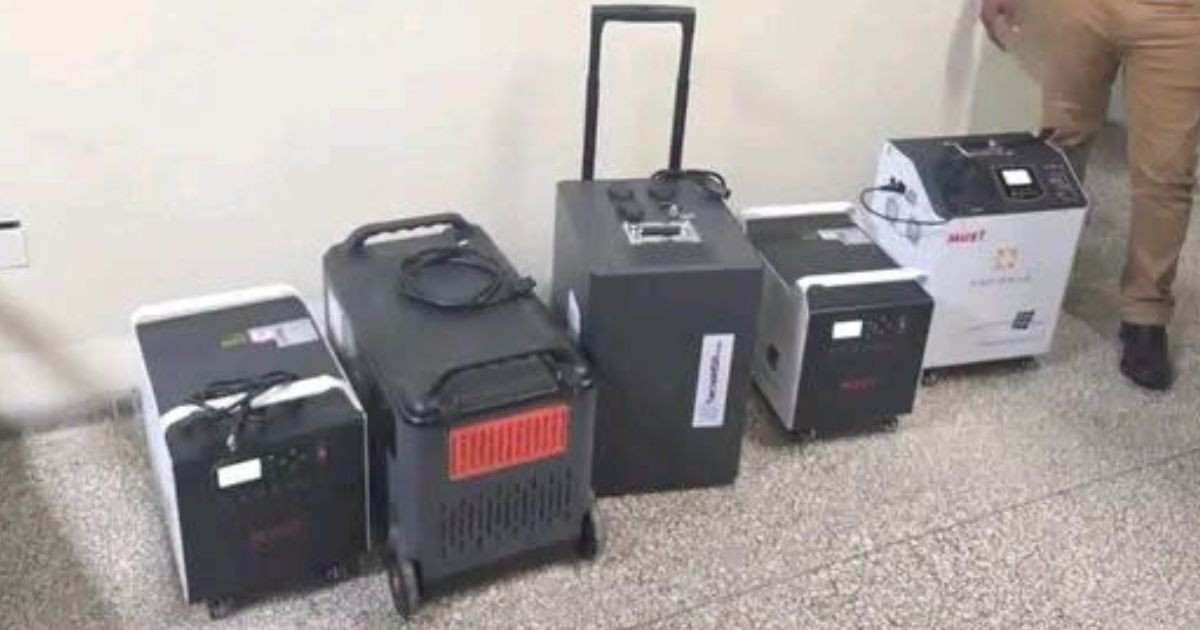
Several SMEs from Villa Clara donated backup electric equipment to hospitals in the province to strengthen the operation of anesthesia machines and safeguard the care of critically ill patients, in light of the risk that the generators in these institutions may fail due to the extended hours of operation.
The official journalist Henry Omar Pérez reported this Friday on Facebook that the event took place following a call from the Communist Party of Cuba (PCC) and the provincial government, organized by the ONURE.
According to the explanation, the small and medium-sized enterprises provided several EcoFlow units to "support the anesthesia machines for critically ill patients in the intensive care units of provincial hospitals."
Pérez assured that the generators currently have a guaranteed fuel supply, but he acknowledged a particularly sensitive issue: «their technical condition may be affected due to excessive operating hours».
The warning highlights that the devices provided by the private sector are not merely a symbolic donation, but an additional protection for essential medical equipment in case the generators that are supposed to keep the services running during power outages fail.
The journalist presented the report with the rhetoric and usual romanticism of the government, framing it as a demonstration of the "sensitivity" of the small and medium-sized enterprises, and publicly thanked them for their contribution. However, the ensuing exchange in the comments provided a different perspective on the situation.
A user responded that donating that equipment was "the least they can do".
Pérez immediately came to the defense of private entrepreneurs: "Who told you they are obligated to give anything? They do it out of goodwill and you with a venomous and spiteful comment," wrote the official journalist, in an openly confrontational and dismissive tone, more akin to the usual trench discourse of regime defenders on social media than to a respectful exchange.
In another response, he insisted: "The important thing is to know what your attitude would be if you had the money and the possibility. Would you contribute? My question is what do you contribute, what do you do."
The defense is significant because it precisely underscores that micros, small, and medium-sized enterprises are not obligated to provide these resources to the public health system.
Private businesses are allocating part of their funds to strengthen vital equipment in hospitals that rely on an electrical infrastructure facing significant pressure due to the energy crisis.
And, above all, with a difficult background that cannot be overlooked: the Cuban state cannot even guarantee the necessary electrical support to protect essential equipment in its own hospitals.
And practice, where the criteria for truth are tested, has shown this to be true.
In February, the Ministry of Public Health itself announced a contingency plan to address energy difficulties, which included reducing elective surgical activities and prioritizing urgent and emergency operations.
Months later, official sources acknowledged that more than 100,000 surgical interventions were still postponed in Cuba, a figure that sparked strong criticism after the state media attributed the delays to the impact of U.S. sanctions.
Electrical issues have also directly impacted critical areas. In April, a blackout in the Intensive and Intermediate Care units of the Saturnino Lora Provincial Hospital in Santiago de Cuba forced the evacuation of 12 patients, as confirmed by the institution's management at that time.
Related videos:
Filed under: