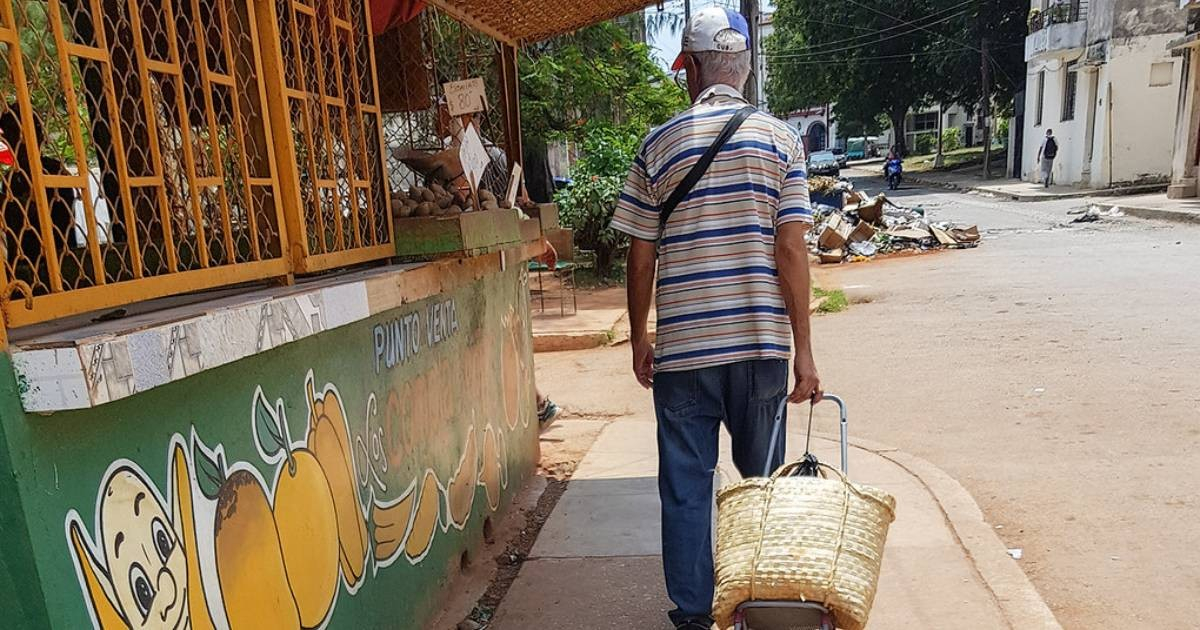
A phrase heard from someone close was enough for Arnoldo Fernández, a writer, journalist, and historian based in Contramaestre, Santiago de Cuba, to create one of the most heartbreaking portrayals of hunger in Cuba. His Facebook post, titled "Cuba: the country where hunger learned to speak about food," resonated this week among Cubans both on and off the island.
It all starts with a phrase that someone Fernández claims to love and respect said to him at some point: "Cubans live to eat. We don't eat to live."
From that point on, the author unfolds an intimate essay that is not a political denunciation, but rather an emotional autopsy of chronic scarcity.
"In Cuba, talking about food is not just any conversation. It's a way of recounting the day. It's asking what has appeared, what is missing, what has been obtained, what has been lost, and what can be created with the little that remains," writes Fernández.
The reflection delves into something deeper: the way hunger colonizes the thought, dreams, and even the language of an entire people.
"We spend our lives thinking about what we're going to eat. And although it may seem like a domestic habit, it's one of the most silent ways that hunger enters into a society," the author points out.
Fernández describes how Cubans have learned to imagine flavors they have never tasted, to celebrate as a feast what would be an ordinary meal anywhere else.
"There are flavors that exist for us just as some countries do: we know they are there, but we do not know them," he writes with a precision that hurts.
The text also portrays the Cuban who emigrates and is bewildered by the abundance: not only by what they see in the markets, but also by everything they discover that exists and that for years belonged solely to their imagination.
For Fernández, this collective obsession with food does not reveal a gluttonous people, but rather one that has spent too much time in hunger.
"Hunger does not always take the face of those who haven't eaten anything. Sometimes it looks like those who eat but cannot choose. Those who fill their plates but think about tomorrow," he points out.
His conclusion is as simple as it is devastating: "Talking about food every day doesn’t necessarily mean you love food too much. Sometimes it means we have lacked it too much."
Fernández's reflection is not an isolated perception. Data confirms that the food crisis in Cuba is the most severe in decades. According to the survey "En Cuba Hay Hambre 2025", conducted by the Food Monitor Program and Cuido60 with over 2,500 responses from the 16 provinces, 33.9% of households reported that at least one member went to bed hungry in the past 30 days, nine points higher than in 2024.
79.4% of families allocated 80% or more of their income solely for food, and 40.6% spent all their earnings just on groceries.
National production has collapsed between 2018 and 2023: 95% in pork, 87% in rice, 70% in beans, and 58% in milk, while Cuba imports about 80% of the food it consumes at an annual cost of approximately 2.4 billion dollars.
The impact goes beyond the stomach. A study published in Social Science & Medicine found that 55.4% of Cuban adults surveyed experienced extremely severe depression, 66% severe anxiety, and 65.8% extreme stress.
Testimonials collected in August describe the daily routine of "finding" food as a "constant psychological torture" and an "unrelenting physical and emotional strain."
80% of Cubans believe that the current crisis is worse than the Special Period of the 1990s, according to a survey from March of this year.
Fernández concludes his text with a rephrasing of the sentence that sparked it all: "Perhaps we do not live to eat. Perhaps we have spent too long living around hunger. And when hunger becomes a habit, it ends up occupying everything: conversation, memories, dreams, worries, visits, celebrations. Even language."
Related videos:
Filed under: