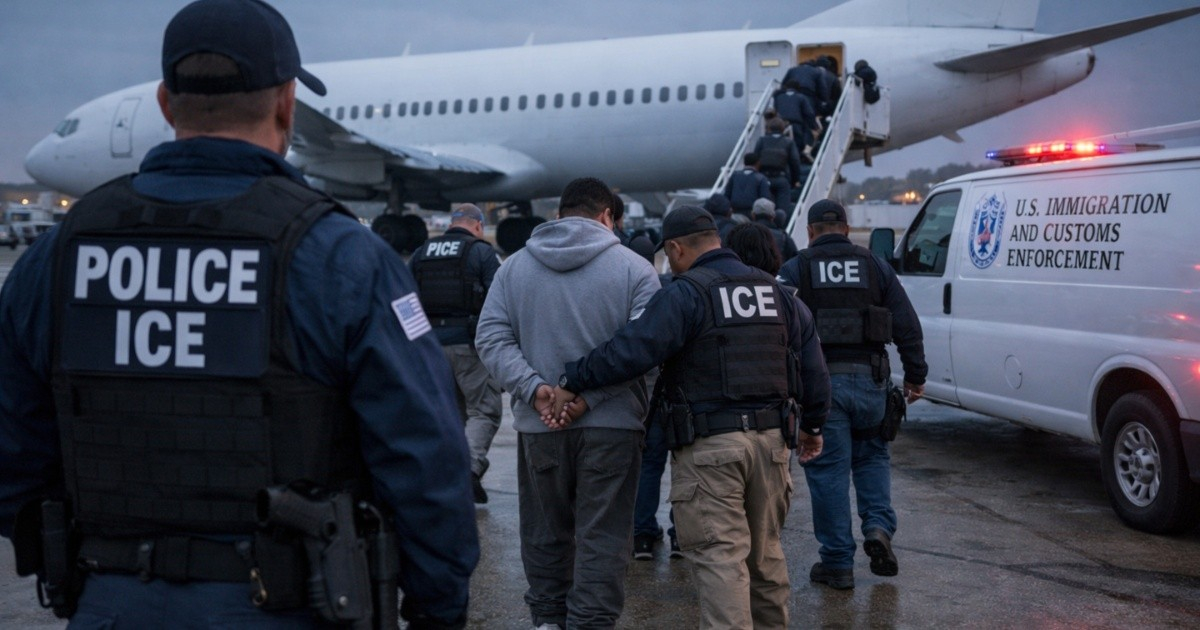
A unanimous panel of three judges from the United States Court of Appeals for the First Circuit, based in Boston, rejected this Friday the immigration policy of the Trump administration that allowed the deportation of migrants to countries with which they have no connection, without prior notice or the opportunity to challenge their destination.
The ruling, outlined in a 55-page document, substantially reaffirms the decision made by federal district judge Brian Murphy of Massachusetts in February 2026, when he declared the policy of the Department of Homeland Security (DHS) illegal.
The unanimous opinion was written by Judge Seth Aframe, appointed by Biden, and joined by Judge Lara Montecalvo, also appointed by Biden, and Judge Jeffrey Howard, appointed by George W. Bush.
"The right of an individual to challenge their deportation to a country due to a fear of persecution in that country holds little value if they do not receive prior notice of the intended destination for deportation and a meaningful opportunity to contest that destination," wrote Aframe in the decision.
"DHS must provide them with a meaningful opportunity to contest deportation to that third country by claiming a reasonable fear of persecution or torture there," the text states.
The court also rejected the DHS's argument that general assurances from receiving countries were sufficient to prevent torture or persecution of deportees, without the need for individualized notification.
"The law and regulations establish hearing procedures for claims based on fear of persecution without any exceptions for deportations to third countries. We reject the DHS's attempts to create such an exception out of thin air," added Aframe.
"La policy conflicts with the legal and regulatory provisions that govern claims of fear of persecution, to the extent that it allows deportations to third countries without effective notification and a meaningful opportunity to present those claims. The policy is therefore illegal under the Administrative Procedure Act", concludes the ruling.
The controversial policy, implemented as part of Trump's mass deportation agenda, allowed for the expulsion of migrants with just six hours' notice and without the opportunity to claim fear of persecution or torture in the destination country, a practice that previous administrations rarely employed.
According to the Third Country Deportation Watch monitoring project by Refugees International and Human Rights First, the administration has sent over 25,000 migrants to at least 29 third countries since implementing this policy.
Among those affected are numerous Cubans deported to African nations such as Eswatini, the Central African Republic, and Liberia, who have reported precarious conditions, isolation, and lack of documentation in those destinations.
Cuba is one of the countries that has historically restricted the acceptance of deportees from the United States, which has led to its citizens being redirected to third countries under this policy.
Trina Realmuto, spokesperson for the National Immigration Litigation Alliance, the organization that initiated the lawsuit, welcomed the decision.
"For over a year, class members have lived under the threat of being sent to countries they were never told they could be deported to, with little or no notice and without a meaningful opportunity to explain the dangers that awaited them there. Many have been deported to horrific and dangerous situations under this policy," he stated.
The court did indeed narrow one aspect of the Murphy ruling: the part concerning the order of preference for destination countries, considering that none of the main plaintiffs had claimed that the DHS ignored their requests on that point, making that forum inappropriate for addressing the issue.
The judicial history of the case is extensive. A preliminary injunction by Judge Murphy was suspended by the Supreme Court in June 2025, in a six-to-three decision that allowed the government to resume deportations.
The substantive ruling from Murphy, issued in February 2026, was subsequently suspended by the First Circuit in March while the appeal was underway. The decision made this Friday represents the appellate court's substantive pronouncement.
The DHS and the Department of Justice did not immediately respond to requests for comment on the ruling.
The case is expected to reach the Supreme Court for the third time, in what is shaping up to be the final chapter of a legal battle that has defined the immigration policy of the Trump administration.
Este fallo forma parte de una serie de batallas legales en torno a las políticas migratorias de la administración Trump. Sigue toda la actualidad sobre deportaciones, cortes y derechos de los migrantes en nuestra sección de
Related videos:
Filed under: