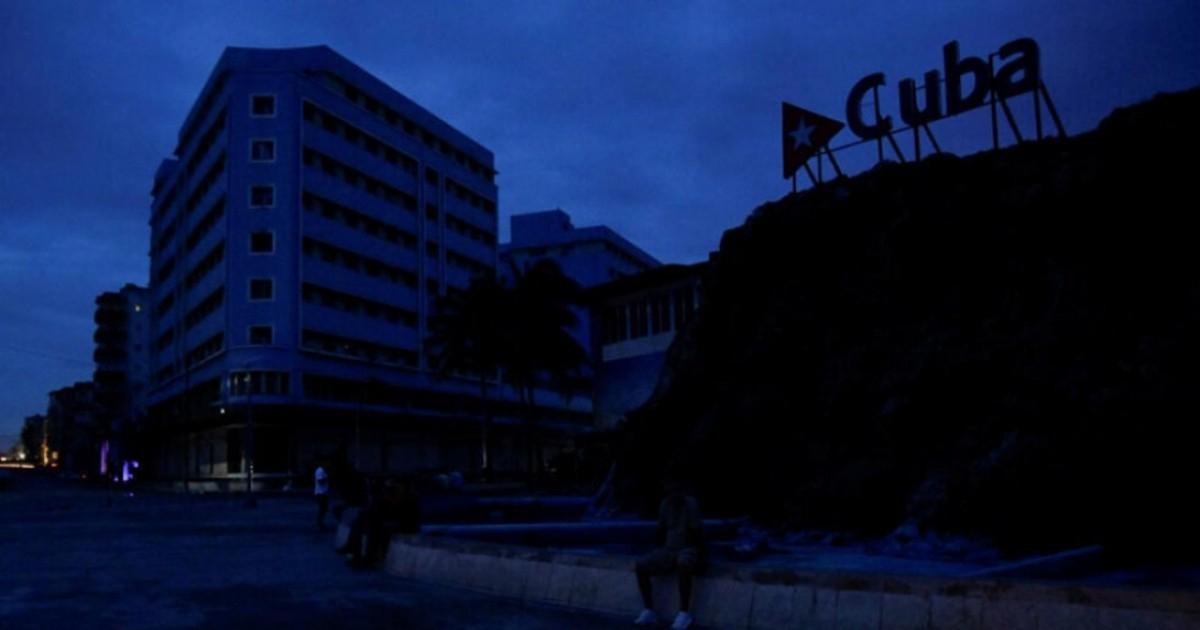
The Cuban writer and activist Yasser Sosa Tamayo reacted to the new total disconnection of the National Electric System with a reflection that resonated among hundreds of compatriots: “I no longer know what is more exhausting: the darkness or always having to be ready for it.”
The collapse, the eighth nationwide blackout in Cuba in 2026, occurred on Friday at 1:57 PM, when two 220 kV transmission lines originating from Matanzas — the Matanzas-Cienfuegos and the Matanzas-Santa Clara — failed in succession, leaving approximately nine million people without electricity across the Island.
From her profile, Sosa Tamayo shared a reflection on the collective exhaustion that transcended the blackout itself: "In Cuba, even the daily routine requires an emergency plan."
The writer from Santiago made a distinction that many Cubans recognized immediately: "Adapting to what should not require adaptation. Because one thing is to go through a crisis. Another is to make the crisis the way a country organizes its life."
He also rejected the regime's calls for patience and resilience with a straightforward phrase: "They have asked us for patience. They have asked us for resilience. They have asked us to understand. But there comes a time when so many explanations no longer shed any light."
And he concluded with the phrase that summarized the feelings of many: "Cubans do not need to learn how to live better in the dark. We need to stop living in the dark."
The comments on the post echoed the same frustration. "It's already a trauma. A constant fear of food going bad, not being able to cook, not being able to sleep," wrote one user.
Another pointed directly to the inequality between the rulers and the people: "We are told to resist, quite easily, but since they lack nothing, it is very easy for them to tell us to resist."
A third internet user described the constant anxiety even when there is electricity: "Even when we have the esteemed power supply, we are anxious, thinking that it could go out at any moment."
Several comments articulated the political dimension of the issue. "Until all Cubans understand that freedom is not negotiable, that we can't live creatively resisting when we don't even have a plate of food, as long as they have everything, they will continue to demand resistance."
"This is driving ordinary people crazy; you can't plan anything, you live in constant improvisation... it feels like they are crushing you like a cockroach, and you lose a leg, but you keep dragging yourself to the cemetery," summarized a social media user in the comment thread.
It is not the first time Sosa Tamayo has documented the energy crisis from this perspective. At the end of August, he stated that blackouts also steal time from life and that "the blackout does not just interrupt electricity. It interrupts life." In July, he claimed that the true blackout in Cuba is the loss of the ability to feel indignant about the precariousness.
Related videos:
Filed under: