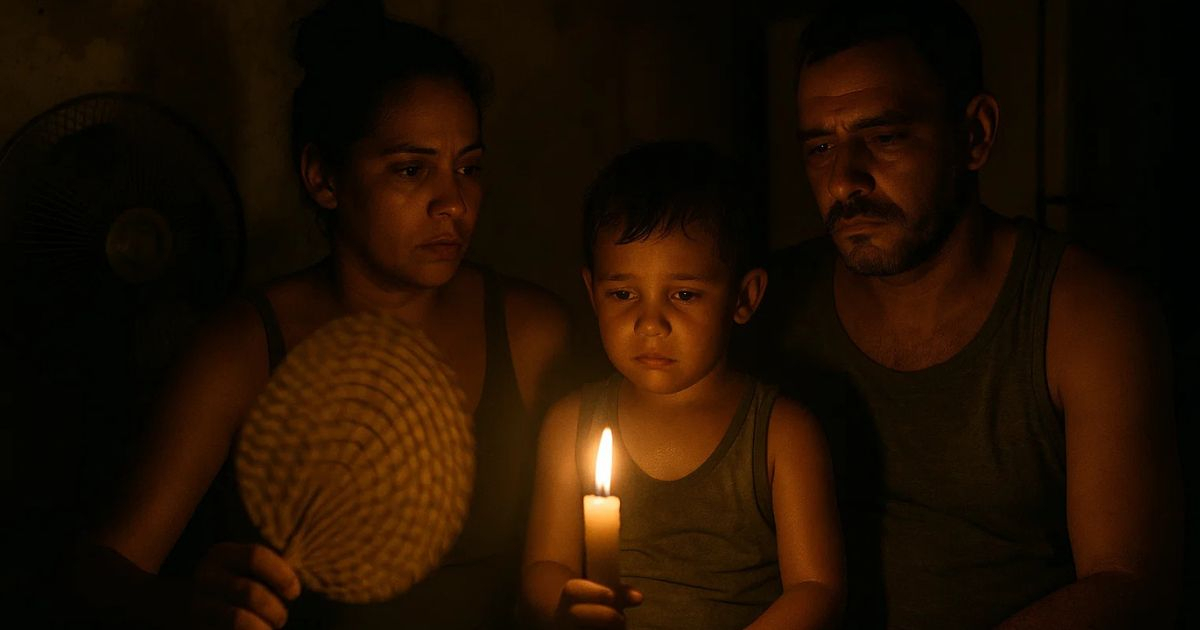
The writer and activist from Santiago de Cuba Yasser Sosa Tamayo questioned the cost of blackouts in Cuba this Friday and stated that their deepest impact is not measured in megawatts, but in the hours of life that citizens lose while trying to resolve basic needs.
In a post on Facebook, Sosa wrote that "the blackout not only interrupts electricity. It interrupts life," a reflection that received dozens of comments from people who claimed to relate to his viewpoint.
The author argued that the electricity crisis forces millions of Cubans to spend a significant part of their days seeking water, preserving food, cooking, or enduring the heat—tasks that displace activities such as working, studying, creating, resting, and caring for others.
"When a country forces millions of people to spend a huge part of their day solving the basics, it is not only taking away their resources. It is taking away their time," he wrote.
Sosa emphasized that those hours cannot be recovered once the service is restored. "Electricity may return at eight in the evening. The eight lost hours do not come back," he stated.
The publication also raised a question about the consequences of a crisis that, according to the writer, leaves less and less room to think about the future. "What future can a people build when their present is being consumed?" he asked.
The comments reflected the experiences of Cubans affected by prolonged power outages. One citizen recounted days of 26 hours without electricity followed by just one hour of service, describing the nights of darkness, hunger, heat, and mosquitoes as a situation that pushes ordinary Cubans to the limit of what they can endure.
Another person summarized their perception of the crisis with the phrase, "It's no longer a matter of hours; it has stopped being that. Now it's about how much life we lose each day." A third comment conveyed a similar idea by stating, "In that loss of time, we are losing life."
Sosa himself expanded on his reflection in the comments and asked his followers how many hours of their lives they had spent waiting for electricity, searching for water, trying to preserve food, or dealing with "something that should be basic."
"I am not only talking about the current. I am talking about that time that no one can return to us," he wrote.
"They don't have another lifetime to pay back or make amends for all the damage they have caused," wrote a Cuban in the comments, referring to the poor governmental management regarding the energy issue.
The publication arrives at a time when the energy crisis in Santiago de Cuba has reached extreme levels. So far this year, the National Electric System has collapsed several times, while blackouts lasting over 24 consecutive hours persist in many areas of the country.
In June, the Electric Company of Santiago admitted that it could not guarantee even two hours of electricity a day, after reorganizing the outages into nine blocks.
The Minister of Energy and Mines, Vicente de la O Levy, acknowledged at the end of July before the National Assembly that there are communities that have gone up to 105 consecutive days without electricity, while attributing part of the problem to the theft of dielectric oil from transformers.
In the eastern city, even the photovoltaic lights installed as a temporary measure were stolen days after their installation on the main avenues.
It is not the first time Sosa has addressed the issue with such depth. At the end of July, he stated that "the most serious thing that happened to Cuba was not the blackouts. It was that one day we stopped asking ourselves if this was life", in a text that was widely shared on social media and gathered hundreds of reactions.
In April, it reported the case of a 14-year-old teenager who was selling polvorones in a park in Santiago de Cuba to help his mother.
In May, he found a 77-year-old grandmother who walks nearly 15 kilometers at dawn pushing a wheelbarrow to sell okra and survive.
For the activist, all these stories are part of the same phenomenon he denounces in his reflections, a "blackout" that not only affects the electrical system but also impacts the dignity and the ability of a society to accept as normal a reality characterized by daily survival.
Related videos:
Filed under: