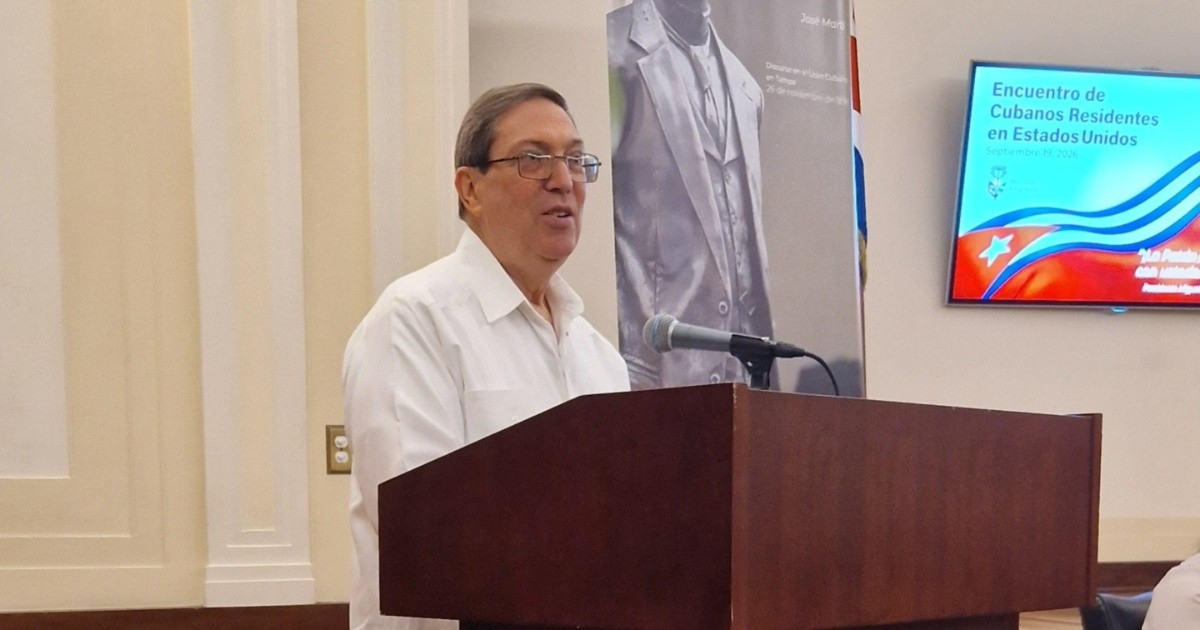
The Cuban Foreign Minister Bruno Rodríguez Parrilla stated this Saturday that the regime is carrying out an "important effort" to achieve the integration of Cubans living abroad, during his participation in the National Meeting of Cubans Residents in the United States, held in New York alongside the UN General Assembly.
Rodríguez shared his remarks on his account on the social network X, where he noted that the event is part of the General Debate of the High-Level Segment of the 81st session of the United Nations General Assembly.
"I highlighted the important efforts made by our country to achieve the greatest relationship and integration in national life for compatriots residing or staying for an extended period outside of Cuba, and for their descendants," wrote the Minister of Foreign Affairs.
The speech combined an opening message to the diaspora with the regime's usual narrative regarding U.S. sanctions.
Rodríguez stated that "there is no way to justify such a cruel crime," referring to the embargo, which he described as a "collective punishment" against the Cuban people.
The chancellor also denounced what he described as a "strengthening of the U.S. aggression against Cuba" and its "ruthless impact" on Cuban families, without mentioning the responsibility of the government itself in the crisis the island is facing.
The discourse of diaspora integration has concrete legal support: the regime published in May 2026 the new Cuban migration laws —Law 171 on Migration, Law 172 on Citizenship, and Law 173 on Foreigners—, which will come into effect next November.
Among the most significant changes is the removal of the 24-month limit for staying abroad before losing Cuban residency, replaced by the concept of "effective migratory residency" based on family, labor, economic, or property ties.
The human rights organization Cubalex criticized these regulations for reinforcing a discretionary control system over the mobility of Cubans, instead of ensuring real rights for the diaspora.
Rodríguez's visit to New York has been full of diplomatic activity. On Thursday, he had a meeting with the Chinese Foreign Minister, described as "fruitful," and on Friday he lashed out against a Harvard report on Cuba, labeling it as "pseudoscientific" and an attempt to "confuse and manipulate."
This report, published in early September, directly attributes responsibility to the Cuban government for the crisis on the island and proposes a new constitutional assembly, amnesty for political prisoners, and a social market economy.
On the bilateral front, Rodríguez acknowledged at the beginning of the month that talks between Cuba and the United States are "stalled" and making no progress, which contrasts with the conciliatory tone the chancellor adopted towards the diaspora this Saturday.
Cuba plans to bring the issue of the embargo before the UN General Assembly again on October 27 and 28, 2026, in what will be another chapter of the regime's diplomatic offensive in the multilateral organization.
Related videos:
Filed under: