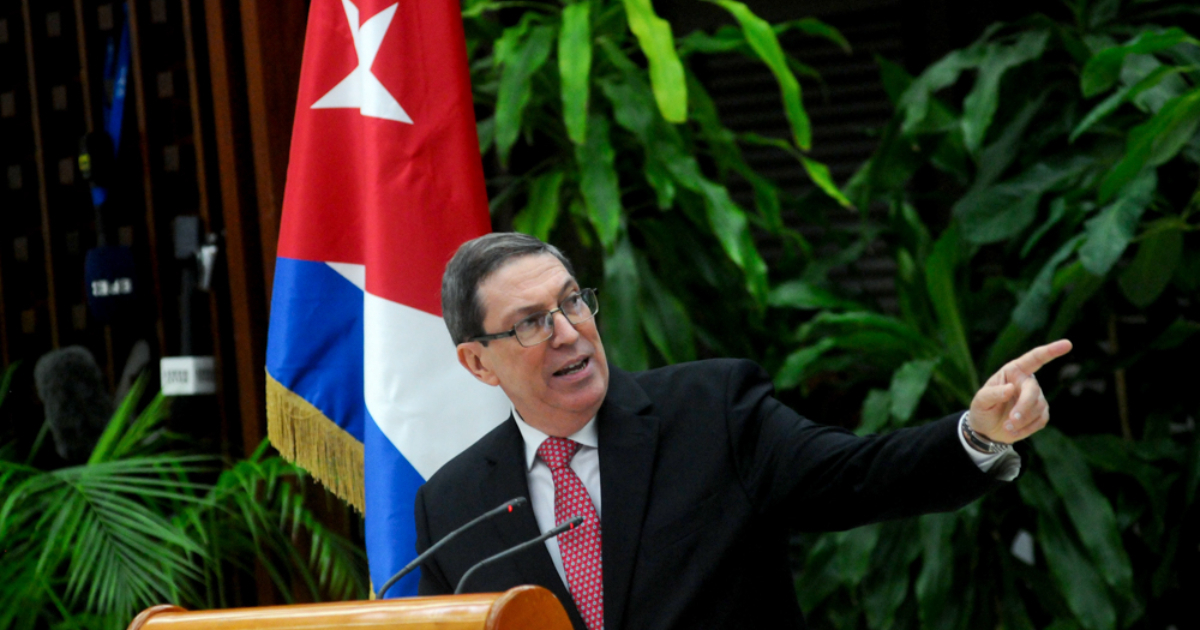
The Cuban Foreign Minister, Bruno Rodríguez Parrilla, described this Friday as "pseudoscientific" the report published by the Task Force on the Future of Cuba at Harvard University, linking it to the propaganda of the U.S. State Department and the "psychological warfare" against the Cuban people.
In a message posted on his X account, the Minister of Foreign Affairs accused the authors of the document of having "marked ideological biases and clear financial interests," and stated that its dissemination calls into question "the prestige and scientific rigor of that renowned American university for which they claim to work."
Rodríguez focused much of his criticism on what he described as a deliberate omission: "They intentionally hide the consequences of nearly 70 years of U.S. economic suffocation policy, commercial and financial persecution, and the imposition of fear on those who trade and invest in Cuba."
The chancellor drew on official figures from the regime to support his argument: according to those data, the embargo caused $8.083.3 million in damages between March 1, 2025, and February 28, 2026, a figure he described as a record, exceeding the previous period by 7%.
The historical accumulated damage, according to Havana, amounts to 178,700.5 million dollars at current prices.
Additionally, he stated that without the embargo, Cuba's Gross Domestic Product in 2025 would have been 10.8% higher than the estimated value for that year, and he concluded his attack by pointing out that the report "spends over 50% of its pseudo-report on criticisms and political recommendations aligned with the American discourse."
The document that sparked the official reaction was published on September 10 by the Cuba Studies Program and the David Rockefeller Center for Latin American Studies (DRCLAS) at Harvard, after six months of work by 14 Cuban and international academics and experts.
In its 21 pages, the report diagnoses a multidimensional crisis —economic, political, demographic, energy, health, food, and educational— and suggests a peaceful democratic transition.
Among the immediate measures, the text calls for a general and unconditional amnesty for political prisoners and the repeal of decrees 349, 370, and 35.
In the medium and long term, it suggests a Constituent Assembly and a social market economy with recognition of private property, as well as the reintegration of Cuba into the IMF and other international financial institutions.
The report also proposes that the current Cuban authorities act as facilitators of the transition process, rather than as obstacles, a stance that explains the harshness of the official response.
Rodríguez's reaction follows an established pattern: in July he labeled another report from the State Department as a "slanderous pamphlet," and that same month he accused Secretary of State Marco Rubio of preparing a pretext for a military aggression against the island.
Reactions to the Harvard report have not been uniform outside the government. Economist Pedro Monreal considered that the document and the proposal "Cuba Transformación" are compatible as they address different dimensions, while activist Ariel Ruiz Urquiola questioned some of its points days before the official response.
The context in which the clash occurs is that of the worst economic downturn in Latin America in 2026, which hits Cuba particularly hard while the regime continues to adopt a strategy of blaming the crisis on the embargo and rejecting any analysis that points to internal responsibilities.
Related videos:
Filed under: