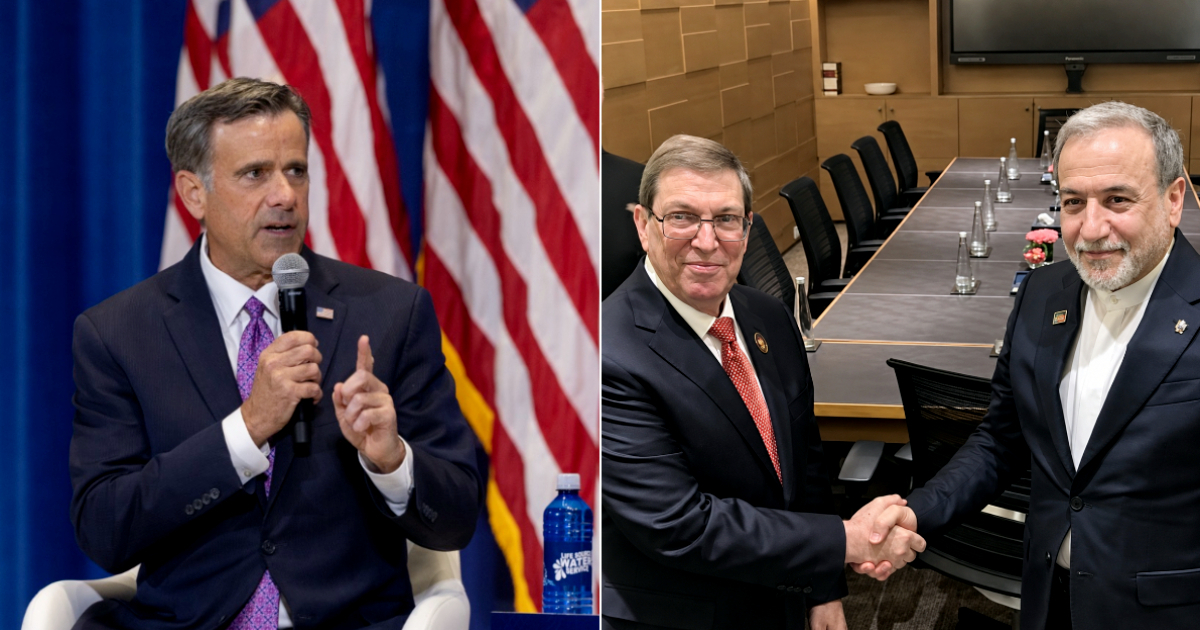
Cuban Foreign Minister Bruno Rodríguez Parrilla held a "productive meeting" with his Iranian counterpart, Abbas Araghchi, during the BRICS Summit held in India, at a particularly sensitive moment for relations between Havana and Washington and amidst the armed conflict between the United States and Iran.
Rodríguez Parrilla reported on social media that, in addition to the Iranian representative, he held meetings with the foreign ministers of Brazil, Mauro Vieira; India, Subrahmanyam Jaishankar; and Thailand, Sihasak Phuangketkeow.
"We emphasize the need to continue strengthening bilateral ties and to leverage the political and economic potential of the BRICS Group," stated the Cuban minister.
Additionally, he took advantage of those contacts to denounce what he described as an "energy siege," an "extreme intensification of the blockade," and "secondary sanctions" from the United States, which he argued are causing a "collective punishment" against the Cuban people.
However, among the meetings announced by the chancellor, the one held with Araghchi takes on special significance given the current geopolitical landscape.
Iran is at war with the United States and Washington has placed Tehran's cooperation with Havana among its national security concerns in the western hemisphere.
Cuba, Iran, and Washington's Concerns
The meeting comes after months of warnings from the administration of Donald Trump regarding the use of Cuba as a platform for the operations of strategic adversaries of the United States, particularly Russia, China, and Iran.
In August, the Secretary of State Marco Rubio directly accused the Cuban regime of operating as a platform for those three countries just 90 miles from the shores of the United States.
Washington then announced sanctions against five entities and eight officials related to the importation of foreign weapons and the military cooperation of the Cuban Armed Forces with adversaries of the United States. “We will not tolerate it,” emphasized the Secretary of State.
The American concern transcends the diplomatic relations that Havana maintains with those governments. The Trump administration has placed at the center of its policy towards Cuba the military, intelligence, and security implications that it attributes to those alliances.
The report «Cuba: The Capital of 21st Century Communism», published this summer by the Department of State, presented the Cuban regime as a structural threat to American security and paid particular attention to its contemporary relations with Russia, China, and Iran.
The document is part of a shift in Washington's approach that had already been reflected in Executive Order 14380, signed by Trump on January 29, in which the White House declared the actions of the Cuban regime as a «unusual and extraordinary threat» to the national security and foreign policy of the United States.
Among the arguments used by Washington are precisely the cooperation of Havana with Russia, China, and Iran and the intelligence activities linked to U.S. adversaries.
Iranian drones and Cuba
The relationship between Havana and Tehran took on an even more delicate dimension after U.S. intelligence reports emerged regarding Cuba's acquisition of military drones.
In May, Axios reported, citing classified U.S. intelligence, that Cuba may have acquired more than 300 military drones from Russia and Iran since 2023.
Washington's concerns had been conveyed directly to Havana just days before these revelations came to light. On May 14, the CIA director, John Ratcliffe traveled to Cuba and met with the head of the regime's Intelligence Directorate, marking the first visit by a head of the American agency to the island in over a decade.
According to a CIA official, Ratcliffe warned that Cuba "cannot continue to be a platform" for US adversaries to promote hostile agendas in the region and made it clear that the Western Hemisphere cannot become the "playground" of those actors.
Two days after the visit was made public, Axios revealed intelligence assessments regarding Cuba's acquisition of Russian and Iranian military drones, providing much more concrete context to the warnings issued by the CIA director. “They are trying to learn how Iran has resisted us,” a U.S. intelligence official told the outlet.
Additionally, according to the report from Axios, Cuban officials are said to have even discussed possible scenarios for using these capabilities against the Guantánamo Naval Base, U.S. military ships, and potentially Key West, Florida.
The information also pointed to the presence of Iranian military advisors in Cuba, a particularly sensitive issue for Washington due to Tehran's accumulated experience in the development and use of attack drones.
These claims have not been independently verified. Russia denied that Cuba had purchased the 300 drones mentioned in the report, while Havana defended its right to acquire means for its defense without publicly providing details that would clarify the composition of its arsenal.
The matter, however, became part of the U.S. security debate regarding Cuba.
In July, the group United Against a Nuclear Iran (UANI) displayed a replica of a Shahed-136 in Coral Gables, one of the Iranian drones most known for its use in recent conflicts, to draw attention to information related to Cuba.
Iran and its penetration in the hemisphere
Washington's concerns are not limited to Cuba. For years, the United States has closely monitored the political, economic, and military expansion of Iran in Latin America, particularly the close ties established by Tehran with chavismo in Venezuela.
The fall of Nicolás Maduro following the U.S. military operation on January 3 significantly changed that scenario and strengthened the Trump administration's determination to reduce the influence of adversarial powers within the Western Hemisphere.
The U.S. policy towards Cuba is now following that same logic: to prevent governments like those of Iran, China, and Russia from using countries in the region to develop military, technological, or intelligence capabilities near U.S. territory.
In this context, any deepening of the ties between Havana and Tehran takes on a dimension for Washington that transcends the bilateral relations between the two governments.
Cuba seeks refuge in the BRICS, but Russia sets limits
The context is even more significant as Havana seeks to strengthen its integration into the BRICS as part of its strategy to expand its political and economic alliances beyond the influence of the United States.
Cuba is currently a partner country of the group, but the regime has made its aspiration to become a full member clear, a status that would grant it greater political weight and participation in the decisions of the bloc.
That goal recently received a significant cold shower precisely from Moscow.
The Russian Embassy in Havana confirmed at the beginning of September that a new expansion of BRICS to include full members is not currently on the table.
The Russian position came after the Cuban Embassy in Moscow publicly announced Havana's intention to advance from a partner country status to full membership and sought support for this, particularly from Russia.
Moscow, one of the main political allies of the Cuban regime, did not respond with the expected support.
What did Bruno Rodríguez and the Iranian foreign minister discuss?
So far, Rodríguez Parrilla has not disclosed specific details about his conversation with Araghchi.
The Cuban chancellor grouped the meeting with the Iranian official alongside his meetings with the foreign ministers of Brazil, India, and Thailand, merely noting that they discussed the strengthening of bilateral ties and the "political and economic potential" of the BRICS.
For this reason, there are no public elements to suggest that Rodríguez Parrilla and Araghchi discussed military cooperation, Iranian drones, or the current hostilities between Tehran and Washington.
The context, however, turns the meeting into something more than a routine bilateral.
Araghchi represents a government currently militarily confronted with the United States, while Rodríguez Parrilla represents a regime that Washington situates within a hemispheric network of cooperation with its main strategic adversaries.
Havana is also seeking political and economic alternatives within the BRICS and through its relationships with Russia, China, and Iran in the face of increasing U.S. pressure, although its recent attempt to raise its status within the group has just encountered limits even among its allies.
None of this demonstrates what specific issues were on the table during the "fruitful meeting" between Rodríguez Parrilla and Araghchi. But it explains why, under the current circumstances, the meeting will hardly be viewed in Washington as just a diplomatic encounter.
Related videos:
Filed under: