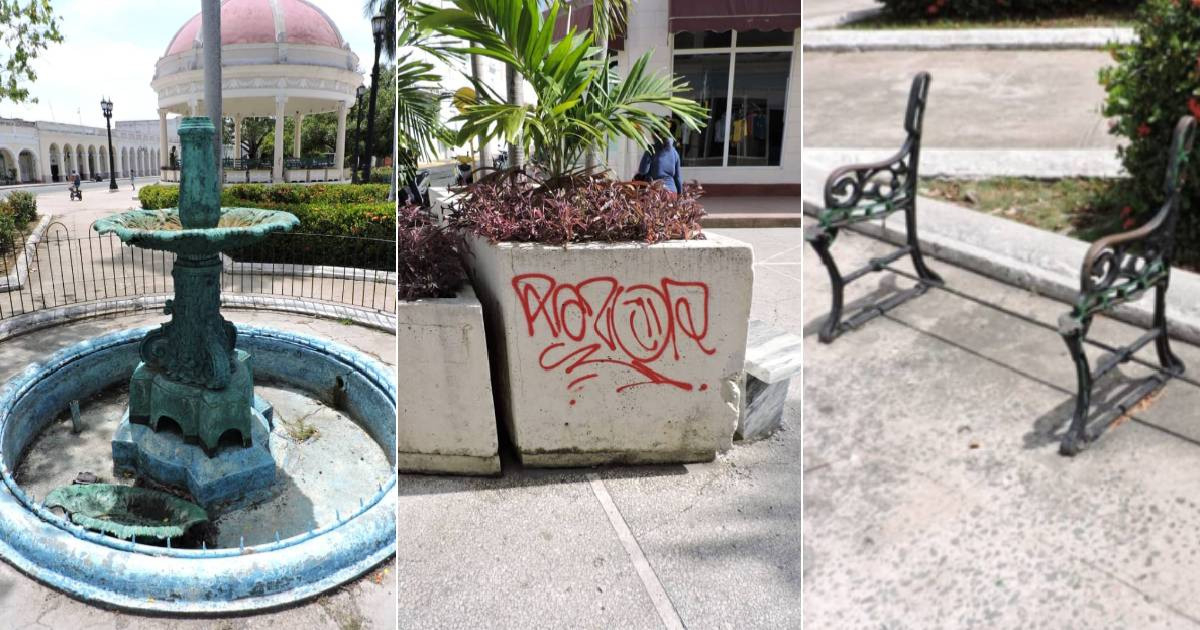
The official newspaper 5 de Septiembre reported on the increase of vandalism and the accumulation of garbage in public spaces in the city of Cienfuegos, amidst campaigns aiming to present the so-called Pearl of the South as a dream city.
In an article published on Tuesday, the provincial organ of the Communist Party described the decline of the central José Martí park, with republican benches missing slats, missing railings, and fountains "drowned in their own filth."
The monument dedicated to the Cuban National Hero also appears, according to the text, "increasingly unprotected."
The planters on the boulevard are not exempt from deterioration. The media outlet alerted about the presence of graffiti and, with irony, compared those who create it to the controversial British urban artist known as Banksy, though in this case to highlight actions deemed purposeless.
The problem extends to the accumulation of waste in the streets. The 5 de Septiembre complained about a "'Escambray' of mountains of filth everywhere" and pointed out that the situation is worsened by the absence of trash bins, many of which have been "severed from their bases, on one side or entirely."
The text attributed part of the deterioration to a "selfish and repugnant minority" that, it indicated, acts against citizens' right to enjoy a better-maintained city. The statement addressed both vandalism and the neglect of public spaces.
But the complaint also highlighted the focus on the authorities. The article warned that without a "strong response" to prevent impunity and a greater presence of those responsible for enforcing the rules, Cienfuegos could return to the same point of deterioration.
As an alternative, the news outlet advocated for promoting a public debate to update the urban regulations and establish penalties for those who harm public spaces.
Among the measures mentioned are fines that can reach the equivalent of a minimum wage and the requirement to perform community service.
The report comes at a time when the official press itself is promoting campaigns to showcase a revitalized city, with renewed spaces, new projects, and elements aimed at strengthening the tourist image of Cienfuegos.
The city founded in 1819 by French settlers, under the name Fernandina de Jagua, and whose historic center has held the distinction of World Heritage Site since 2005, faces a dual threat: structural abandonment by the state and the active destruction by those who, as the newspaper pointed out, turn the common space into a stage for their own misery.
In June 2025, the source itself reported on the accumulation of trash in major arteries such as Prado, San Fernando, and 5 de Septiembre Avenue, while the state-owned company Comunales justified the lack of collection by citing fuel shortages.
In June, residents of the Tulipán neighborhood reported an improvised landfill on 75th Street, across from buildings occupied by children and the elderly. One resident described San Carlos Avenue as having only one passable lane: "the other half is garbage from the sidewalk to the middle of the street."
Likewise, a resident of Santa Clara Street, between 50th and 53rd Streets in Cienfuegos, reported on Facebook that in his block they had not collected the garbage for over a month.
Vandalism is not exclusive to Cienfuegos. In recent weeks, spray-painted graffiti damaged the Ignacio Agramonte Park in Camagüey, which has been declared a UNESCO World Heritage Site, while in August, the planks from the benches in Plaza de Marte in Santiago de Cuba were torn down, and the bust of Antonio Maceo was toppled in Las Tunas.
Related videos:
Filed under: