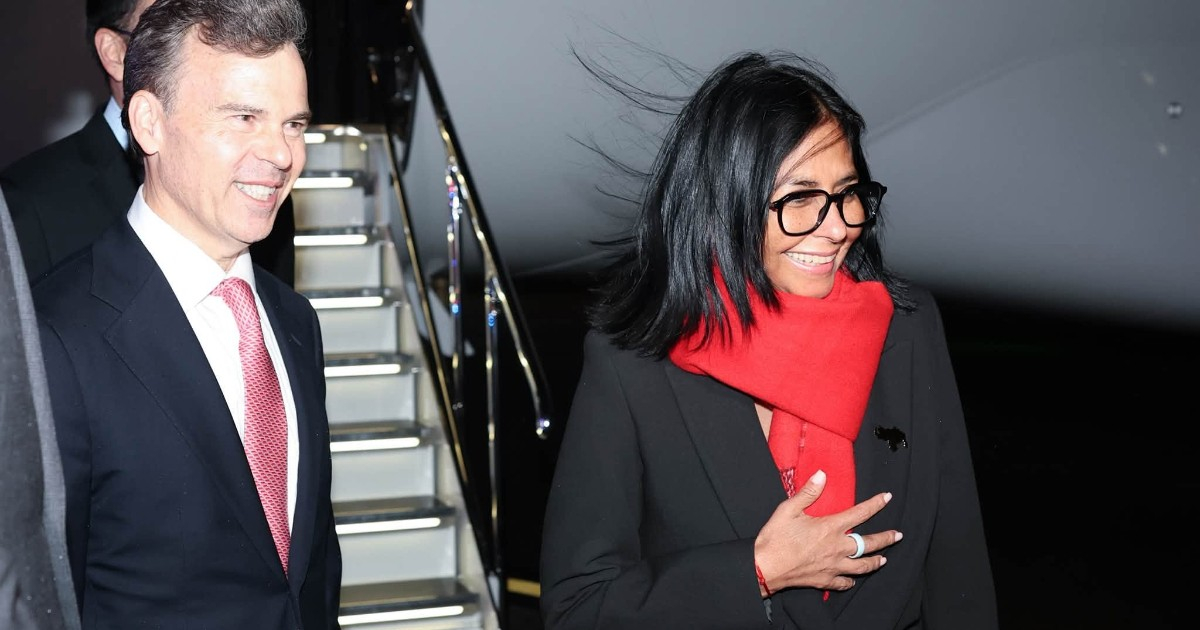
Delcy Rodríguez, the acting president of Venezuela, arrived this Monday at Teterboro Airport in New Jersey to participate in the 81st United Nations General Assembly in New York, where she is scheduled to meet with U.S. President Donald Trump on Tuesday.
The most remarkable aspect of his arrival was not the journey itself, but who was waiting at the foot of the staircase: alongside Venezuelan officials such as the sectorial vice president of Economy, Calixto Ortega, and the first deputy minister of Foreign Affairs, Oliver Blanco, was John Barrett, chargé d'affaires of the U.S. in Venezuela, in a gesture that did not go unnoticed.
The visit carries a symbolic weight that is hard to ignore: it is the first time a Venezuelan head of state has set foot on U.S. soil since Nicolás Maduro did so in 2018. Maduro is now detained in a prison a few kilometers from the UN headquarters, after being captured by U.S. forces on January 3, 2026.
From her account on social media, Rodríguez shared a message of reconciliation: “We arrived in New York with the determination and hope of a people who believe in encounter and unity among nations.”
The White House confirmed last Friday the meeting between Trump and Rodríguez set for Tuesday, on the margins of the General Assembly, in a brief and informal format known as pull-aside, without sitting delegations or a joint appearance before the press.
It will be the first face-to-face meeting between a U.S. president and a Venezuelan leader in more than eleven years, since the brief exchange between Barack Obama and Maduro at the 2015 Summit of the Americas in Panama.
The rapprochement between Washington and Caracas has accelerated since Maduro's capture. In April 2026, the U.S. removed Rodríguez from the OFAC sanctions list, where she had been listed since September 2018 due to her role in dismantling Venezuela's democratic institutions.
At the end of August, Trump announced a historic oil agreement with Venezuela that granted the company North American Blue Energy Partners rights over 17 fields with over 65 billion barrels of proven reserves, with a 35% share for the U.S. Department of Defense.
But the good rapport between Trump and Rodríguez is creating increasing discomfort among those demanding a real democratic transition. Opposition leader María Corina Machado was emphatic in her criticism of the oil agreement: «The wealth of our land does not belong to an illegitimate regime», warning that the democratic transition «has not yet taken place».
The UN warned on September 16 that the repressive chavista apparatus remains "essentially intact", with 64 new cases of torture documented since January and between 328 and 500 political prisoners according to various organizations.
Diosdado Cabello continues to lead the Ministry of the Interior with direct control over the state's security forces, having faced neither sanctions nor any judicial processes.
To all this backdrop is added the case of Alex Saab, who pleaded guilty on September 15 before a federal court in Miami to conspiracy to commit money laundering, accepted the forfeiture of 195 million dollars, and agreed to fully cooperate with the Department of Justice, which could implicate high-ranking Venezuelan officials still in power. His sentencing is scheduled for January 20, 2027.
Rodríguez thus steps into a New York where her predecessor remains behind bars, while she negotiates with the very administration that captured him.
Related videos:
Filed under: