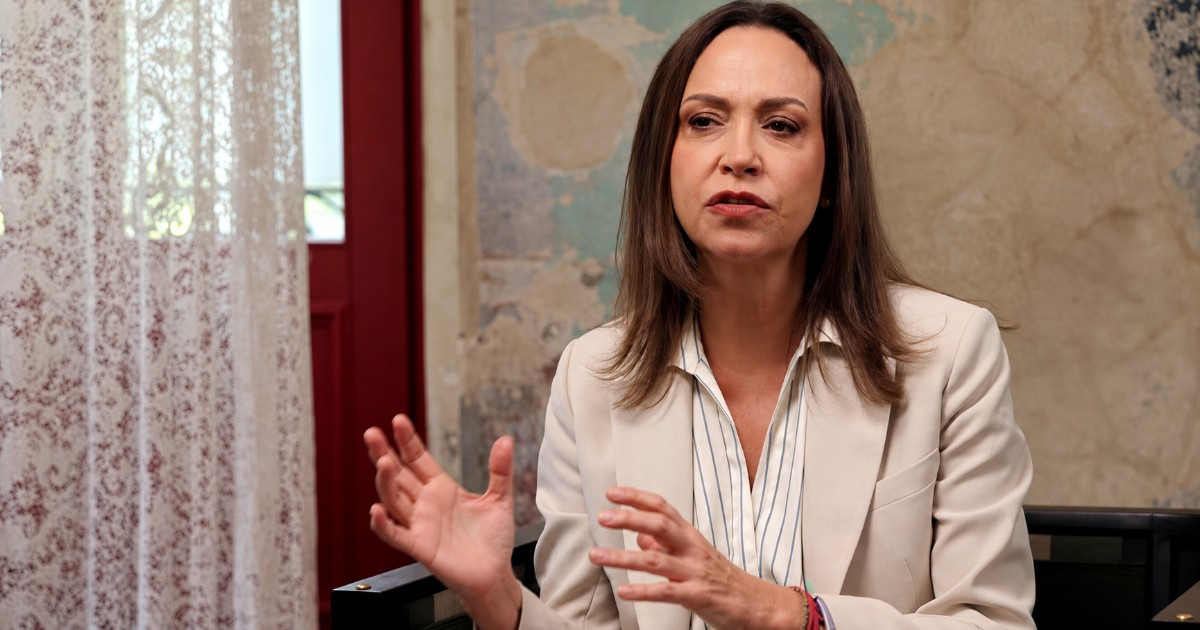
María Corina Machado, the Venezuelan opposition leader and Nobel Peace Prize laureate, announced this Saturday that she will be returning to Venezuela imminently, in an exclusive interview with The Wall Street Journal in which she stated that she can no longer lead the democratic transition process from abroad.
It’s time to return. I cannot lead a process from the outside if our people are suffering, he stated.
Machado has been out of the country for more than eight months, residing in Panama City since she clandestinely escaped from Venezuela in December 2025 —first by boat to Curacao and then by private plane to Oslo— to receive the Nobel Peace Prize. Since then, she has made several attempts to return without success.
The announcement comes at a time of high political tension. Following the capture of Nicolás Maduro on January 3, 2026, the Trump administration decided to keep Delcy Rodríguez as the acting president of Venezuela, with whom it signed a oil agreement at the end of August that grants the American company NABEP rights over 17 fields with approximately 65 billion barrels of reserves.
Trump publicly praised Rodríguez: “We are getting along very well with the government. Delcy, as you know, is doing a very, very good job, very respected.” Machado responded cautiously but without ambiguity: “Some say it was the greatest agreement ever made. Let’s see what happens.”
About the interim government, the opposition figure was categorical: "Delcy Rodríguez is chaos. That's what they represent. That's how they have sustained themselves. They have brought poverty, terror, and have forced one third of the Venezuelan population to flee".
The oil agreement generated significant discontent among Venezuelans. According to a survey by AtlasIntel published by Bloomberg Línea in early September, 47% of respondents believe that the interim government lacked the legitimacy to negotiate long-term contracts for natural resources, while 38% oppose the agreement and only 35% support it.
Sectors within the White House fear that Machado's return could destabilize the agreement and ongoing negotiations. In July, Washington reportedly actively blocked her return following the earthquakes on June 24 — which resulted in over 3,800 deaths — and in September asked her to visit Washington before returning to Venezuela, a request that the opposition figure has not publicly complied with.
Machado rejects the narrative that his presence would be destabilizing. "My return is not a challenge; it is a contribution to the process. There is no one more interested than us in ensuring that this process is successful and progresses steadily," he stated.
About his ties to the U.S. administration, he noted: «I have good relationships. We have been in contact. I will never go into the details of private conversations, but they certainly understand the reasons why I believe I am very, very helpful for this process».
The opposition leader expressed faith in the three-phase plan of Secretary of State Marco Rubio —stabilization, economic recovery, and democratic transition— but warned that the timelines must be met. "People are not demanding results, and the way to manage all these tensions is to set a date when people know that political change will come," she stated.
Once in Venezuela, Machado plans to travel the country from end to end to meet with local communities and organize “thousands, tens of thousands of public debates and assemblies” to promote the transition. He noted that more than 85% of the population lives in poverty and that the crisis has worsened since the earthquake in June.
His family, including his children whom he had not seen in two years while he remained hidden in Venezuela, supports the decision. "I believe this is the first moment when my entire family understands and absolutely supports this decision. Do you know why? Because I also want to return. Like all of us, all my children, we need to go back," he concluded.
Related videos:
Filed under: