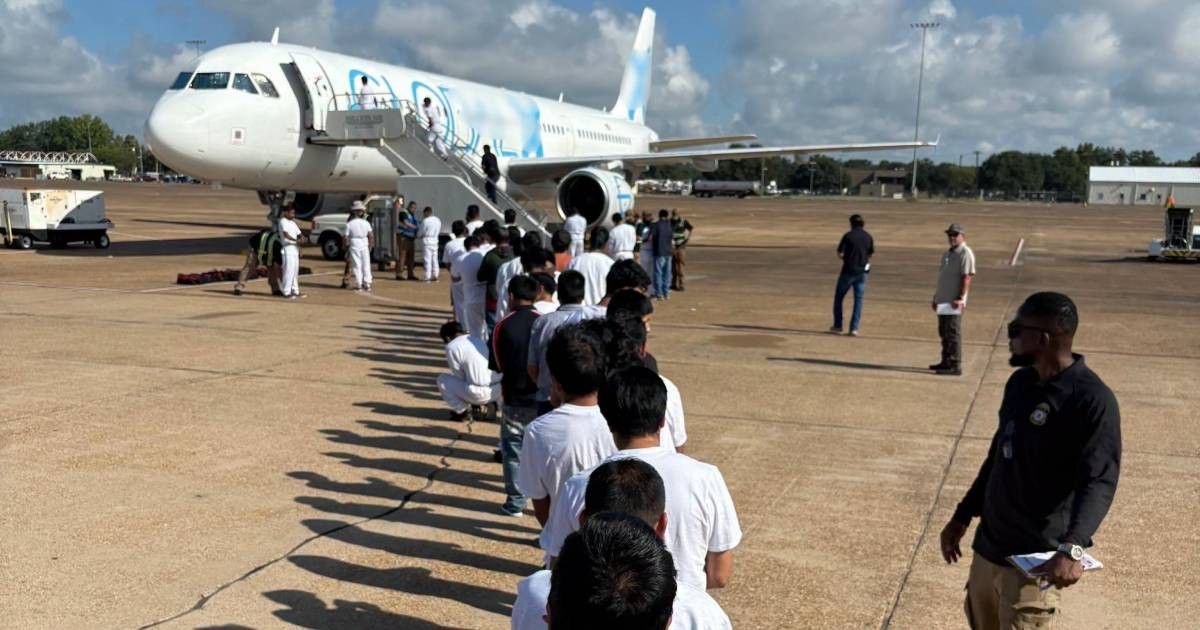
At least 44 African migrants were deported from the United States to Cameroon, a country with which they had no previous ties, and they remain there with their documents withheld and limited freedom of movement, according to an investigation by France 24 and RFI, conducted in collaboration with the international consortium Forbidden Stories.
Among those deported are citizens from Angola, the Democratic Republic of Congo, Ethiopia, Ghana, Kenya, Morocco, Senegal, Sierra Leone, and Zimbabwe. They are currently in a government facility in Yaoundé, designated as a "temporary shelter for migrants," where they share rooms with bunk beds.
The policy of deportations to third countries has already directly affected Cuban citizens, including several who were sent from the United States to African nations with which they had no connection whatsoever.
One of the most recent cases is that of Yasmany Moreno de Armas, a 31-year-old Cuban who was living and working in Florida and ended up deported to the Central African Republic. Moreno stated that he only discovered his destination was Africa when, after about five hours of flight, the plane was arriving in Bangui. "We can't leave, we don't have documents, we are suffering and missing our families, in a continent we don't know," he recounted at that time.
Days later, four Cubans refused to disembark from another deportation flight in Liberia, claiming they had no ties to that country and feared for their safety. Instead of being returned to the United States, they were taken to Equatorial Guinea, where some reported being left without documents and legal assistance.
Among them was Leonardo Sánchez Fernández, a Cuban who had been in the United States for 16 years and whose mother reported that he was being held and had been hospitalized due to health issues.
Africa has not been the only destination. The larger dimension of the phenomenon for Cubans is found in Mexico. A report from Human Rights Watch documented that 4,353 citizens from the island were deported from the United States to Mexican territory between January 2025 and March 2026, many of them lacking family or personal ties to that country.
The new transfers to Cameroon broaden the documented scope of a policy that has already sent migrants to countries other than their own when they are not directly deported to their countries of origin.
One of them is Barbara, a young Ethiopian from Tigray who fled the war and had obtained a "stay of expulsion" from a judge. This protection prevented her from being sent back to Ethiopia, but it did not block her transfer to a third country considered safe.
On April 28, she recounted, U.S. immigration authorities moved her without prior notice.
"The police came to get me and told me I had to go back. I was in shock. They put me on a plane and I landed here," he recounted.
A similar situation is faced by Soraya, a woman from Ghana who fled her country due to her sexual orientation and also had legal protection in the United States. She was sent to Cameroon on the first deportation flight, which arrived on January 15.
Their situation is particularly delicate because Cameroon criminalizes same-sex relationships, with penalties of up to five years in prison.
"In Accra, people I know are looking for me. They want to kill me," Soraya said. "Here, we wake up, and each day is the same as the last. They just wait for us to give up and agree to go back home. But most of us can't go back."
According to the research, the agreement between Washington and Yaoundé was negotiated without being made public initially. The primary known document is an exchange of diplomatic notes from December 2025, which was subsequently disclosed by the State Department.
The New York Times, cited in the investigation, also reported that the negotiations were accompanied by financial pressure from Washington, which threatened to suspend about 30 million dollars intended for the office of the United Nations High Commissioner for Refugees in Cameroon. The funds were transferred on January 9, six days before the arrival of the first flight.
At the end of August, the United States and Cameroon held their first "Bilateral Economic and Trade Dialogue" in Yaoundé, during which Washington announced investments of $7 billion in sectors such as technology, critical minerals, and infrastructure.
Meanwhile, the deportees are attempting to challenge their situation before the Cameroonian authorities.
Attorney Joseph Awah Fru, who represents several of them, filed an appeal on August 5 before the Administrative Court of Yaoundé on behalf of 36 migrants sent from the United States between January and May. He argues that the transfers could expose them to persecution and torture once again.
"Precisely because these individuals have been granted this protection in the United States, they are sent here. The United States needed a country where they could start over," the lawyer stated.
The investigation also indicates that Awah Fru and four journalists were briefly detained by judicial police in February while visiting the center where migrants are held. The reporters, according to the report, were forced to delete their recordings.
Deportations are part of the strategy of the Donald Trump administration to send migrants to third countries when they cannot be returned directly to their places of origin. According to France 24 and RFI, Washington has reached over 35 agreements of this kind, which have facilitated the transfer of more than 25,000 people.
Politics faced a judicial setback last Friday, when the First Circuit Court of Appeals rejected the procedure used by the Trump administration, deeming the prior notice and opportunity to contest the transfer inadequate.
In Cameroon, the future of the deported remains uncertain. For Barbara, returning to Ethiopia does not seem to be a safe alternative either.
"I've heard that there are human rights problems here. But if I go back to my country, I know what will happen; I have no other option," he lamented.
Las deportaciones a terceros países son parte de una política migratoria en constante cambio. Sigue todos los detalles y novedades en nuestra sección de
Related videos:
Filed under: