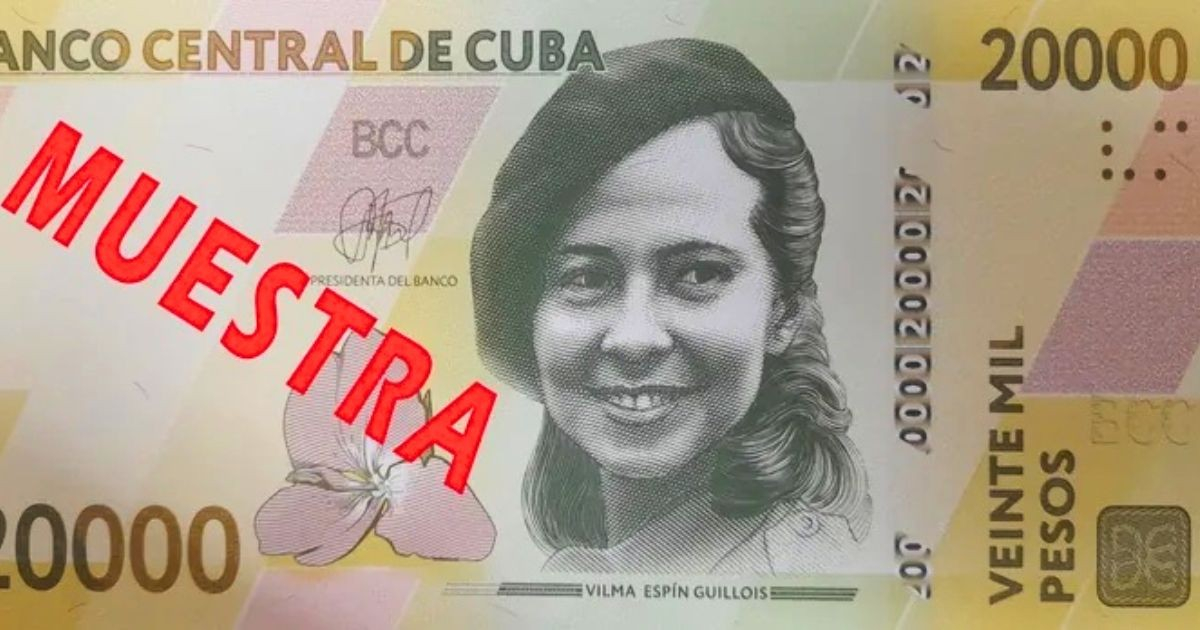
A Cuban doctor with two specialties, a master's degree, and over 35 years of professional experience summarized this Sunday, in a Facebook post, the paradox embodied by the new 10,000 and 20,000 Cuban peso bills: her entire monthly salary, including incentives, does not even cover the value of one of those bills.
Alina Arcos Fdez-Britto, a healthcare professional, wrote: “With the recent issuance of 10,000 and 20,000 Cuban peso bills, I find myself faced with the evidence that my salary as a healthcare professional, including 'salary incentives,' could be summed up in a single bill. And I would still have to give change... which would not be insignificant.”
The doctor specified that her monthly income is around 13,125 Cuban pesos (CUP), an amount that, according to the current informal exchange rate this Sunday, amounts to less than 19 dollars per month.
That amount represents less than one-fifth of the extreme poverty threshold set by the United Nations: 90 dollars a month, or three dollars a day, according to the index updated in 2025.
The contrast is even more severe when compared to the estimated minimum expenditure required to cover basic needs in Cuba. The economist Javier Pérez Capdevila calculated that this threshold is 96,060 CUP per month, a figure that exceeds Dr. Arcos's salary by more than seven times.
The Central Bank of Cuba introduced the 10,000 and 20,000 CUP bills on September 16, the highest denominations ever issued in the country's history. The president of this institution, Juana Lilia Delgado Portal, justified the measure by the current conditions of prices and monetary circulation.
It is the second cycle of high-denomination currency issuance in 2026: in April, 2,000 and 5,000 CUP banknotes had already entered circulation.
The economist Pedro Monreal warned that the new bills reflect a system where work no longer matters: “When the highest denomination bill far exceeds the monthly payroll, it usually indicates chronic inflation, monetary duality, or a dollarized circuit, rather than a payment system anchored in work.” The national minimum wage is set at 3,210 CUP, and the average state salary barely exceeds 7,000 CUP, meaning that a 20,000 CUP bill is equivalent to almost three average salaries.
Dr. Arcos emphasized that doctors are far from being the lowest-paid workers and directed her reflection toward those in even more precarious situations: "What about retirees, who devoted their entire lives and dreams for the 'bright future' promised by the Revolution?" Her own mother, a pensioner, receives just over four dollars a month.
The doctor described the situation as "modern slavery" and pointed out the central contradiction of the Cuban economic model: "The Cuban state continues to pay its workers in national currency. A currency that is openly and shamelessly devalued and has very little purchasing power," while dollarization progresses de facto as a state policy.
The publication also questioned the argument that the embargo is the cause of Cuba's ills and rejected the idea that the situation can be alleviated through multidimensional assessments: the majority of Cubans lack stable electricity, regular drinking water, safe housing, and food security. "Not even health and education are guaranteed anymore," the author wrote, "because both, while public, have long ceased to be free in practice. And I can testify that often, even when paying for them, they are not of good quality."
The Cuban Observatory of Human Rights estimated in 2026 that 94% of the Cuban population lives in extreme poverty due to income, a figure that turns Dr. Arcos' case into a reflection of a reality that extends across almost the entire island.
Related videos:
Filed under: