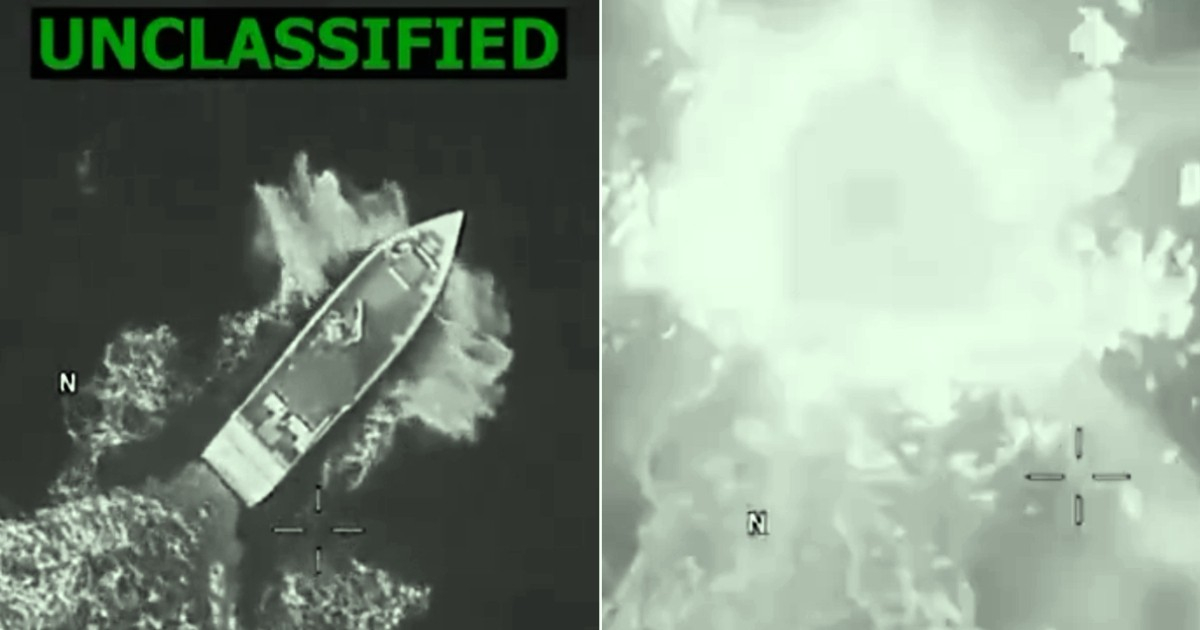
The UN Human Rights Council published an informational note this Monday concluding that the airstrikes by the United States against vessels suspected of drug trafficking in the Caribbean and the Eastern Pacific could constitute crimes against humanity, according to a report by the special rapporteur Ben Saul referenced by BBC News.
The document accounts for at least 68 attacks carried out since September 2025 in international waters, outside of U.S. territorial waters, resulting in a total of 223 deaths.
Saul was categorical in his legal assessment: "Such attacks constitute a series of extrajudicial executions that violate the right to life," as they are not supported by legitimate defense—neither national nor individual—nor by international humanitarian law, maritime law, drug control treaties, or international anti-terrorism law.
The rapporteur's conclusion was even more direct: "There are reasonable grounds to believe that the 68 reported attacks, in which 223 people died, constituted crimes against humanity for homicide under customary international law."
The report arrived two days after the U.S. Southern Command reported a new attack on a vessel in the Caribbean that left four dead, whom it described as "narcoterrorists" based on "confirmed intelligence information."
The operation, officially named Lanza del Sur (Southern Spear in English), was launched in September 2025 and formalized by Secretary of Defense Pete Hegseth on November 13 of that year.
Hegseth has defended the campaign as a mission to “eliminate the narcoterrorists from our hemisphere” and to protect the U.S. from “the drugs that are killing our people.”
However, according to special rapporteur Ben Saul, U.S. authorities have not provided conclusive evidence that all the attacked vessels were linked to illegal trafficking, and neither the White House nor the State Department responded to requests for comments on the UN report.
Since the beginning of the operation, legal experts and human rights organizations questioned its legality, and several Latin American governments whose citizens are among the victims expressed their disapproval.
The then Colombian president Gustavo Petro described the attacks as "murder" and ordered the suspension of intelligence cooperation with Washington, a stance that defined diplomatic tensions for months.
Petro left power in August 2026 following the victory in June of a candidate endorsed by Donald Trump, which diminished the Latin American governmental resistance to the operation.
The Cuban Foreign Minister Bruno Rodríguez Parrilla also expressed his views at the time, describing the U.S. anti-drug campaign as a "farce" linked to political and military objectives in the region.
Saul's report represents the most formal accusation issued to date from the United Nations system, and it increases international pressure on the Trump administration to justify or halt an operation that has already accumulated a year of lethal attacks in the waters of the Western Hemisphere.
Saul further argued that, even if the targets could be identified as members of terrorist groups, none had carried out an armed attack against the United States that would allow for invoking legitimate defense under international law, which undermines the legal basis for the central justification of the operation.
Related videos:
Filed under: