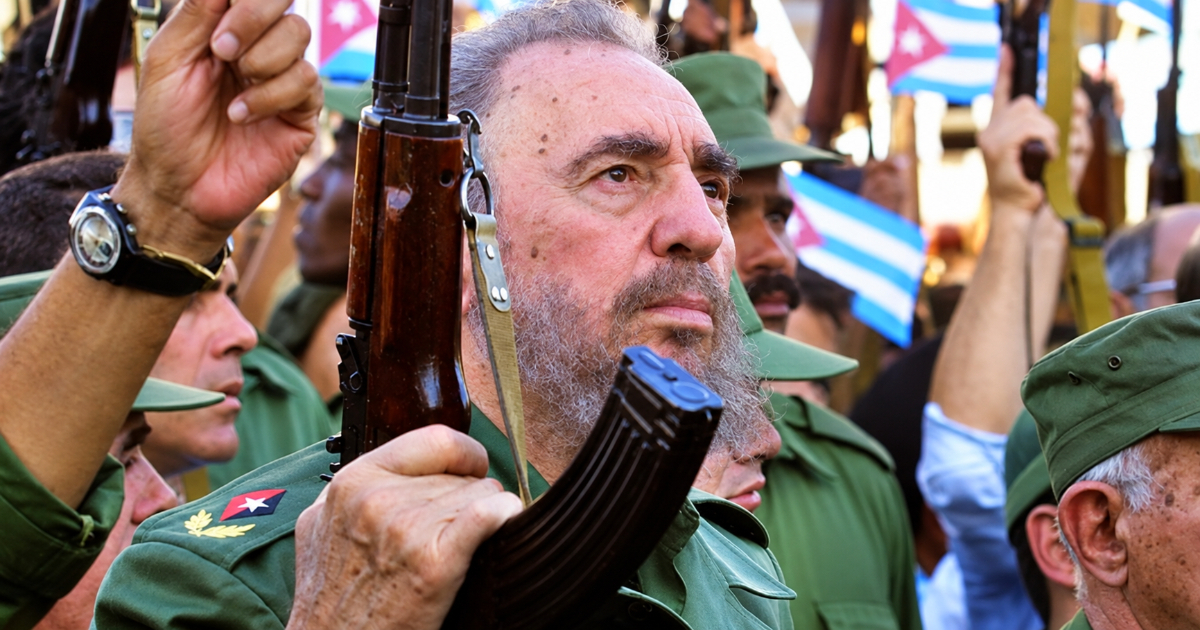
The official newspaper Granma took advantage of International Day of Peace to showcase a carefully selected image of the dictator Fidel Castro: that of the statesman concerned with preventing wars, advocate for disarmament, and convinced that preserving peace was "the most sacred duty of all human beings".
In the article "Fidel and Peace as a Sacred Right," published this Sunday, the newspaper of the Communist Party of Cuba linked statements from the Cuban leader regarding peace, peaceful coexistence, and the threat of a global conflict. The quotes exist and are part of his political discourse.
However, what is missing from the text is the other part of Castro's biography: the leader who came to power through an armed insurrection, who publicly advocated guerrilla warfare as a revolutionary path for Latin America, and who supported armed movements outside of Cuba.
In the idealized portrait presented by the state media —accompanied by the elaborate illustration by Ernesto Rancaño— there is no mention of the strategist who considered a nuclear escalation during the Missile Crisis in the event of a U.S. invasion, who sent tens of thousands of soldiers to African wars, and who built a society on the island that was prepared for decades to fight.
The issue with the portrait of Granma lies not so much in what it reveals, but in everything that it leaves out.
The speech on peace and the nuclear letter of 1962
One of the passages selected by Granma comes from 1962. Upon receiving the Lenin Peace Prize, Castro stated that fighting for peace meant saving humanity from an "apocalyptic destruction."
But that same year, he left behind another extraordinarily revealing document.
On October 26, 1962, at the height of the Missile Crisis, Castro wrote to Nikita Khrushchev convinced that a U.S. attack on Cuba could occur within the next 24 to 72 hours.
In the event of an invasion aimed at occupying the island, Castro suggested that the Soviet Union should not allow the United States to subsequently be in a position to launch a first nuclear strike against Soviet territory.
The John F. Kennedy Presidential Library summarizes the document noting that Castro urged Khrushchev to carry out a first nuclear strike against the United States in the event of an invasion of Cuba.
The context is essential: Castro believed that a U.S. invasion was imminent, and Cuba had suffered the previous year from the Bay of Pigs invasion.
But the document is also part of his legacy. It is challenging to construct a complete historical portrait of Fidel in 1962 by selecting only his statements about avoiding nuclear apocalypse and excluding his stance during the crisis that brought the world closest to that scenario.
When Fidel argued that one should not get one's hopes up with a peaceful approach
Five years later, Castro left even less room for interpretation regarding the role he assigned to arms in the expansion of the Latin American revolution.
In August 1967, during the conference of the Latin American Organization of Solidarity (OLAS) held in Havana, he argued that no one should harbor "illusions" about the acquisition of power through peaceful means in Latin America.
His reasoning went further. Castro asserted that, in the long term, there was a solution for the region: guerrilla warfare. He described it as the primary form of struggle and clarified that this did not exclude other forms of armed struggle.
It was not then a doctrine conceived to defend Cuba's coasts from a U.S. invasion. Castro was talking about how to conquer political power in other Latin American countries.
In the same speech, he lashed out at Venezuelan communist leaders who intended to abandon guerrilla warfare and participate in elections. The text reveals the extent to which revolutionary violence was an explicit part of his political conception during that period.
None of this means that Castro maintained exactly the same international strategy for almost half a century. His foreign policy evolved, and at times he resorted to negotiation and diplomacy. However, that doctrine cannot be overlooked when attempting to reconstruct his thoughts on peace.
From the Sierra Maestra to the wars in Africa
The military dimension of Castroism was not limited to rhetoric.
In 1975, the great Cuban intervention in Angola, known as Operation Carlota began. Cuba provided military support to the MPLA in an internationalized war that also involved various forms of intervention from the Soviet Union, South Africa, the United States, and opposing Angolan movements.
The Cuban explanation portrayed that participation as internationalism and solidarity with African liberation movements against colonialism and the South African apartheid regime. That context should not be overlooked either.
However, the dimensions achieved by the Cuban presence are difficult to reconcile with the image of a state whose military policy was limited to protecting its own territory.
When Cuba, Angola, and South Africa reached the agreements of 1988, the withdrawal schedule subject to international verification included about 50,000 Cuban soldiers in Angola. The United Nations established the UNAVEM I mission to oversee their departure, which was finally completed in May 1991.
It was an extraordinary military projection for a country the size and population of Cuba, developed thousands of kilometers away from national territory.
It wasn't just Angola: 42,000 to 47,000 Cubans in Africa
Ethiopia represents another difficult episode to overlook.
U.S. documents from 1978 estimated between 42,000 and 47,000 Cubans deployed in Africa, including approximately 20,000 military personnel in Angola, 17,000 in Ethiopia and hundreds of military advisors in Mozambique, along with thousands of civilian collaborators.
The same analysis described the Soviet-Cuban relationship in Africa as "symbiotic": their interests aligned on numerous points, even if they were not necessarily identical. Cuba primarily provided the human component; Moscow supplied vast amounts of weapons, transportation, logistics, and strategic support.
In Ethiopia, U.S. documents also describe the arrival of Soviet and Cuban advisors through the Soviet airlift and preparations to deploy Cuban troops in combat with artillery, rockets, anti-aircraft weaponry, and even aviation.
The historiographical discussion on whether Cuba acted as a mere instrument of Moscow requires caution. There are studies that grant Castro considerable autonomy, particularly in the decision to intervene in Angola.
But that does not eliminate another reality: the immense expeditionary capacity of Cuba was possible within a privileged economic, military, and logistical relationship with the USSR.
Cuban soldiers as "bargaining chips" with Moscow?
Declassified documents even allow us to explore a dimension that rarely appears in the official Cuban narrative: the economic cost of those interventions and the potential Soviet reimbursement.
A memorandum from the State Department dated January 1976 estimated Soviet military support to the MPLA in 1975 at approximately 160 million dollars, including the Cuban costs that the analysis suggested Moscow might be reimbursing.
The estimate calculated around 63 million related to Cuban participation: 39 million for equipment, 20 million for military personnel, and four million for transportation.
The nuance is fundamental: the American document explicitly assumed that the USSR was reimbursing those expenses. It does not constitute a Soviet invoice, nor does it prove that Castro received a specific amount for each soldier sent to Africa.
What is widely documented is a very convenient division of capabilities for both parties: Moscow provided resources, weapons, and strategic transport, while Havana could offer something politically much more delicate for the USSR: thousands of men willing to fight directly on the ground.
An exchange between the United States and the Soviet Union in 1979 precisely illustrates that discussion.
In response to the U.S. accusation that the USSR had effectively transported a Cuban army to Angola, the Soviet diplomat Aleksandr Bessmertnykh stated that Moscow did not control the Cubans and that they formed an independent force.
The American representative responded that, although Moscow might not be able to dictate to Castro what to do, Cuba relied on Soviet ships and planes to project such strength.
More than just a simple relationship between master and subordinate, the documentation allows for a discussion of converging interests: Castro obtained resources, military capacity, and international influence far exceeding Cuba's economic weight; the USSR had an ally capable of deploying large contingents of fighters in Cold War scenarios without needing to send an equivalent number of Soviet soldiers there.
Militarization also occurred within Cuba
But there is a part of the story that is even closer to several generations of Cubans.
The military culture developed under Castro was not limited to the Revolutionary Armed Forces.
The State articulated a defensive conception known as the War of All the People, created the Territorial Troops Militias, maintained military service, and extended defense preparation to various sectors of society.
The official logic was fundamentally deterrent: given the impossibility of conventionally defeating the United States, an invasion needed to meet with a country ready to offer widespread and prolonged resistance.
The existence of American threats during certain periods was not a fabrication. The Bay of Pigs occurred, Operation Mongoose existed, and Washington conducted covert actions against the Cuban government during the Cold War.
But acknowledging those facts does not imply that the threat of invasion maintained the same intensity in the following decades, nor that each new government warning about an imminent attack was proportionately aligned with Washington's actual plans.
That is precisely one of the aspects that the official narrative rarely examines: to what extent real threats, especially intense during certain periods, ultimately became a permanent element of political mobilization.
Tunnels for a war that always seemed on the verge of starting
Preparation came to physically modify the cities.
At the beginning of the 1990s, the so-called “popular tunnels” continued to be constructed in Havana, intended to serve as shelters and positions in the event of a possible U.S. attack.
An article from Los Angeles Times published in 1991 described kilometers of tunnels built while the population was warned of the possibility that the United States might take advantage of the collapse of the communist bloc to attack Cuba.
The Washington Post described the following year thousands of workers mobilized to expand that network and noted that Castro had been resorting for decades to the image of a Cuba subjected to a permanent threat from its powerful neighbor.
Determining at which specific moments that threat was real, plausible, exaggerated, or politically utilized requires comparing Cuban rhetoric with declassified documents from each period.
But the internal consequence is observable: generations of Cubans lived within a political structure where the possibility of war held a constant place.
The external enemy and internal cohesion
Fidel's rhetoric was also marked by a vocabulary of combat that extensively exceeded strictly military matters: "battles," "trenches," "enemies," "mercenaries," "traitors," "resistance," "victory," and "defeat" were recurring categories in his political discourse.
The confrontation with the United States provided a real external enemy at certain moments, but also a powerful narrative framework: a Revolution that is perpetually under threat needed unity, discipline, mobilization, and vigilance.
Within that logic, the boundary between external adversary and internal political opponent could become blurred. Criticism of the system could be presented not just as a disagreement, but as collaboration with the enemy, "mercenarism," or "counter-revolution".
That mechanism deserves to be analyzed with specific documentation and without turning each case into an identical one. However, it is an essential dimension for studying to what extent the notion of a country that is permanently besieged also helped to legitimize the political model built by Castro.
The Fidel that fits in Granma
Nothing prevents us from finding numerous statements by Fidel Castro in favor of peace. They exist. He also negotiated, supported diplomatic agreements, and ultimately accepted a negotiated withdrawal from Angola that was verified and deemed fulfilled by the United Nations.
Precisely for that reason, reducing its trajectory to a single dimension would not be historically rigorous. The problem arises when Granma transforms part of that trajectory into the complete trajectory.
The Castro that the official newspaper presents on International Day of Peace speaks of disarmament, peaceful coexistence, justice, and the survival of humanity.
Outside of that framework stands the dictator who came to power through armed force; who in 1967 rejected the "illusions" of peacefully gaining power in Latin America and advocated for guerrilla warfare as the main form of struggle; who during the Missile Crisis presented Khrushchev with an extreme nuclear position in the event of an invasion; who turned Cuba into a military player in African conflicts and who presided over a state for decades where preparation for a potential war permeated deeply into society.
Related videos:
Filed under: