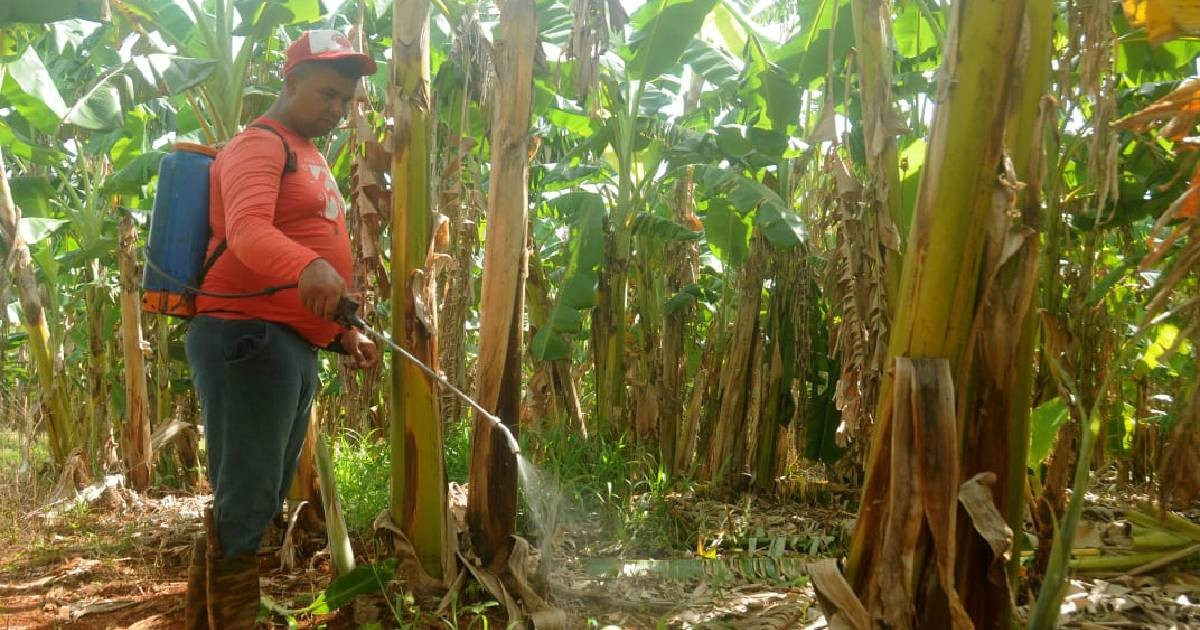
The Agropecuaria Artemisa Company has accumulated a debt of tens of millions of pesos with producers in the province, with payments pending since the end of 2025, according to a report from the state media Cubadebate published this Wednesday.
Only with the Tomás Álvarez Breto Credit and Services Cooperative (CCS), the Agricultural Company has accumulated a debt of over 12 million pesos, a figure that continues to grow as new unpaid amounts are added.
«We also owe for the air conditioning. Of course, the largest debt is that of the Agropecuaria Company: over 12 million. Each month that passes adds to that debt, making it increasingly difficult to pay,» declared Fernando García Cazañas, president of the CCS Álvarez Breto.
Among those affected is Daniel Evelio González, who has been growing bananas in the area for nearly four decades. He acknowledged that he has had to suspend deliveries to Acopio because without payment he cannot sustain the farm or pay his five workers, who demand daily cash.
"I am owed about half a million pesos. I will be honest with you: we have had to stop collecting because, since we haven't been paid, we don't have the means to cover the expenses of the farm," he stated.
Another producer from the same cooperative, William Hernández Valdés, with more than 19 hectares planted with burro bananas, reports a debt of over a million pesos. According to his testimony, the last payment was made in October 2025, and new debts have been accumulating since November of that year.
"Everyone wants the money in hand, immediately; they don’t want a transfer, but cash. The last payment they received was in October, after a long time," he pointed out to the cited media.
The issue has a ripple effect: some farmers are struggling to withdraw cash from the money accumulated in their bank accounts—one producer reported that despite having over a million pesos deposited, he could barely withdraw 2,000 or 5,000 pesos in cash—while their laborers demand payment in cash. In light of this situation, many have chosen to sell their harvests in Pinar del Río, Guanajay, or directly to organizations such as Commerce and Public Health, which complicates Acopio's ability to fulfill its supply commitments in Artemisa and Havana.
The figures regarding approved credit vary among the sources cited by Cubadebate. Fernando García Cazañas, president of the CCS Tomás Álvarez Breto, spoke about financing of 48 million pesos, while Alfredo Morales López, president of the CCS Camilo Cienfuegos, mentioned 46 million. Meanwhile, Osbel Guilarte González, municipal director of the Agropecuaria Enterprise, reported that the approved credit for marketing was set at 45 million pesos and confirmed that 22 million had already been paid to the productive bases. According to the official, these payments allowed for settling debts with the CCS Camilo Cienfuegos and making partial payments on the outstanding amounts to the cooperatives Tomás Álvarez Breto and Rigoberto Corcho, although some debts still remained to be cleared.
The financial situation of the company, however, extends far beyond the debts owed to farmers. By the end of May, debts to the productive bases —CCS, UBPC, and CPA— amounted to 35.7 million pesos, of which 29.3 million were overdue, according to Guilarte González. The entity was also carrying over 260 million pesos in overdue bank loans and had accumulated almost 120 million in accounts receivable. Due to the renegotiated debts with the bank, it withholds 80% of the income that enters the company’s accounts, according to the explanation provided by the official.
García Cazañas questioned the decision: "How is it that if you owe me 30,000 pesos and receive three million, you won't pay me my 30,000 pesos, but rather whatever comes after that? This encourages the producer not to deliver anything."
This is not a new problem nor one exclusive to Artemisa. In July 2024, the Cuban government acknowledged a debt of nearly 200 million pesos to farmers across the country, with Artemisa being the hardest-hit province, accounting for over 167 million pesos. The Popular Savings Bank then intervened with multi-million dollar loans, but the problem resurfaced.
In April 2025, the dairy company Río Zaza in Sancti Spíritus accumulated more than 150 million pesos in debt with private producers, halting milk production and impacting the supply to children, pregnant women, and patients on medical diets.
Despite the fact that at the beginning of 2026 the government announced the formal end of the Acopio monopoly on agricultural marketing, state controls over prices and destinations remain, and million-dollar debts to producers continue to persist.
Related videos:
Filed under: