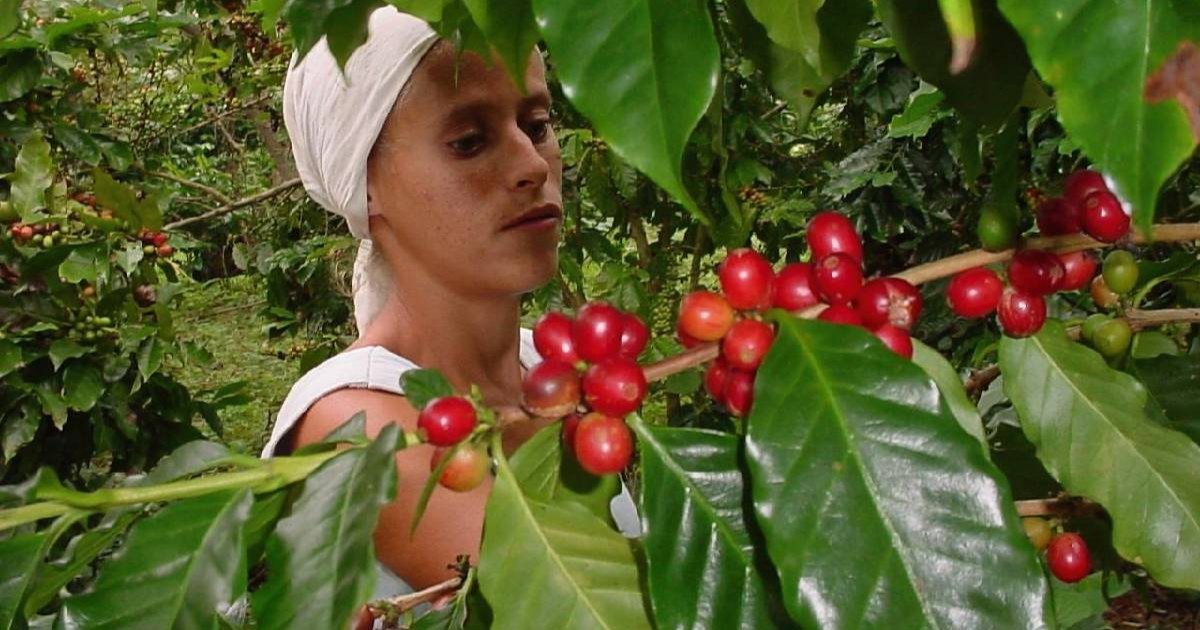
The province of Guantánamo has kicked off its coffee harvest for 2026-2027 with activity in eight municipalities and the explicit challenge to reverse a previous harvest that was deemed "very low" by the official Cuban press itself, according to the Cuban News Agency, citing the provincial newspaper Venceremos.
The official note candidly acknowledges that "Guantánamo faces the challenge of achieving an efficient harvest, as the previous one was very low, first affected by intense rains and then by Hurricane Melissa, which knocked down a lot of grain and damaged the crops."
The hurricane Melissa made landfall in eastern Cuba during the early morning of October 29, 2025, as a category 3 storm, with sustained maximum winds of about 195 km/h. The phenomenon caused severe agricultural and infrastructure damage in Santiago de Cuba, Granma, Holguín, and Guantánamo. Estimates of the affected agricultural land increased with subsequent evaluations: a regional report from the Pan American Health Organization in November placed the losses at around 158,000 hectares of crops.
As of the close on Thursday, September 17, the province reported a total of 25,535 matured cans, a figure that the state agency describes as not high but warns that "should not generate confidence, especially in the municipalities with the highest production, where a grain explosion creates urgencies and difficulties." Of that total, 20,395 matured cans were from the municipality of Maisí, the largest producer in the province.
As for the collection, the province had gathered up to that date 34,374 cans, with Maisí leading the way with just over 20,800 units. Following were Yateras and El Salvador, each with more than three thousand cans. The provincial estimate for the entire 2026-2027 harvest amounts to 294,568 cans, with Maisí, El Salvador, and Yateras being the municipalities most committed to their delivery, in that order, according to the source.
Of that estimated total, more than 145,600 cans will need to be processed, according to the government report. The state agency warns that the anticipated rise in maturation—favored by recent rainfall and high temperatures—"must be closely monitored by the forces involved in the harvest to ensure timely collection and prevent the falling and loss of the cherries."
The situation facing Guantánamo is not isolated: it is part of a prolonged structural crisis in the Cuban coffee sector. In the first half of 2025, the industry reported a production of only 2,887 tons of coffee, which is equivalent to 23.7% of the planned target, against an officially estimated national consumption need of around 24,000 tons per year. In Santiago de Cuba, the country's main coffee-producing territory, the 2024-2025 harvest had only reached 65% of the planned target by the end of February.
The situation has escalated to such an extent that, in August 2026, the Manuel Ascunce roasting plant in Villa Clara had to process corn, sorghum, and rice due to the lack of sufficient coffee to operate.
Behind the productive collapse lie causes that the regime only partially acknowledges: the mass exodus of rural workers from mountainous areas, power outages, delays in payments to producers, and chronic shortages of supplies.
Cuba surpassed 60,000 tons of coffee annually at the beginning of the 1960s. In contrast, during the first half of 2025, the industry reported a production of only 2,887 tons, which is equivalent to 23.7% of the planned target.
The estimate of 294,568 cans for the 2026-2027 harvest in Guantánamo comes after a crop that the official press itself described as "very low." Its fulfillment will depend, among other factors, on whether the increase in ripening does not exceed the collection capacity, a risk that the authorities have drawn attention to.
Related videos:
Filed under: