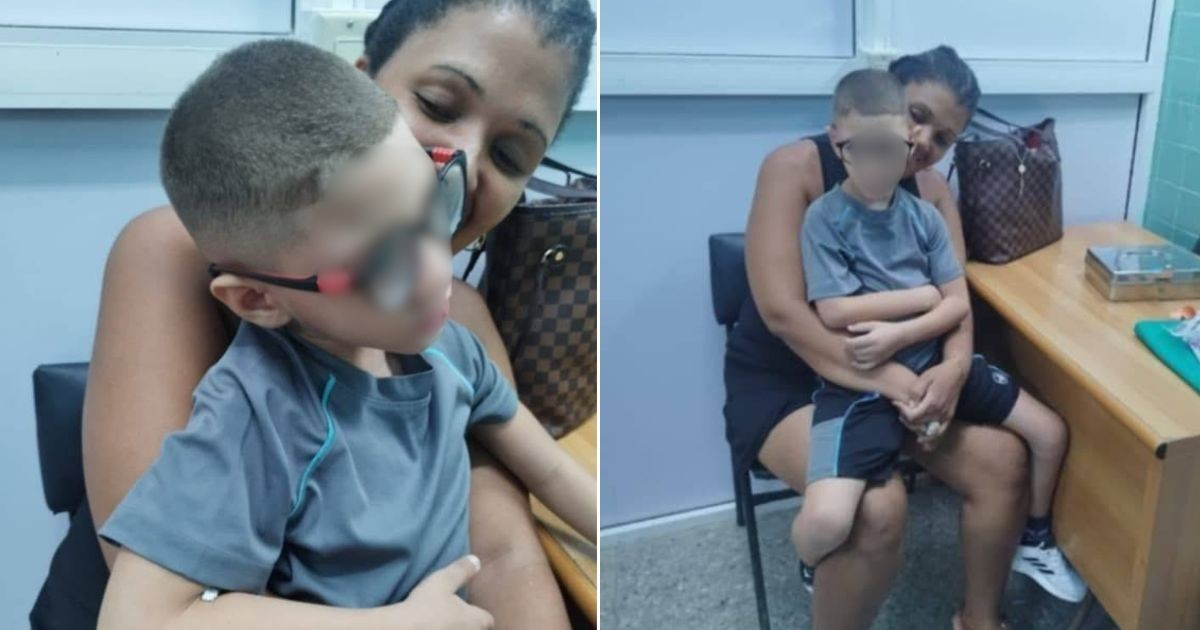
More than a month after his blood was drawn for specialized genetic testing in Argentina, the seven-year-old Cuban boy Eithan Urbay Rosell continues to wait for the results that could finally clarify the chromosomal alteration he was born with.
His mother, Dalma Rosell Marrero, reported on that, as of September 21, Cuba had still not made the payment to the Argentine laboratory responsible for analyzing the samples.
"To date, September 21, 2026, no payment has been made to the Laboratory of the INGEN Foundation in Argentina by Cuba," he wrote.
The blood was drawn on August 18 at the provincial genetics center located at 19 and 4 in Havana. According to Rosell, the extraction, mixing with anticoagulant, and preparation of the sample proceeded successfully.
However, more than a month later, the studies still have not been able to be carried out.
An administrative procedure is pending payment
The mother explained that Eithan's file is already complete and is with the Ministry of Public Health (MINSAP), although the necessary documentation to process the payment is still pending.
According to their update, the Argentine laboratory's tax identification number (VAT, as per the required documentation) is pending, which is necessary for the invoice to be issued in Cuba's name.
Rosell stated that the necessary Argentine authorizations to receive the sample are already in the hands of the doctors in charge of the case.
Once the invoice is issued, he explained, it would be pending approval and disbursement by the Cuban authorities.
"We will then await and be ready for the officials at the Ministry of Public Health who need to approve the payment," he noted.
Four years searching for answers
The delay is part of a battle that the family has been fighting for about four years.
In August, Rosell had decided to make her situation public after years of demanding the studies her son needs and which, as she claimed at the time, are not conducted in Cuba.
"Even today, the State has not paid for the studies at the laboratory in Argentina," the mother reported just three days after the sample was finally extracted.
Eithan presents a structural chromosomal alteration related to the short arm of chromosome 3, but so far only a conventional karyotype has been performed, and his diagnosis remains not fully defined.
Among the pending studies are a complete exome, analysis of copy number variations, and chromosomal microarrays, tests that would provide much more accurate information about his condition and better guide his medical care.
A second battle: managing to bring it to Argentina
Faced with the prolonged wait, Rosell simultaneously began looking for a way to travel to Argentina with her son to obtain specialized care there.
At the end of August, Eithan was accepted to receive care at the Jérôme Lejeune Foundation Medical Center, in Córdoba, which specializes in individuals with disabilities and genetic disorders.
The mother then began to seek financial assistance to cover the trip and process a humanitarian visa.
"All doors are closing on us," she lamented at that moment, after assuring that she had begun to feel the consequences of publicly denouncing the difficulties in obtaining care for her son.
The new delay in genetic studies, Rosell clarified, does not prevent her from proceeding with the humanitarian visa application.
There are, therefore, two paths that the mother is trying to pursue simultaneously. After years of efforts, she insists that she does not intend to abandon either.
"I remain in the fight, I will not get tired," he concluded.
Related videos:
Filed under: