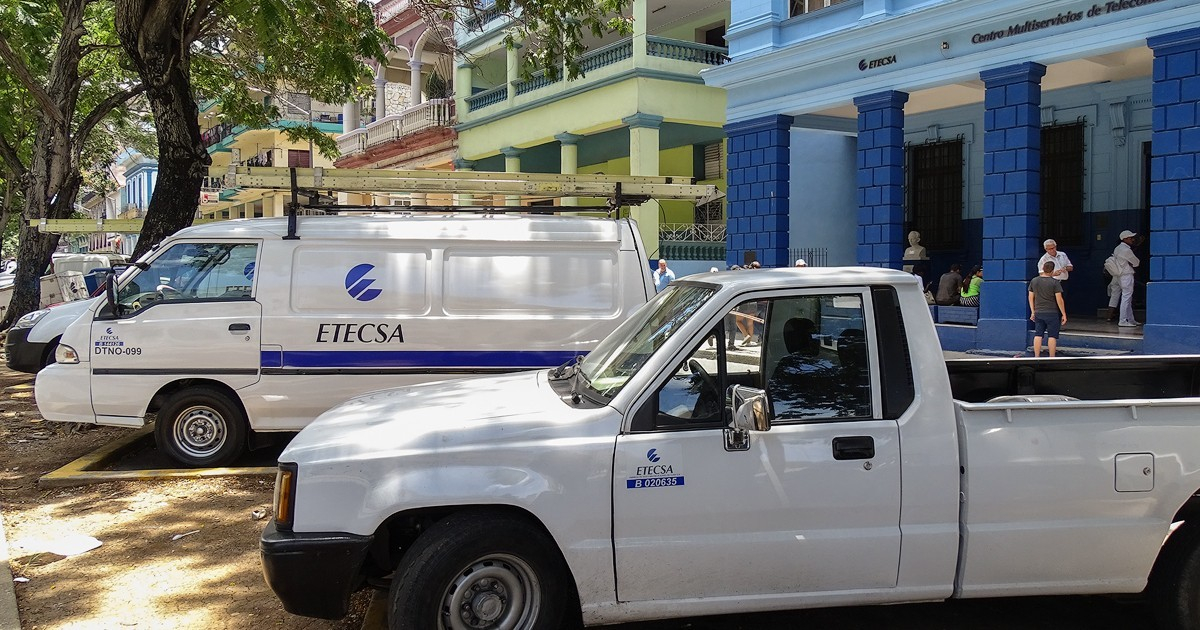
The state telecommunications monopoly ETECSA openly acknowledged that the energy crisis affecting Cuba prevents it from expanding its communications infrastructure, in a statement published on its official website titled "Telecommunications in the Current Context."
The company acknowledges that the lack of electricity shuts down dozens of technological sites, leaving entire communities without landline service, cell coverage, or internet access. "In recent months, the availability of both mobile and fixed services has decreased, causing increasing inconveniences for the population. This is largely due to many technological sites being shut down due to a lack of electrical power," the text states.
The most serious incident described in the statement was the failure of the National Electric Power System (SEN), which disrupted over 80% of the radio base sites and nearly 70% of the telecommunications cabinets, resulting in internet traffic losses that reached 58% compared to similar periods.
That outage corresponds to the eighth total blackout experienced by Cuba in 2026, recorded on September 18, when the SEN took approximately 32 hours to restore, according to the Electric Union. At that time, the available generation was only 1,000 MW against a demand of 3,200 MW.
Given this situation, ETECSA was unequivocal: "It is not feasible to continue investing in expanding the access network (radio bases, cabinets, WiFi sites, etc.) if there is no capacity to support the telecommunications infrastructure with energy."
The statement also reveals the economic deterioration of the company. Landline services do not cover their own operating costs and must be subsidized by income from mobile telephony, which is not sustainable under current conditions. The result: around 77 thousand reports of interrupted fixed services, attributed to a resource deficit and technology that the company itself qualifies as obsolete and expensive.
This is compounded by thefts and acts of vandalism against the infrastructure. In Santiago de Cuba, two solar panels were stolen from a telephone cabinet in the Santa Bárbara neighborhood, leaving nearly 900 users without backup energy. In that same province, between 140 and 150 ETECSA sites go out of service every day due to a lack of electricity or fuel for the generators, according to Ricardo Serrano Díaz, the territorial director of the company, as reported by the government-affiliated Granma.
As part of its structural response, ETECSA announces a phased program for transitioning to photovoltaic energy. At the end of the announcement, the main centers of 64 municipal capitals already had solar coverage, with the most significant progress in Pinar del Río, Villa Clara, Matanzas, and Granma. However, the company acknowledges that the installed capacity does not always provide coverage for 24 hours a day.
The citizens' reaction on social media was one of skepticism and frustration, partly because the announcement comes more than a year after the controversial "tarifazo" of May 2025, when ETECSA limited top-ups in Cuban pesos to 360 per month and raised data package prices. "Is that why they raised the prices last year?" asked a user on Facebook. Another was more straightforward: "So, there will be no connection because the power supply isn't going to improve."
Out of the approximately 2,520 radio bases in the country, only half have some form of energy backup, and around 450 are experiencing mechanical failures or fuel depletion in their generators—a figure that illustrates the magnitude of the problem that ETECSA acknowledges but cannot resolve as long as the electrical crisis remains unsolved.
Related videos:
Filed under: