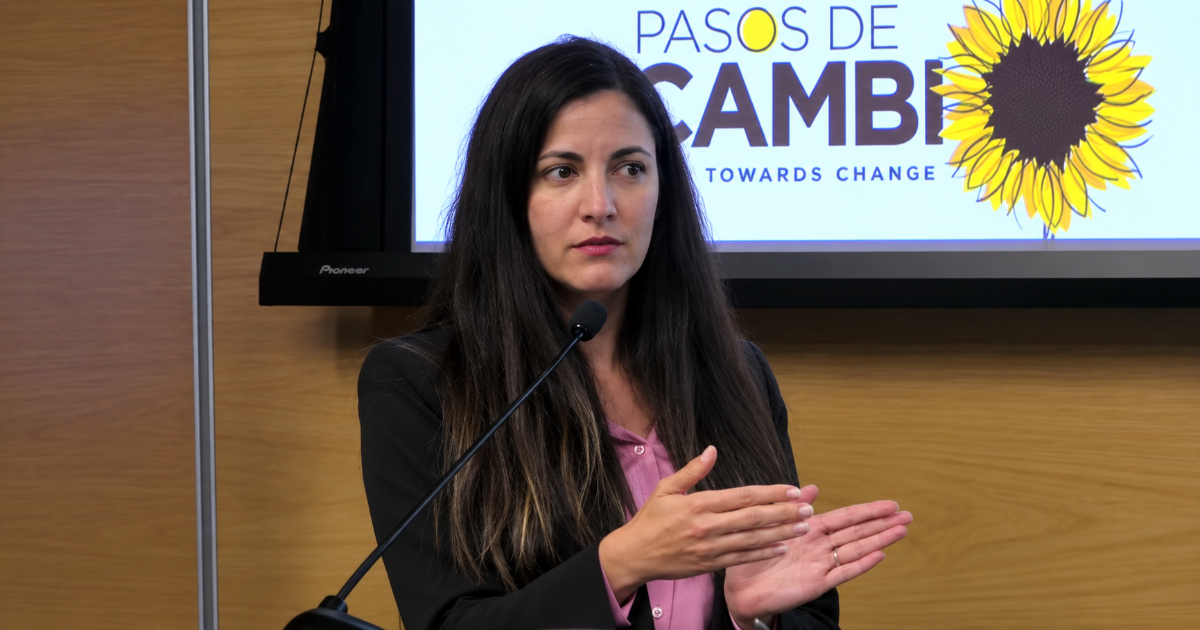
Rosa María Payá Acevedo, founder of Cuba Decide and coordinator of Pasos de Cambio, led a conference at Florida International University (FIU) where she presented concrete tools to address the humanitarian catastrophe in Cuba and plan for a democratic transition.
“We are not just here to denounce the collapse; we are here to present tools to confront it,” the activist made clear from the start.
The event, titled «Social Collapse in Cuba» and jointly organized by Pasos de Cambio and FIU, brought together experts in humanitarian emergencies and representatives of Cuban civil society. Payá framed it as real planning for the "day after" the dictatorship, not as an academic exercise.
"Cuba is not simply experiencing an economic crisis. We are facing the collapse of a system that has destroyed the country's productive capacity, impoverished families below the extreme poverty line, and turned daily survival into a desperate struggle," he stated.
The first part of the meeting presented the IX Study on Social Rights in Cuba by the Cuban Observatory of Human Rights (OCDH), based on 1,318 interviews conducted between June 27 and July 29 in 79 municipalities across the 15 Cuban provinces.
The data is striking: 94% of Cuban households live in extreme poverty, five points higher than the previous year. To avoid falling below that threshold, a family of three needs to earn more than 87,000 Cuban pesos per month, a figure that the vast majority do not reach.
Hunger is advancing uncontrollably: eight out of ten Cubans have been forced to skip at least one meal due to lack of money or food; among older adults, the proportion rises to nine out of ten. "Last year it was seven out of ten. In other words, this year there has been a worsening of the food situation," noted Yaxys Cires, director of Strategies at OCDH.
For the first time, power outages have surpassed the food crisis as the main issue identified by respondents. Rejection of the regime's management reaches 95%, and only 6% believe that the 176 announced economic measures will lead to any improvement.
The second block brought together specialists in humanitarian logistics. Teo Babún, president of Outreach Aid to the Americas —with over 30 years of experience distributing aid in Cuba through religious networks— warned that what is lacking on the island is not capacity but funding, and proposed to utilize the more than 4,000 Catholic and evangelical churches as a decentralized distribution network.
The Reverend José Joaquín Espino, rector of the National Sanctuary Hermitage of Charity, presented a specific obstacle: all aid currently arrives through Mariel, and transporting a package from there to Guantánamo costs more than sending it from Miami to Mariel, due to the lack of independent transportation.
Andrés Asión, from Global Empowerment Mission, presented the organization's response to the earthquakes in Venezuela as an operational model: within 30 days, they provided food assistance to over 228,000 people, mobilizing 24 cargo planes and five military vessels.
Payá Acevedo was emphatic in closing the event: «The regime is the only obstacle between that definitive aid and the Cubans».
The panel is framed within the Agreement for Liberation, signed in March 2026 by Pasos de Cambio and the Assembly of the Cuban Resistance, which proposes a transition in four stages —liberation, stabilization, reconstruction, and democratization— and includes a specific technical commission for Humanitarian Emergency.
«We are preparing for the day after, to stop being a failed state», Payá wrote on his X account the next day. «The only way out of the crisis is to exit the dictatorship».
Related videos:
Filed under: