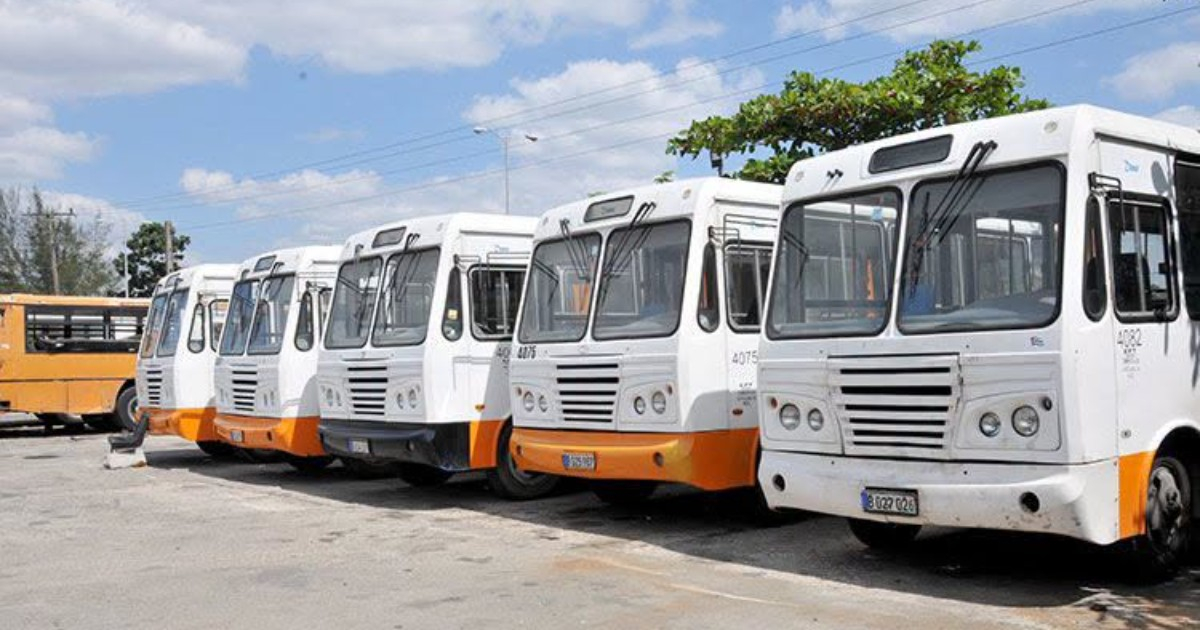
Urban transport in Cienfuegos could begin to recover starting on October 1, with the gradual reactivation of five routes through a scheme in which private individuals would provide fuel and operate buses contracted by the state-owned company.
The journalist Jesús Álvarez López reported this Thursday on Facebook that the announcement was made on Radio Ciudad del Mar by Orlando Valdés Pérez, an official from the Provincial Transportation Department.
According to the information released, the fuel necessary to restore part of the urban service will be provided by private individuals through a partnership with the state-owned company.
The initial announcement did not specify who will provide the fuel, what volume will be available, or how much the service will ultimately cost passengers.
Later, Directorio Cubano provided more details about the plan based on statements from Orlando Valdés, identified as the director of the Basic Passenger Unit of the Provincial Transport Company.
According to this information, the recovery would begin gradually with five urban routes: route 1, which connects Pastorita, O’Bourke, and Punta Gorda; route 3, towards Reina and Junco Sur; route 5, heading to Tulipán; route 200, between Paraíso, Pueblo Grifo, and Venta del Río; and route 207, reaching Caunao.
The departures would continue to take place from the Villuendas park. The company intends to guarantee initially at least one service at the start and another at the end of the workday, with routes in the morning and afternoon.
Regarding one of the issues that has raised the most concern among users, Valdés announced that the official rates will be communicated later and assured that they will be below the amounts initially calculated in the technical sheet.
Valdés explained that frequencies could be increased on those routes with higher demand if the new system manages to maintain stability.
The Provincial Transportation Company also received tires, primarily intended for the Diana buses, which must be installed before the commencement of the first routes.
The recovery will not be limited to the city of Cienfuegos. Authorities are also working to restore connections with other municipalities in the province through contracted transporters.
Cumanayagua concentrates, according to Valdés, the highest number of operators included to cover the connection with the provincial capital. Subsequently, services from Lajas, Cartagena, Rodas, and Aguada de Pasajeros could be added.
Some buses contracted with small and medium-sized enterprises are already making trips to municipal capitals and to Santa Clara, although they operate with differentiated fares and without subsidies.
During the radio program where the measures were explained, several listeners questioned prices that exceed one thousand pesos on certain routes.
The situation remains particularly complex for the state fleet. The shortage of diesel has left a large part of the buses immobilized, with specific exceptions for services related to Health and Education workers.
In the areas of the Turquino Plan, some connections are maintained once a week. From Cumanayagua, for example, departures are scheduled on Mondays to Cuatro Vientos, on Wednesdays to El Nicho, and on Thursdays to Yaguanabo Arriba, with returns on the same day.
The maritime crossing of the bay, however, will remain paralyzed in the short term due to a lack of fuel. The vessel currently lacks the necessary diesel to even restore the route between El Castillo-CEN and Pasacaballo.
The announcement comes amid a growing openness to private solutions in response to the decline of state transportation. This Thursday, it was reported that more than 1,900 individuals have been authorized to operate electric transportation in Cuba after the Ministry of Transportation eased the requirements for obtaining licenses.
Cienfuegos, along with Havana and Matanzas, is among the provinces where authorities claim these relaxations have had the greatest impact.
The Ministry has also acknowledged experiences of linkage between the state and private sectors for transporting passengers and small cargo.
The transportation situation in Cienfuegos has significantly worsened, especially since the beginning of the year. In February, in response to the worsening energy crisis, the provincial authorities suspended intermunicipal and rural departures and also halted the crossing of the bay using barges, leaving only ten boarding points within the territory.
The relationship between the state enterprise and private operators had seen other chapters in the province. In July 2025, the authorities withdrew 42 buses that had been leased to private operators and began reintegrating them into the state system, after a significant portion of those vehicles had been out of regular service for nearly a year.
Related videos:
Filed under: