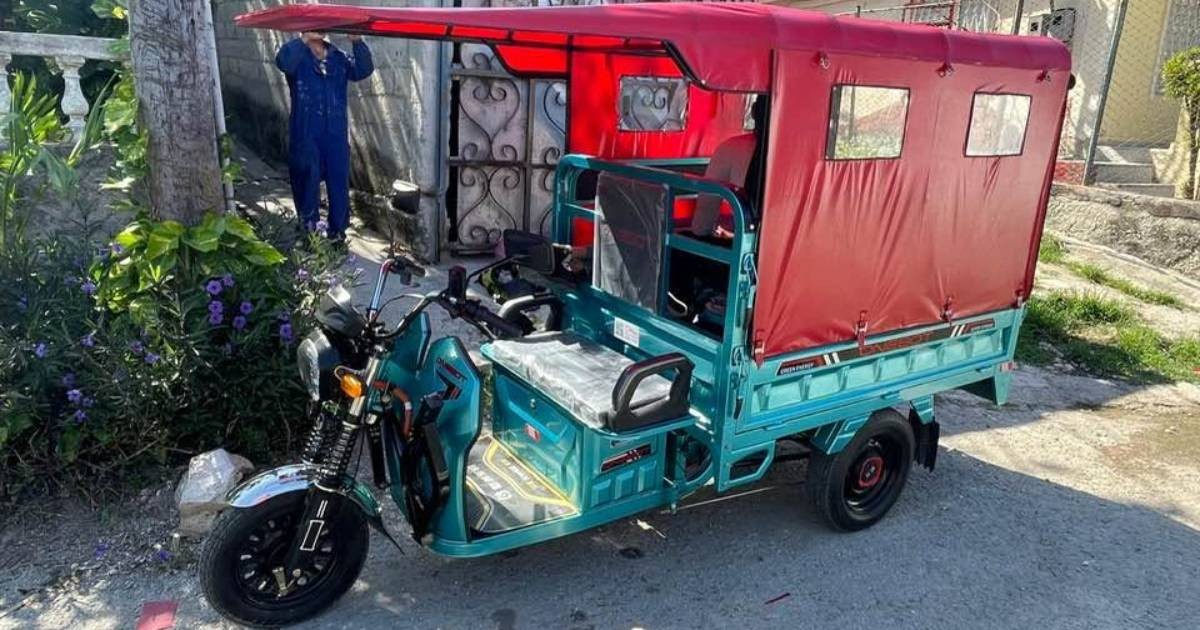
The Ministry of Transportation of Cuba reported this Thursday that 1,912 people with electric vehicles had been authorized as of the end of July to operate in the transportation of passengers and cargo, as part of the relaxed requirements approved this year amid the transportation crisis in the country.
According to an official post shared on Facebook, the measure takes effect from Instruction No. 1, issued on February 18, which exceptionally and temporarily relaxed the granting of the Transportation Operating License (LOT) for individuals with tricycles, motorcycles, and electric mopeds, including bike taxis with built-in motors.
According to the information, this decision allowed the inclusion of vehicles that until now could not be formally integrated into the system, even in cases of vehicles without registration, as long as their owners could demonstrate legal ownership.
In the case of leased vehicles, the Ministry indicated that it is sufficient to present the owner's authorization to operate the means of transport. For tricycles, it is only required to have a driver's license of category "A" or "A-1", depending on the type of vehicle.
Later, on June 30, Instruction No. 3 additionally opened the possibility of exceptionally authorizing drivers who had not yet met the three years of experience required by Law 109.
The ministry assured that, since the implementation of both provisions, there has been a recorded increase of 1,280 media and that Havana, Matanzas, and Cienfuegos are among the territories where the impact of the measure has been most felt.
The authorities maintain that the flexibilization has allowed to cover routes for passenger transport that were previously unprotected and to create new ones. They also pointed out that in some areas these vehicles are used to transport small batches of goods.
According to the Ministry, these experiences have also allowed to link the state sector with the private sector in certain transportation services.
In total, the country reached the figure of 10,466 self-employed workers operating electric and animal-drawn transport.
The official information indicates that some of these workers also participate in patient transportation services within the healthcare system, although it did not specify how many transporters are assigned to these roles or in which areas they are carried out.
The official publication itself presented these results as a response to the lack of fuel, the shortage of parts and pieces, tires, and batteries, an implicit acknowledgment of the state transport's inability to meet the mobility demands of the population.
In practice, the data confirms the extent to which the regime has had to make room for private solutions and alternatives to transport people and goods in a country where state routes continue to be collapsed or severely limited.
In the comments on the official post, several users argued that these licenses should stop being temporary and become permanent if the established requirements are met.
Others complained that, despite the talk of relaxation, in practice the procedures remain cumbersome, with long waits, multiple bureaucratic requirements, and obstacles that vary by region.
There were also criticisms regarding the number of requirements needed to obtain the operating license, the slowness of processes in provinces like Pinar del Río, and obstacles such as the requirement that certain procedures can only be carried out by the holder or someone with a notarial power of attorney.
Some comments also requested to broaden the categories of valid licenses for driving tricycles, while others questioned the operating costs and the economic conditions imposed on drivers.
The announced flexibilization continues measures that had already been anticipated months ago.
In February, authorities announced that they would issue licenses for transporting passengers on motorcycles and electric tricycles without registration, a decision initially presented as a temporary solution to the severe transportation crisis.
Weeks later, the shortage of buses and gasoline turned those vehicles into one of the few real mobility options for thousands of people, especially in the capital, where electric tricycles became a lifesaver amidst the collapse of the state system.
But the growth of this sector has also been accompanied by tensions. In Matanzas, for example, the rise in fares generated strong public complaints before authorities intervened to reorganize the service, as reflected in reports about how electric tricycles doubled their prices overnight and later authorities were forced to lower the rates following user protests.
Related videos:
Filed under: