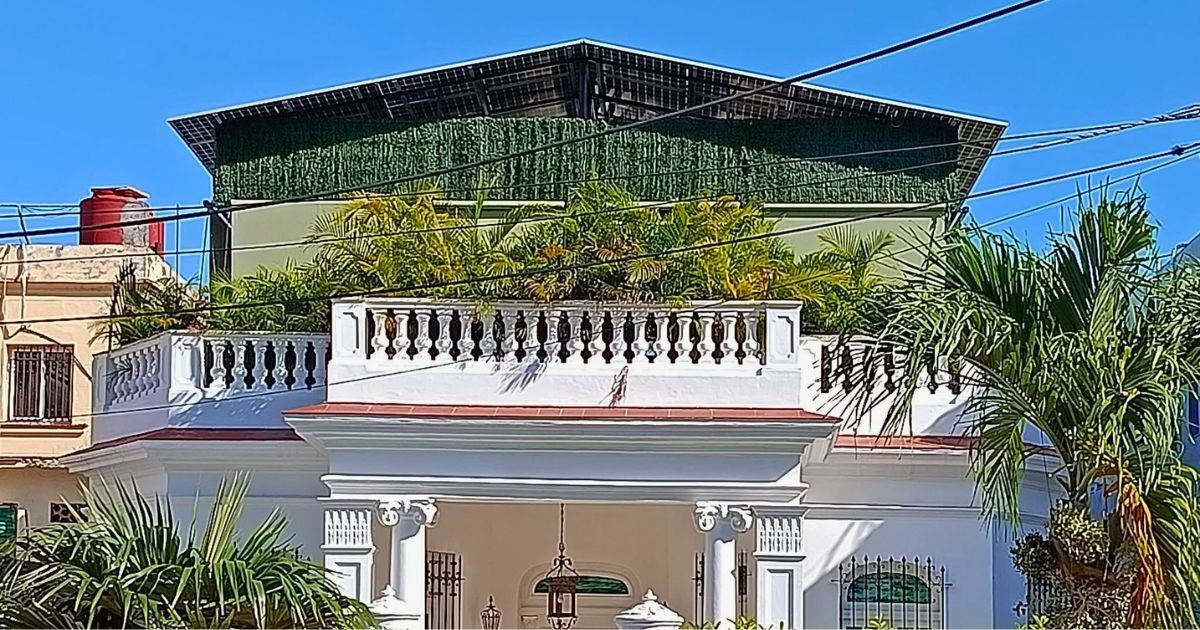
The renowned Cuban architect and professor Humberto Ramírez published an analysis this week on the most common mistakes in the installation of photovoltaic solar panels in buildings in Cuba, warning that what can be a solution to the energy crisis can also lead to serious problems if not executed with technical precision.
The text, shared on Facebook by the architect and professor Abel Tablada, is titled "Photovoltaic Panels: A Great Solution That May Create New Problems."
Ramírez, recipient of the 2022 Life and Work Award from the Society of Architecture at the National Union of Architects and Engineers of Construction of Cuba, acknowledges the value of solar expansion—“a fortunate and fairly rapid expansion [...] that can greatly relieve our agonizing suffering”—but warns that alongside the small and medium-sized enterprises and the state company Copextel, “teams with insufficient knowledge have also entered the field, resulting in truly concerning outcomes.”
The first defect noted is the orientation. Most of the panels are correctly aimed at the south, but Ramírez claims to have seen some oriented towards the north and, in more striking cases, installed in a "sawhorse" manner, with half of the modules facing the wrong direction, as he observed on the Cuban Television News.
The second and most noticeable problem is the tilt. Ramírez describes variations that range "from almost zero degrees, horizontal, to around 60°," while architect Dania González Couret —a professor at the University of Technology of Havana (CUJAE) and founder of Cuba Solar— has pointed out that the optimal angle for Cuban latitude is between 15 and 30 degrees from the horizontal.
The support structure is another critical point, especially in a country prone to hurricanes. "In our country, which faces relatively frequent hurricanes, this is vital to protect the investment made," writes Ramírez, who has observed structures almost touching the ceiling at their lowest point and raised more than a meter at the opposite end, without diagonal braces in either direction.
This is compounded by the poor anchoring of the bolts on the rooftops, which can lead to the loss of panels in the face of any wind, even a "banana" wind.
Leaks pose an additional risk to third parties: "If the waterproofing of the numerous necessary bolts is not guaranteed, we introduce an indeterminate amount of leaks on the lower level, with the aggravating factor that in many cases it is not precisely the neighbor who installed the panels," points out the architect.
The sixth identified problem is theft, which Ramírez describes as a "new criminal figure that is rapidly progressing," with cases reported in polyclinics, banks, and private homes. The phenomenon is documented: on September 19th, solar panels were stolen from an ETECSA cabinet in Santiago de Cuba, leaving almost 900 users without energy support.
In July, four solar panels were stolen from a drinking water point in Holguín and others from a Maternal Home in Cárdenas. The People's Supreme Court classified this type of theft as sabotage in May 2025, with penalties ranging from seven to 30 years or the death penalty in the most severe cases.
Ramírez's analysis is part of a broader debate in which the government has also tried to establish order in response to the rise of solar panels. The energy crisis of 2026 — with eight total collapses of the National Electric System, deficits exceeding 2,000 MW, and constant blackouts lasting up to 20-24 hours a day in some areas — has surged the demand for individual photovoltaic systems.
Ramírez concludes his guiding text by warning those who must carry out these processes: "It is essential that the entities engaged in this new task possess the necessary knowledge and the assistance of professionals [...] otherwise, we will not achieve full effectiveness or we may witness a surreal image of panels flying like kites in the skies of our towns and cities."
Related videos:
Filed under: