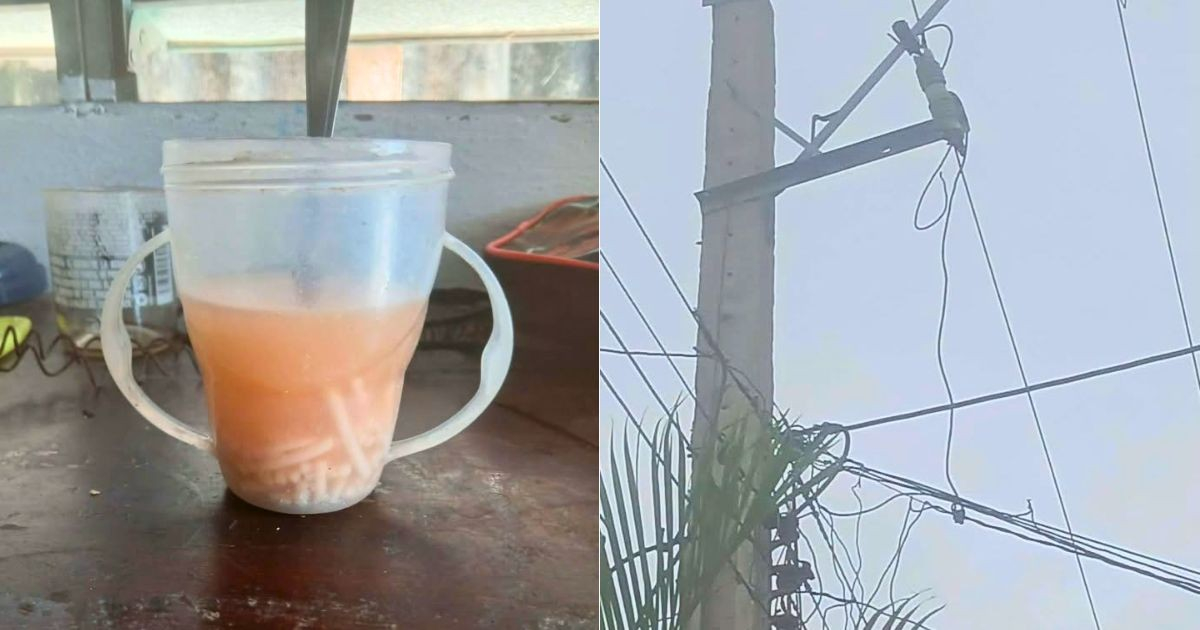
A mother from Caibarién, in the province of Villa Clara, reported this Sunday through journalist Mario J. Pentón that the neighbors on 22nd Street, between 23rd and 25th, have been without electricity for 12 days due to a transformer malfunction that local authorities have not repaired.
The woman, who requested anonymity for fear of reprisals, explained that the outage occurred "when the transformer shorted and blew a high-voltage fuse, something that could have been resolved at the municipal level. They said they would try not to delay, but they never fixed it."
In the affected area, there are bedridden individuals and minors who need ventilation. The complainant is the mother of two children, one of whom is ill and receiving care in Santa Clara, and she noted that she cannot expose her identity because her children depend solely on her.
The assistance from state institutions has been limited to selling food of terrible quality. "The only 'response' has been to sell a soup at noon, made in Brisas del Mar, for 150 pesos per serving. We neighbors are tired of being mocked," the woman wrote in her message to the journalist.
In addition, he mentioned that the secretary of the Communist Party of Cuba (PCC) in the area promised to send a water truck when the supply cycle was due, but the truck never appeared.
The case of Caibarién is not isolated. This same coastal municipality had already experienced a fire at its electrical substation in the Van Troi 2 neighborhood on June 16, which damaged the transformer and left 15 districts without service. On that occasion, the municipal mayor Rogelio Ruiz Rodríguez attributed the incident to overheating caused by high temperatures and peak consumption.
The pattern repeats itself across the island. In the middle of this month, a mother from San Miguel del Padrón reported 17 days without electricity while her children slept on the sidewalk due to the heat. A doctor in Matanzas had been without power for nearly three months along with her bedridden mother; and in Camagüey, neighbors reported that they had to wait between 15 and 20 days without electricity without anyone providing a solution, according to the authorities' response.
The fear of retaliation is also a common denominator: in August, a mother from Lawton was threatened with a police patrol when she complained about the lack of water and electricity.
The shortage of transformers has become a problem acknowledged by the Cuban authorities themselves. In June, the Electric Union admitted the lack of immediate availability of equipment and spare parts to replace the damaged ones, while the country fundamentally relies on three repair and recovery facilities located in Havana, Villa Clara, and Manzanillo.
In Havana, an average of 25 transformers break down each day —with some days seeing the number exceed 60—, according to the state-run Canal Caribe. Cuban media estimates the combined capacity for production and recovery at the facilities in Havana, Villa Clara, and Manzanillo to be around 70 units per day, which is insufficient to meet the demand.
The national context exacerbates any local malfunction. Cuba experienced its eighth national blackout of the year on the 18th of this month. In the weeks leading up to the report from Caibarién, the outages simultaneously affected between 65% and 70% of the country during peak hours, with a generation deficit that often exceeds 2,000 MW.
Related videos:
Filed under: