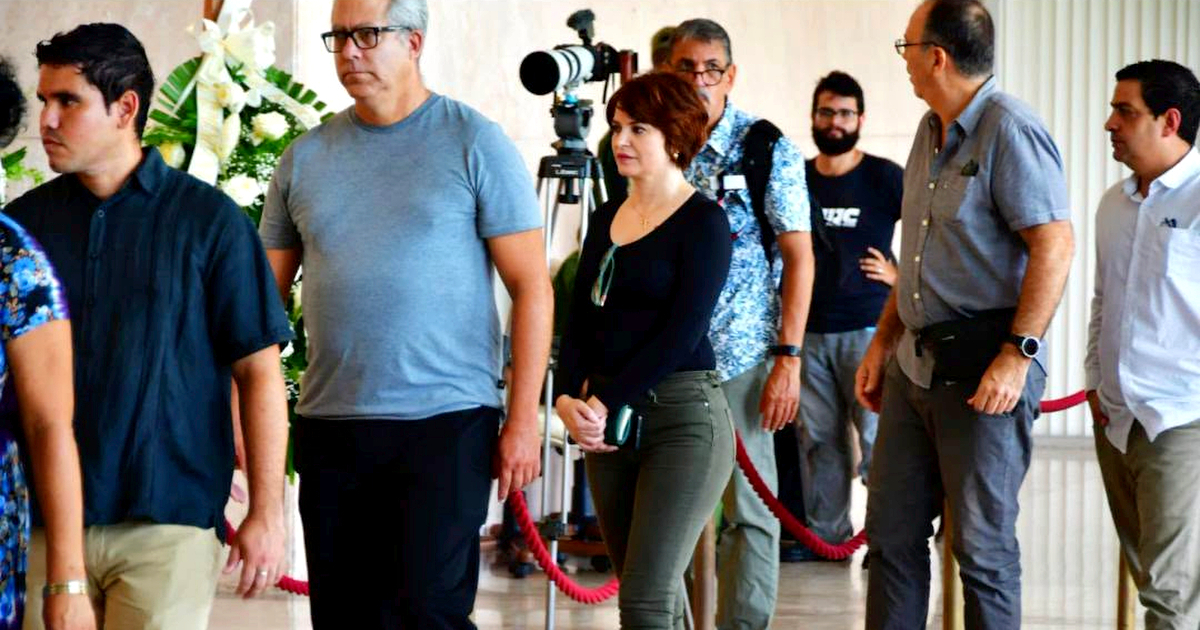
Ana Hurtado reacted to the recent leak from CBS News regarding U.S. military preparations around Cuba with the same old script: it would all be a "psychological war" from Washington against Havana.
What the United States doesn't want to leak, doesn't leak, he wrote on Facebook, suggesting that the report about possible support units of the U.S. Army — logistics, medical personnel, engineers, and military police — would be nothing more than a scare tactic.
The phrase may sound convenient for the regime's propaganda, but it overlooks an essential point: in security policy, leaks can also be signals. And in the case of Cuba, the signals have been accumulating for months.
CBS reported that the U.S. Army Reserve is assessing whether it can provide Southern Command with military police units, medical personnel, engineers, and logistical support within 90 to 120 days.
The report clarified that there is no public order for deployment nor an announced decision to intervene in Cuba, but it also noted that several U.S. officials link these preparations to planning regarding the island.
That nuance is important. It does not prove an imminent operation, but it also does not allow us to dismiss it as mere theater.
Since the capture of Nicolás Maduro, the Trump administration has intensified its rhetoric towards Cuba, declared the island a threat to U.S. national security, pressured the regime's energy supply, increased aerial surveillance in the Caribbean, strengthened regional capabilities in Puerto Rico and Guantánamo, and reiterated that it will not allow Cuba to serve as a platform for Russia, China, Iran, or other adversaries of the United States.
In addition, there are statements from Trump himself, who has spoken about "taking Cuba," sending an aircraft carrier, and applying direct pressure on the regime. Among his circle, officials like Marco Rubio and Pete Hegseth have reinforced the idea that the U.S. president does not typically issue warnings to be ignored.
That’s why Hurtado's response speaks just as much as the leak it aims to ridicule.
The Spanish communicator is not a distant observer. Journalistic investigations identify her as the wife of Senén Casas Más, noted as a operator within the intimate circle of Alejandro Castro Espín, a figure associated with the Cuban military security and intelligence apparatus and the son of Raúl Castro.
This connection may help explain why Hurtado's message is permeated with language typical of intelligence services, while simultaneously aligning with the regime's propaganda narrative in response to any signs of external pressure.
Hurtado's thesis is that Washington is playing a game of intimidation. Recent experiences in Venezuela suggest something more troubling for Havana: before the United States took action against Maduro, there were also warnings, leaks, deployments, sanctions, statements, and alerts that the chavismo chose to underestimate.
Not every warning ends in an operation. Not every leak amounts to an order. But a regime that thrives on interpreting signals of power should understand that mocking them does not make them false.
The question is not whether CBS published the preview of an intervention. The question is why Havana insists on treating a series of warnings that Washington has been making increasingly visible for months as propaganda.
Related videos:
Filed under: