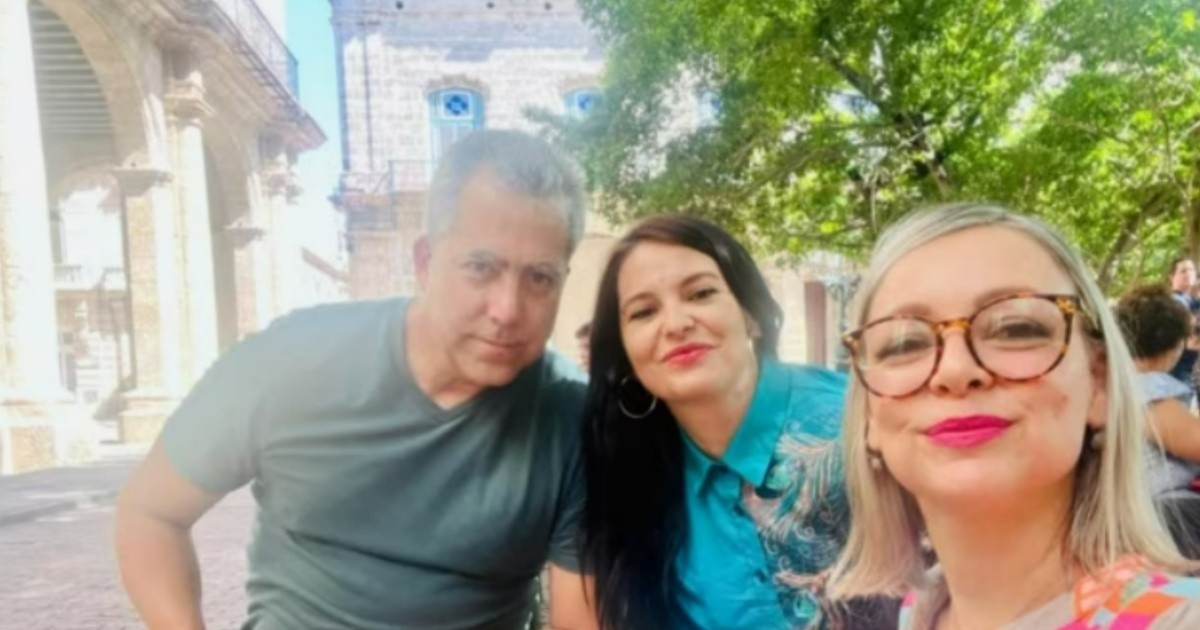
An investigation by Martí Noticias and Mario J. Pentón, based on classified information obtained from Cuba, identifies Senén Casas Más as a key player in the inner circle of Alejandro Castro Espín, son of Raúl Castro and former head of the National Defense and Security Council, with access to diplomatic passports from the Ministry of the Interior and a history of dozens of secret missions abroad.
The researcher Luis Domínguez from the Foundation for Human Rights in Cuba, who also had access to the classified documentation, detailed the extent of the activities of Casas Más: "Supported by diplomatic passports from the Ministry of the Interior, Casas Más has carried out more than 40 missions in other countries, directly accompanying Alejandro Castro Espín to strategic destinations such as Russia, China, Panama, and France."
Despite its virtually nonexistent public presence, Casas Más's level of access to the core of Cuban power is not accidental: its lineage places it at the historical heart of the military elite.
He is the son of the late Division General Senén Casas Regueiro, a fighter of the II Eastern Front Frank País, former Chief of the General Staff of the Revolutionary Armed Forces (FAR), and Minister of Transport until his death in 1996.
His uncle, Army Corps General Julio Casas Regueiro, succeeded Raúl Castro as Minister of the FAR in 2008 and is regarded as the principal architect of GAESA, the opaque economic-military conglomerate that controls the main financial assets of the Armed Forces.
According to Domínguez, the operational network of Casas Más is not limited to its association with Castro Espín: "Not only has it been linked to the powerful Alejandro Castro Espín. It also includes other high-ranking officials from counterintelligence and the institutional image of the regime, such as Major Alaim Peña Santiesteban or Juan Francisco Arias Fernández, former deputy advisor to the National Defense and Security Commission."
Colonel Juan Francisco Arias Fernández, military strategist and cybersecurity analyst, is said to have accompanied Casas Más on nearly 30 official missions abroad, according to sources from the investigation.
The most recent and revealing element of the case is the marriage of Casas Más to the Spanish activist Ana Hurtado Martínez, a well-known public defender of the Cuban regime and collaborator with state-run media.
Hurtado publicly announced the wedding in April 2025 without initially revealing her husband's identity, although the mysterious marriage had already raised questions about her connections to the power structure in Havana.
The investigation reveals that her presence on the island is not that of a mere foreign sympathizer: "Ana Hurtado has not only formally initiated the process to establish her permanent residence in Cuba, but she has also maintained long continuous stays of several months in properties located in exclusive residential areas of the capital, primarily in the municipalities of Plaza de la Revolución and Playa," Domínguez specified.
Hurtado has frequently traveled to Mexico and Venezuela, using official and military aviation routes that connect Caracas with Havana, and maintains ties with pro-Castro networks in Spain.
In October 2024, Spanish justice sentenced her to pay 10,000 euros to the Cuban doctor Lucio Enríquez Nodarse for defamation, and a year earlier, the Spanish judicial authorities had attempted to locate her unsuccessfully to notify her of a complaint, as she was residing in Cuba.
Alejandro Castro Espín, the central figure of this network, was included in June 2026 on the sanctions list of the Office of Foreign Assets Control (OFAC) of the U.S. Department of the Treasury, alongside Díaz-Canel and other figures of the Cuban power structure, due to his political influence and his connection to the regime's intelligence apparatus.
"Both Senén Casas and the others who accompany him on these missions abroad accumulate hundreds of flights that, in addition to ticket expenses, include accommodation and per diems. Who pays for all of this? The Cuban people. The life of this leadership, disconnected from the reality of Cuba, is the best example of how they despise those they govern," concludes Domínguez.
Related videos:
Filed under: