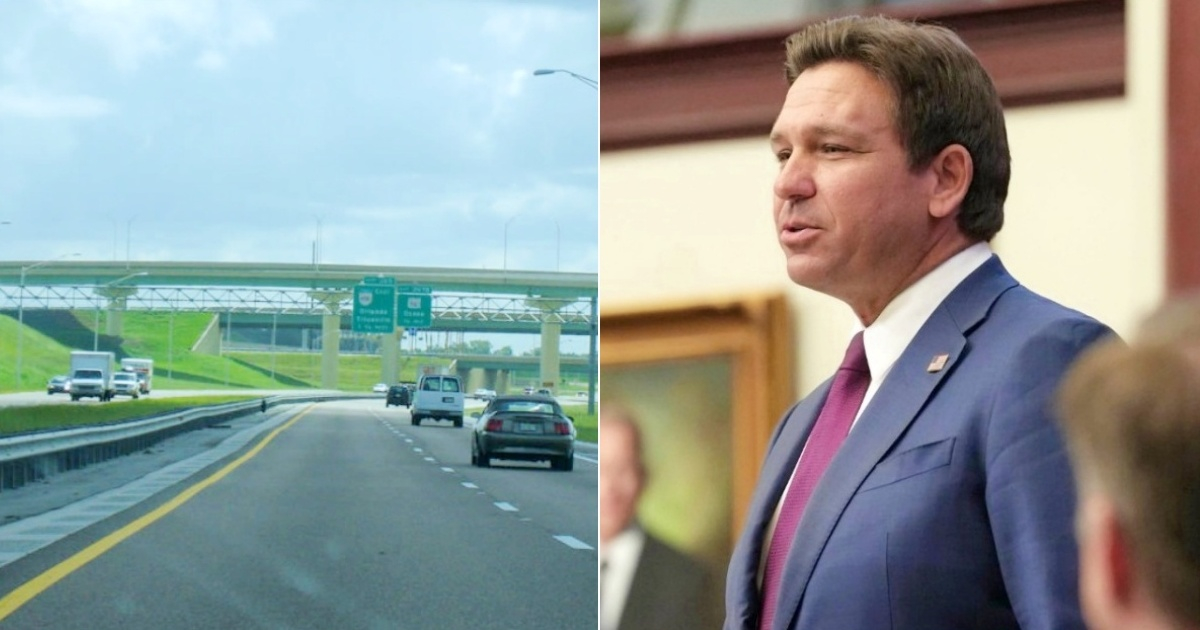
Governor Ron DeSantis reiterated this week the possibility of eliminating tolls on the Florida Turnpike for state residents, this time amidst a investment program exceeding $20 billion aimed at expanding the 320 miles of the highway to six lanes or more throughout its entire length.
The statement, made during a press conference in Orlando, combines a concrete and ongoing infrastructure project with an idea for which the governor did not present a funding mechanism or a timeline.
How much could you save if tolls were eliminated?
For the Cubans in South Florida who use the Turnpike daily—in Homestead, Kendall, Doral, Hialeah, or Miramar—this proposal has a potential direct impact on their wallets.
A driver traveling between Homestead and Kendall pays approximately $0.58 per trip with SunPass at the Kendall Drive toll, and up to $1.16 at the Homestead plaza, which can total between $29 and $58 per month —between $348 and $696 per year— just for that stretch.
Those who pay by plate without SunPass face even higher fees, such as $0.86 compared to $0.58 on Kendall Drive.
A promise without a plan or timeline
“I would love to be able to eliminate the tolls on the Turnpike. I know many people would appreciate it. I would continue charging tourists, but not Florida residents,” said DeSantis.
The governor immediately acknowledged that there is no mechanism to achieve it: "We'll see... maybe it's something for another day."
He did not present a formal proposal, schedule, or source of alternative financing.
DeSantis will complete his term in January 2027 — Florida's Constitution prevents him from a third consecutive term — which leaves a very limited timeframe for such an initiative to progress during his administration.
The proposal is not new either: in December 2025, during the last state cabinet meeting in Tallahassee, DeSantis had already put forth this same idea without providing technical details or legislative support.
The financial obstacle is enormous
Eliminating tolls for residents is not just a political challenge: it is a structural problem.
The Turnpike generated approximately $1.29 billion in toll revenue in fiscal year 2024, which serves as the backing for a bond debt of between $3.9 billion and $4 billion.
The contracts for these bonds require that revenues cover at least 120% of the annual debt service, which would necessitate finding an alternative source of income capable of covering the system's financial obligations if the tolls for residents were eliminated.
What is indeed real: 20 billion to expand the highway
While the proposal for tolls remains unresolved, the investment in infrastructure is concrete and underway.
The expansion program —currently at 55% completion— will transform the entire main road into a six-lane highway or more, adding over 965 lane-miles of additional capacity.
In Miami-Dade, progress is visible: the stretch between the Dolphin Expressway (SR-836) and NW 106th Street was completed in February 2024, and the next segment — from NW 106th Street to I-75 — recently opened to traffic in 2026.
Two projects in the system started approximately 14 months earlier than anticipated.
Concrete improvements for truck drivers and travelers
The announcement also included measures with set dates and a defined budget.
The state will allocate 8.5 million dollars to renovate 19 restaurants and shops in six service areas, with 16 of them set to reopen before the end of the year, featuring new options such as Zaxby's and Jimmy John's in the Turkey Lake area.
For truckers moving goods throughout the state, an investment of $53.8 million was announced to add approximately 150 parking spaces in the Turkey Lake and Canoe Creek/Ocoee areas, part of a total of 250 new spaces across the system.
The secretary of FDOT, Jared W. Perdue, summarized the objective: "Transportation directly impacts the quality of life for Floridians, connecting people to jobs, opportunities, and the communities they call home."
The Turnpike drivers logged approximately 9,500 million miles on the main stretch over the past year, a figure that illustrates why the expansion is urgent — and why any changes to the toll structure would have enormous financial consequences.
Related videos:
Filed under: