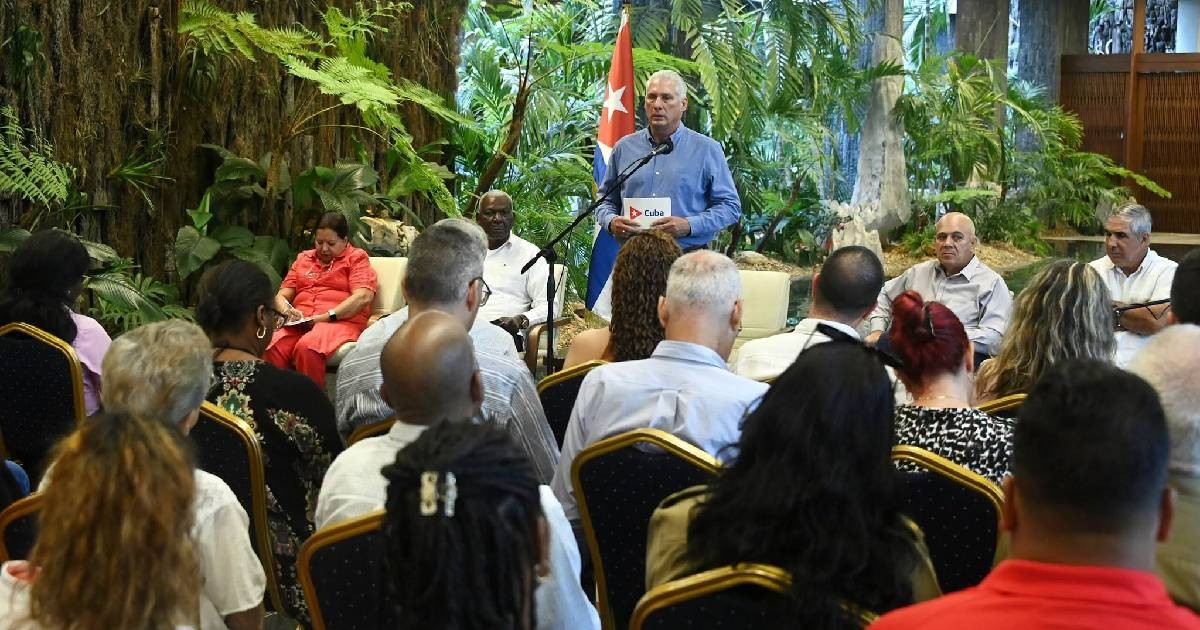
While millions of Cubans are unable to cover a basic basket of goods and the island's economy is contracting rapidly, the island's president Miguel Díaz-Canel held a meeting on Thursday with community leaders and representatives from organizations and institutions to defend what the regime refers to as the social dimension of its economic reforms, as reported by the official website of the Cuban Presidency.
The leader summarized the message of the event on his Facebook account: "We continue working for a better society," following what he described as an "emotional exchange" in which, according to him, the decision to preserve social justice amid the transformations taking place in the country was "defended."
The meeting, moderated by the Minister of Labor and Social Security, Jesús Otamendi Campos, brought together nearly twenty participants linked to the thematic areas of the so-called 176 Economic and Social Transformations, approved by the National Assembly in June 2026.
Also present were figures from the Political Bureau such as Esteban Lazo Hernández, President of the National Assembly; Roberto Morales Ojeda, Secretary of Organization of the Central Committee; and Teresa Amarelle Boue, General Secretary of the Federation of Cuban Women, in addition to Vice Prime Minister Eduardo Martínez Díaz.
Díaz-Canel emphasized that social justice is the element that distinguishes the reform package from capitalism: "For us, economic growth makes no sense if it does not have an impact on social development; for us, generating economic wealth is meaningless if it does not support social programs and, above all, the wealth we create must be distributed with a concept of social justice."
The Head of State also stated that Cuba offers "more opportunities for the social" and advocates "greater inclusion, equity, and possibilities for all," contrasting this with the "shock policies" that, according to him, are applied by those who "attack" and "block" the island, referring to the U.S. embargo.
Among the experiences shared were the work of community leaders in Ampliación de Almendares with retirees and vulnerable individuals, sports programs in the Playa municipality catering to youth with addictions, and the efforts of the small and medium-sized enterprise Hidrox S.U.R.L. from Cerro, which since 2022 has supported health and education facilities by offering services at no extra charge, financed through the expansion of its car wash business.
The official discourse on social justice, however, clashes with an economic reality that the government itself acknowledges as uncertain. At the end of September, Prime Minister Manuel Marrero Cruz reported that the regime had implemented 89% of its reforms, but he admitted that it is still necessary to verify their real effects on production, income, prices, and employment.
The CEPAL projects a decline in Cuba's GDP of 10.3% in 2026, the worst in Latin America, while year-on-year inflation reached 25.19% in August and the peso experienced a depreciation of 39.1% in the first half of the year.
An independent study cited by France 24 estimated that 6.45 million Cubans —66% of the population— cannot afford a basic basket of goods, a figure that contrasts with the official narrative of inclusion and equity that Díaz-Canel repeated this Thursday in front of the attendees of the meeting.
In September, the government admitted that it does not know for sure if the economic changes will work, a confession that highlights the fragility of the model that Díaz-Canel presents as a guarantor of social justice.
Related videos:
Filed under: