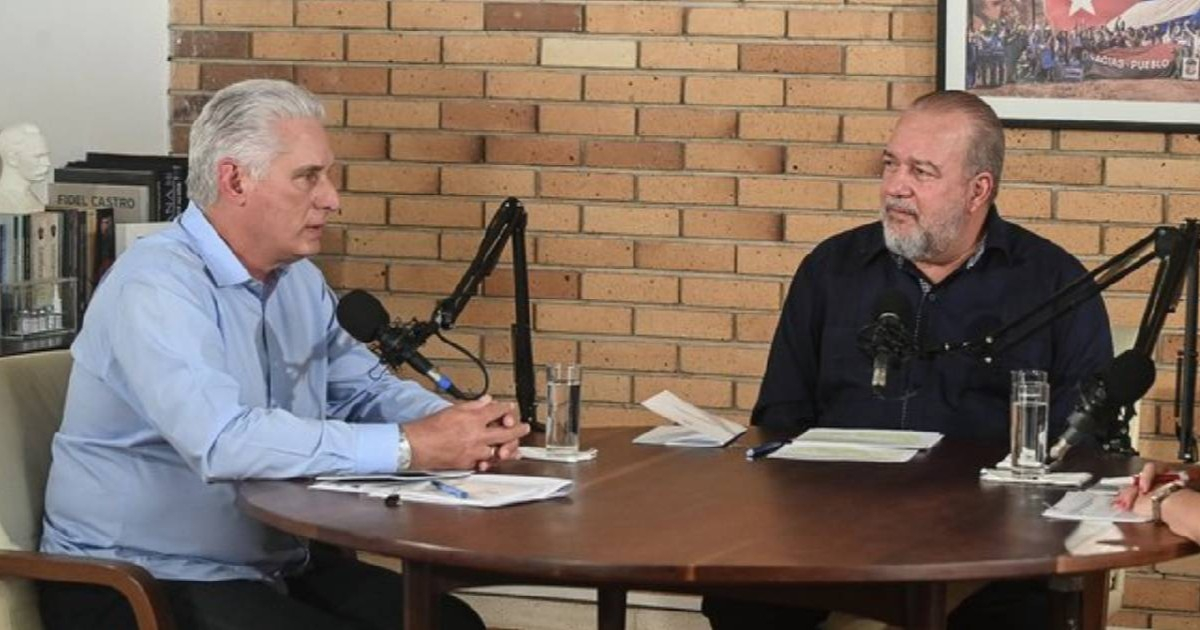
The Cuban Prime Minister, Manuel Marrero Cruz, stated this Friday that the regime has "the open path to progress" in its economic reforms, although he acknowledged that the results are not yet reflected in the quality of life of the Cubans.
In an episode of the official podcast "Desde la Presidencia" hosted by Miguel Díaz-Canel and recorded after the most recent Council of Ministers, the state of the 176 Economic and Social Transformations approved by the National Assembly in June 2026 was analyzed.
Marrero Cruz provided the most concrete overview of the program: in the three months since the approval of the measures, the government focused on designing "the How," that is, the implementation mechanisms.
According to the head of government, during that period, 160 implementation proposals were developed and 197 legal norms of support were approved, including four laws, 29 decree-laws, and 26 decrees from the Council of Ministers.
"160 implementation proposals have been meticulously designed, and to legally support this, 197 legal norms have been developed and approved," affirmed the prime minister.
In that same quarter, the regime approved more than 3,600 new Mipymes, bringing the total to 16,100 nationwide, along with 448 Non-State Cooperatives and over 385,000 Self-Employed Workers.
Despite the optimistic tone, Marrero acknowledged that the progress has not yet translated into tangible improvements for the population: "We already have the path open for advancement; and in fact, we are making progress and results are already noticeable, although this has not yet been reflected in an improvement in the quality of life for the population; but we are gradually moving forward in this process."
The prime minister predicted that the effects of the reform package will be noticeable in 2027, and he rejected the idea that these changes represent a "shift towards capitalism," calling them a "completely sovereign decision" that does not respond to external pressures.
Díaz-Canel, for his part, framed the transformations as a response to what he described as a "Fourth Generation War": "A multidimensional war is being waged, a war that is economic, ideological, cultural, and also communicational," he stated, adding that "we are in a moment of urgency, under conditions of war against Cuba."
The official narrative contrasts sharply with a reality of extreme economic severity. The CEPAL projects a decline of 10.3% in Cuba's GDP in 2026, the worst in Latin America, while economists from the University of Havana anticipate another recession following a decline of nearly 5% in 2025.
The year-on-year inflation reached 25.19% in August 2026, with food experiencing an annual increase of 36.01%, according to official data.
At the end of September, the regime already reported having implemented 89% of the package —158 out of 176 measures— although independent analysts have questioned whether these advancements on paper translate into real changes for the Cuban people.
Díaz-Canel closed the episode with a phrase that summarizes the regime's stance regarding internal and external doubts: "The challenge is great, but we will not back down."
Related videos:
Filed under: