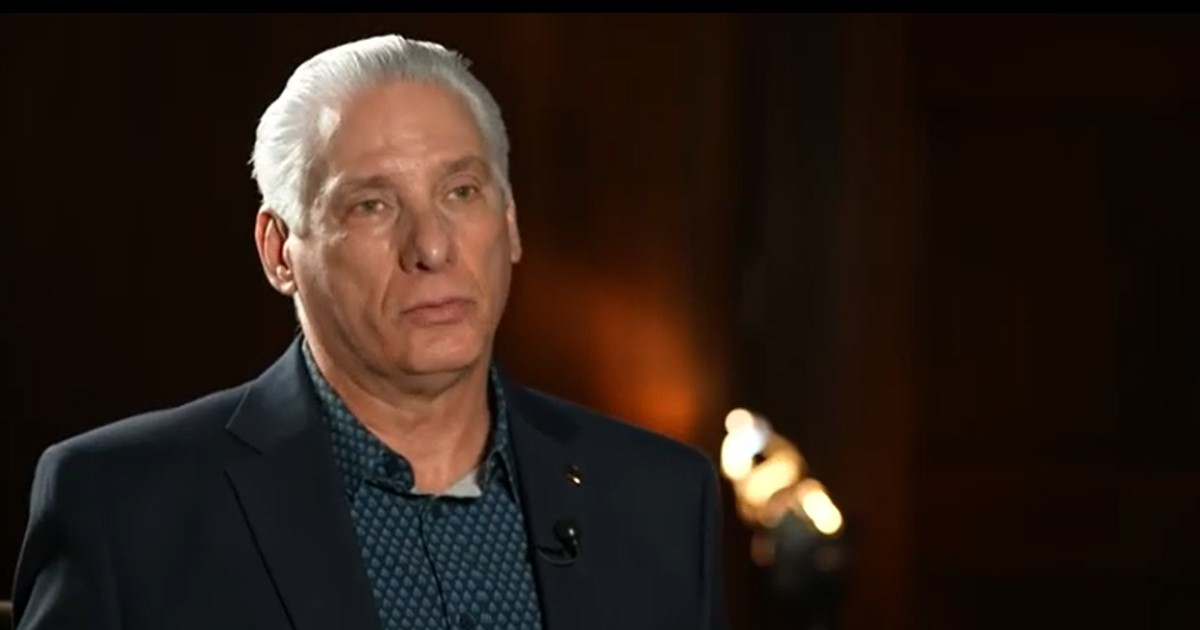
«How can we trust those who have brought us here?» A Cuban's question on social media summarized the skepticism with which the return of the official podcast "Desde la Presidencia" was received this Friday, relaunched after more than 15 months of hiatus, with Miguel Díaz-Canel and Prime Minister Manuel Marrero Cruz once again in front of the cameras to discuss the country's situation.
The comment appeared as a citizen reaction to the announcement of the program, whose second season began with an episode dedicated to the progress of the 176 economic and social transformations promoted by the Cuban Government.
Alongside Díaz-Canel and Marrero was the Minister of Justice, Rosabel Gamón Verde. The program was broadcast at 10:00 a.m. on the YouTube channel of Presidencia Cuba and later disseminated through state media such as Cubavisión, Radio Rebelde, Radio Habana Cuba, Cubadebate, and Mesa Redonda.
During the conversation, Marrero asserted that the effects of the measures will start to be felt next year and expressed the government's conviction that by 2027 the population will be able to appreciate their results.
The promise comes amid a deep economic crisis and a significant decline in trust in the authorities.
A national survey published in April 2026 revealed that Díaz-Canel received an average score of 1.11 out of 5, with 93.7% of respondents marking the lowest score.
Overall trust in the government was rated at 1.09 out of 5, and 94% expressed "no confidence at all." Marrero Cruz fared no better: his average was 1.13.
The regime itself acknowledged in internal opinion studies that part of the population feels that the benefits of the transformations only reach those who have money, which fosters resentment towards the growing inequalities.
The reform package, grouped into 23 thematic areas, includes measures such as private banking, private exchange houses, opening up to foreign investment in the non-state sector, and the removal of the 100-worker cap for small and medium-sized enterprises (mipymes). As of September 2026, Cuba had more than 16,100 mipymes, 448 non-state cooperatives, and over 385,000 self-employed workers.
The economist Elías Amor was more straightforward in his assessment of the set of measures: “a complete deception”, arguing that they do not constitute a real liberalization but rather a shift in control within the same state apparatus.
The return of the podcast occurs just nine days after Díaz-Canel launched another communication format: the radio program "Criterio Compartido" on Radio Rebelde, whose first broadcast was dominated by calls from citizens regarding insufficient salaries, low pensions, and lack of fuel.
Related videos:
Filed under: