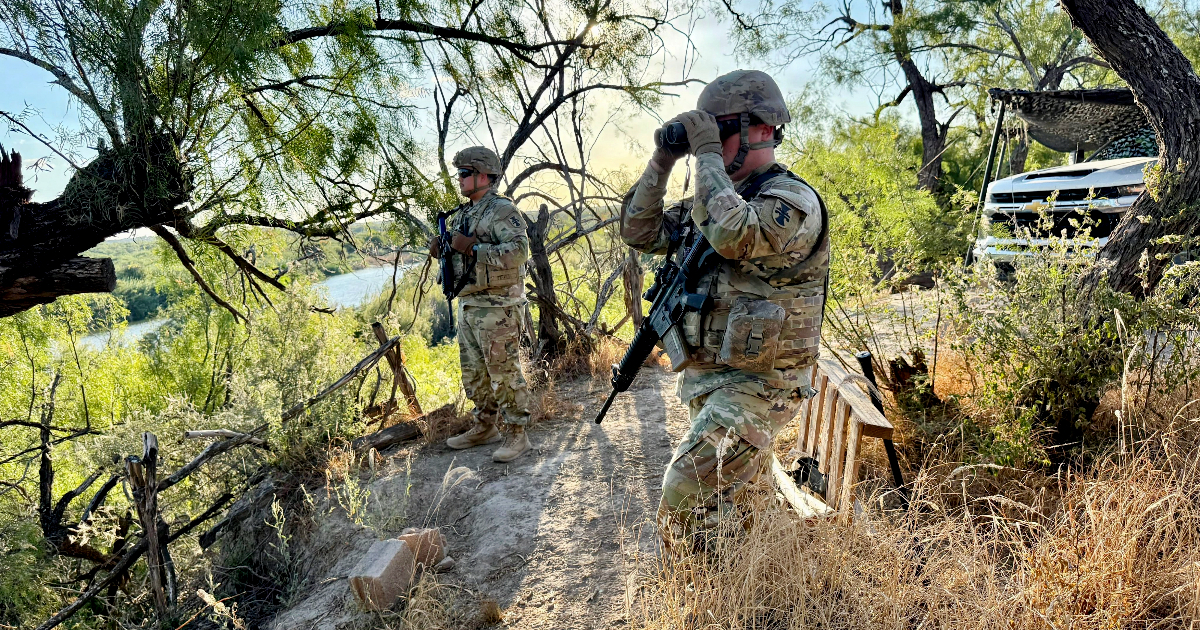
The United States Northern Command announced this Friday the deployment of approximately 500 soldiers to the Rio Grande Valley in Texas, as a direct response to a shooting against Coast Guard personnel that occurred the previous week, according to an official Army statement confirmed.
The incident that triggered the military response took place on September 26 near Garceno, in Starr County, when Coast Guard personnel received gunfire from the Mexican side of the Rio Grande while conducting joint interdiction operations.
Authorities responded to the fire on the same day, and no injuries or damage to equipment on the U.S. side were reported, according to a Coast Guard spokesperson.
The case remains under investigation, although media outlets such as The Texan attribute the attack to suspected members of drug trafficking cartels, a claim that neither the Department of Homeland Security nor the Coast Guard have formally confirmed.
The deployment is part of the Unified Resolve Operation, launched on October 2 under the umbrella of the Ardent Vanguard Operation, the broader military effort that the Joint Task Force - Southern Border (JTF-SB) has carried out since March 2025.
Northern Command described the mission as "an ongoing effort to rapidly reinforce U.S. forces and federal partners operating in the area," with the goal of expanding patrol capabilities, enhancing monitoring and detection, and strengthening security at critical points along the Rio Grande.
The official statement from JTF-SB, issued from Fort Bliss, Texas, mentions "hundreds" of repositioned personnel, while NewsNation specified the number as "approximately 500" military troops.
This episode represents a significant escalation at the border: it is one of the first documented incidents in which alleged cartels have directly fired upon U.S. military or Coast Guard personnel along the Rio Grande.
The political context exacerbates the tension. On September 22, President Donald Trump referred to Mexico as the “epicenter” of cartel violence during the UN General Assembly and warned that Washington would use its military power if it deemed its interests in Latin America to be threatened.
Since the beginning of his second term, Trump has repeatedly threatened to launch ground operations against the cartels on Mexican territory, although to date no such deployment has taken place.
The Mexican government has categorically rejected any foreign military intervention on its soil; however, in September 2026, it authorized the entry of U.S. military personnel for joint training, reflecting a limited cooperation.
The JTF-SB currently has over 10,000 personnel deployed along the nearly 3,145 kilometers of the southern border, in support of the Department of Homeland Security and the Customs and Border Protection Office.
Weeks before the shooting, the U.S. Army had already neutralized three drones linked to cartels using a high-energy laser system at the border, indicating that criminal groups have intensified their use of technology to monitor military personnel and border agents.
The shooting against the Coast Guard and the subsequent deployment of 500 soldiers increase the pressure on Mexico at a time when the Trump administration is assessing how far its military response can go without crossing the line of intervening in a foreign sovereign territory.
El refuerzo militar en la frontera sur forma parte de un panorama migratorio en constante cambio. Sigue todas las novedades sobre la para estar al tanto de lo que ocurre en la frontera y sus implicaciones.
Related videos:
Filed under: