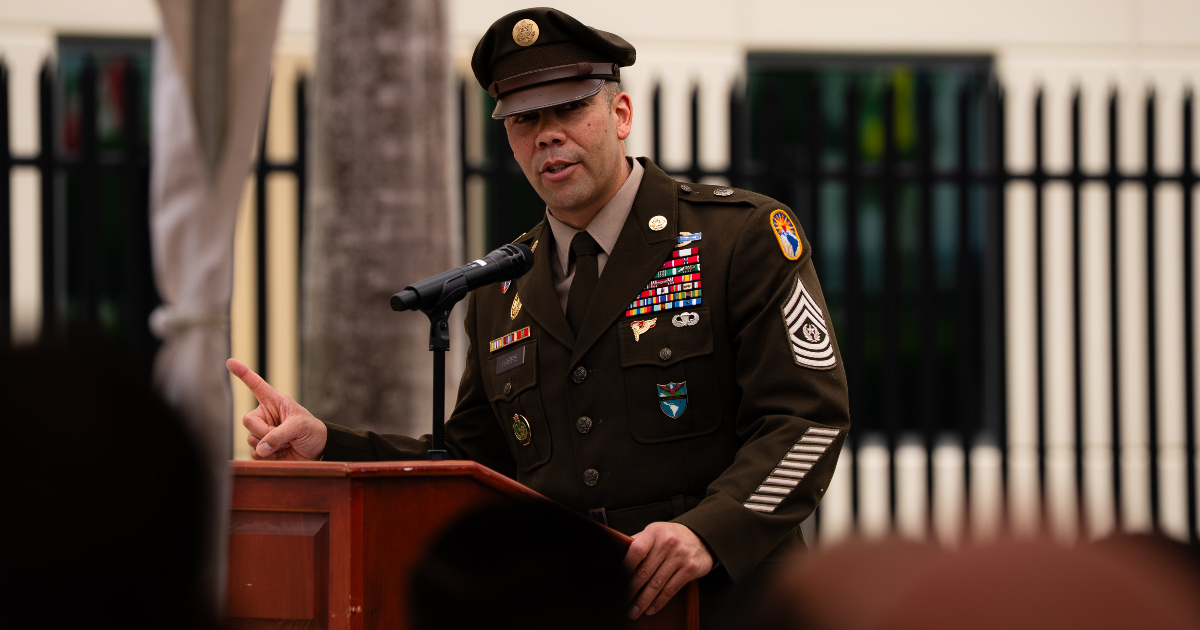
The United States Southern Command (SOUTHCOM) made an internal change this week that takes on special significance given the timing of its occurrence.
The Command Sergeant Major of the Army, Raymond S. Harris, took over as the new senior enlisted leader of SOUTHCOM on September 30 — in English, Command Senior Enlisted Leader (CSEL) — a position equivalent to the highest representative of the troops within the military command responsible for Latin America and the Caribbean.
Harris does not replace General Francis L. Donovan, commander of SOUTHCOM, nor does he directly lead military operations. His role is to advise the commander on matters related to the enlisted force and to communicate his priorities to all ranks, especially regarding readiness, discipline, morale, welfare, and internal execution.
In practice, it helps convert the commander’s strategic intent into concrete guidance for the troops.
The change occurred to replace the Chief Warrant Officer of Marines Rafael Rodríguez, who is retiring after 35 years of service, as reported by SOUTHCOM on its social media.
The arrival of Harris coincides with the leaks from CBS News regarding consultations by the U.S. Army Reserve to determine whether it could provide various support units to Southern Command within a timeframe of 90 to 120 days. The document reviewed by the network does not mention Cuba, but several anonymous U.S. officials linked this planning to scenarios related to the island.
According to that information, the evaluated capabilities include a combat support sustainment battalion, an engineer battalion, an expeditionary sustainment command, a medical brigade, an advanced surgical unit, and a military police brigade.
It is not just a force designed solely for direct combat, but rather structures necessary to support complex operations: logistics, security, transportation, medical care, supplies, infrastructure, area control, and support for deployed forces.
A profile of the Army for a coordination phase
The arrival of Harris does not prove that there is a determined operation against Cuba, nor that his appointment is directly related to the consultations revealed by CBS News. However, the change aligns with a moment when SOUTHCOM seems to be reviewing support capabilities in land, medical, logistical, and security aspects for potential regional contingencies.
The new CSEL comes from the Army, the same branch whose Reserve would be evaluating units to support Southern Command. This information does not establish a causal relationship, but it does reinforce the understanding that the command needs profiles capable of coordinating diverse forces and conveying operational priorities to the troops during a time of increased pressure in the Caribbean.
In practical terms, a leader of that level does not decide on an intervention, but can be key to aligning preparation, discipline, availability, and internal execution in scenarios that require coordination between various military branches and support units.
Planning without a deployment order
The information from CBS News also sets an important limit: there is no public confirmation of deployment orders. No figures regarding personnel, specific destinations, or an ongoing operation are known either.
A spokesperson for SOUTHCOM declined to comment on potential movements or timelines for operational security reasons, although he indicated that the command continuously assesses requirements within its area of responsibility and coordinates with the joint force to support assigned missions.
This places the case, at least publicly, in the realm of contingency planning. However, the nature of the mentioned units —engineers, logistics, medicine, advanced surgery, and military police— suggests preparation for broader scenarios than mere symbolic or routine presence.
Guantánamo and the Caribbean as a backdrop
The change in command occurs as Guantanamo Naval Base gains significance within the U.S. military strategy in the region.
This week, SOUTHCOM announced that the facility will host the first training and mission support site of the SOUTHCOM Autonomous Warfare Command (SAWC), following the deployment of unmanned systems overseen by General Donovan.
Guantánamo, leased to Cuba since 1903 and denounced by the Havana regime as an illegal occupation, has been described by Southcom itself as a "vital operational and logistical center" for U.S. operations in the hemisphere.
With the SAWC, the base now gains an additional dimension as a regional platform for drones, autonomous systems, and unmanned capabilities.
The context includes other recent movements. In April, the FLEX2026 exercise in Key West incorporated artificial intelligence, long-range drones, and unmanned maritime vehicles about 90 miles from Cuba.
In September, official photographs from the United States Space Force showed Cuba and the Caribbean as visible scenery on screens used during the DASH experiment, focused on command and control with artificial intelligence.
The official information about DASH did not identify Cuba as a military target nor did it claim that an attack against the island was being simulated. What the images did document was the presence of Cuban territory in battle management applications with symbols, lines, identifiers, and operational areas during tests designed to speed up military decision-making.
A change that gains significance in the moment
Harris's appointment should not be interpreted as an automatic signal for military action against Cuba. Its significance lies in its alignment with other movements: consultations with the Army Reserve, increased activity from SOUTHCOM, an expansion of autonomous capabilities in Guantánamo, and growing attention from Washington towards the Caribbean.
Viewed in isolation, the leadership change may seem like an internal transition. Inserted in that sequence, it indicates a phase of preparation, coordination, and adjustment within the military command responsible for the region.
For the Cuban regime, the political message will continue to be the increase of U.S. pressure in the Caribbean.
For SOUTHCOM, the operational challenge seems more concrete: ensuring that its command structures, troops, logistics, medical support, and new technological capabilities are ready if Washington decides to activate any of the scenarios that currently remain in the planning stage.
Related videos:
Filed under: