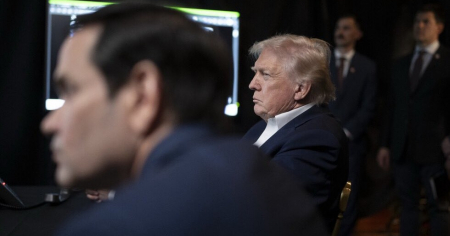
The President of the United States, Donald Trump, has issued a direct threat against the drug cartels in Mexico, asserting that his administration is prepared to launch ground attacks against these criminal organizations, which he blames for the rising addiction crisis and overdose deaths on American soil.
"We're going to start attacking on the ground when it comes to the cartels,” Trump declared this Thursday in an interview with Sean Hannity for the Fox News network.
“The cartels are running Mexico. It is very, very sad to see and realize what has happened in that country”, he added.
"We have eradicated 97% of the drug through water."
In his television conversation, Trump stated that the drug trafficking maritime routes have been almost completely blocked.
“We have eradicated 97% of the drugs that come in by sea. And now we are going to begin to attack the cartels on land,” he stated.
The president's statements come in a context of heightened regional tension. Just days earlier, Washington conducted a swift military operation in Caracas to capture the ousted Venezuelan president Nicolás Maduro, who is accused of "narcoterrorism," and transfer him to New York for trial. This action marked a significant milestone in Trump's international campaign against drug trafficking and has raised alarms about potential similar interventions in Mexican territory.
Although the president did not provide specific details about the scope or location of potential attacks, the tone of his statements suggests that incursions on Mexican soil could be imminent, raising diplomatic alarms.
“As for the cartels, they control Mexico”, he insisted; and added that “they kill between 250,000 and 300,000 people each year” in the U.S.; referring to the overdose victims, primarily due to opioids like fentanyl.
"Mexico needs to organize itself because drugs are being funneled from Mexico. And we will have to do something about it. We would love for Mexico to take action. They are capable of doing it, but unfortunately, the cartels are very strong," he emphasized.
"Drugs are terrible. It's devastating."
Trump, who has openly expressed his abstinence and condemnation of drug use, was visibly emotional when discussing the impact of the opioid crisis.
"Drugs are terrible. It’s devastating. Families often lose a child or a parent. That is to say, parents also die because of drugs. So, we have done a great job. We are reducing it. The numbers are becoming too high if there’s only one person, but they are decreasing, just like the border."
Although he did not specify which border, it is understood that he was referring to the southern border of the United States. At another point in the interview, he asserted that during his first term, "the border was a total disaster for years. The first time I did it very quickly, and this time I did it even better."
Mexico's Response: Sovereignty and Diplomacy
The Mexican president Claudia Sheinbaum has responded firmly to the warnings, dismissing any scenario of invasion.
“Mexico is a sovereign country,” he reiterated. His government has committed to a strategy of bilateral collaboration, promoting a "shared responsibility" and demanding that the United States also take action to curb the trafficking of arms into Mexican territory.
The Mexican Foreign Ministry issued a statement emphasizing “respect for international law, as well as the principles and purposes of the UN Charter,” while also stressing the need for peaceful and multilateral solutions.
Trump had already stated last Sunday that Sheinbaum "is concerned" and "is a little afraid about the cartels controlling Mexico," and that, although he respects her, intervention will be necessary if the country cannot independently stop the flow of drugs.
Venezuela as a precedent and the return of interventionism
Trump's announcement comes in the wake of the recent military operation in Venezuela.
In an unprecedented action since the Cold War, the United States deployed more than 14,000 troops and a fleet of warships in Caribbean waters as part of the so-called Operation Southern Lancer, which in recent months has bombed about thirty vessels allegedly linked to drug trafficking.
According to reports, more than 110 people died in those incursions, which were carried out without Congressional authorization. The capture of Maduro and his wife Cilia Flores, who were taken to New York, sends a strong message to other governments or regions considered complicit or tolerant of drug trafficking.
Unease at the border and a climate of regional tension
The president's statements have raised concern in several areas of northern Mexico, especially in Ciudad Juárez, where some sectors fear a direct military escalation from the United States, reminiscent of the Venezuelan intervention.
Although for now it is a rhetorical threat, additional military movements cannot be ruled out in the coming days.
The national security team of Trump has reiterated that the president “will not hesitate to use the nation’s military power” if he believes American security is threatened.
Conclusion: A New Era of Unilateral Interventions?
The hardening of rhetoric and recent actions by President Trump could mark a turning point in U.S. foreign policy, reviving interventionist doctrines under the guise of combating drug trafficking.
His promise to "attack on land" the cartels, his assertion that "Mexico is being run by organized crime," and the recent operation against Maduro paint a picture of increasing regional confrontation.
Awaiting new decisions, the international community, and especially Latin American governments, are watching with concern the direction that the foreign policy of the White House is taking.
Meanwhile, Trump remains true to his style: provocative, confrontational, and convinced that force is the best response to challenges.
Filed under: