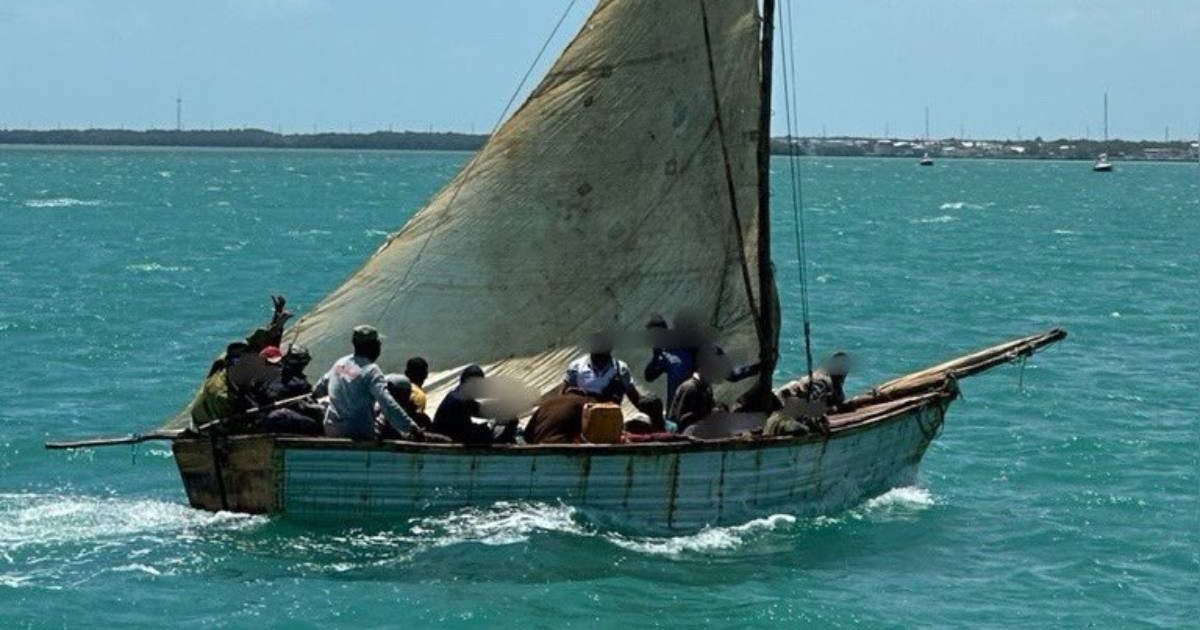
The U.S. Embassy in Cuba posted this Saturday on its official Facebook page a graphic aimed at deterring irregular migration with the message "Don’t risk your life, it’s not worth it," accompanied by an illustration of a small boat crossed out with a red X.
The call, which is part of an ongoing campaign against illegal crossings through the Florida Strait, sparked a flood of responses reflecting the desperation of thousands of Cubans: "Any risk is worth it," declared an internet user.
Dozens of forum members noted that they find themselves trapped between two impossibilities: they cannot emigrate illegally, but they also cannot do so through legal channels.
The contradiction was pointed out immediately. "You can't enter legally either," one of them wrote with striking brevity.
Others were more explicit: "We are not asking to enter illegally. We are asking to be able to meet legally. Our relatives began the correct process. They submitted requests. They gathered documents. They waited. They complied," one user denounced, summarizing the drama of families with family reunification processes stalled by the travel ban and the indefinite suspension of immigrant visas for Cubans, effective since January 21, 2026.
Several commentators reported having minor children approved by the Citizenship and Immigration Services (USCIS) who are unable to enter the United States due to the presidential proclamation under section 212(f).
"I have a minor child approved by USCIS, and he cannot enter due to that proclamation, which is unfair because children are not terrorists," wrote a mother.
The family preference categories F1, F2A, F2B, F3, and F4 were blocked following the restrictions imposed by the Trump administration, and the Cuban Family Reunification Program closed for new applications in December 2025. On September 29, 2026, Washington announced new restrictions that affected additional categories.
In response to the embassy's message, many Cubans replied that the real danger lies not in the sea but on the island. "Living in Cuba, that's what truly puts your life at risk; the sea feels small compared to all the dangers that you can't even speak of," wrote a user.
Another commentator was even more direct: "I would have preferred to die at sea than to live in a country where you cannot speak freely, where just thinking differently can land you in jail, and even for a single song against the government, you can be imprisoned."
The embassy's warning comes at a time when raft departures have not ceased despite the tightening of immigration policies. In August 2026, two young Cuban rafters died in the waters of Pinar del Río, and weeks later, a group of rafters was captured on video leaving a beach in that same province.
A commentator who illegally emigrated in 1979 at the age of 14 from Santa María del Mar and has spent 48 years in the United States offered a generational perspective: "It was worth it. Now it’s not worth it because they no longer let you enter the country, they no longer grant political asylum."
The most quoted response in the thread captured the collective sentiment: "This country is so tough that it’s worth risking your life adrift at sea, even knowing that getting there is difficult and if you do make it, you could be sent back. Still, the Cuban tries, because freedom has no price."
"If the blockade tightens, more Cubans will cross. It's too late for that warning," concluded another commentator.
Between 2021 and 2026, more than 1.79 million Cubans left the island in what is described as the largest exodus in its history, driven by the economic crisis, widespread blackouts, food shortages, and the political repression of the dictatorship.
Related videos:
Filed under: