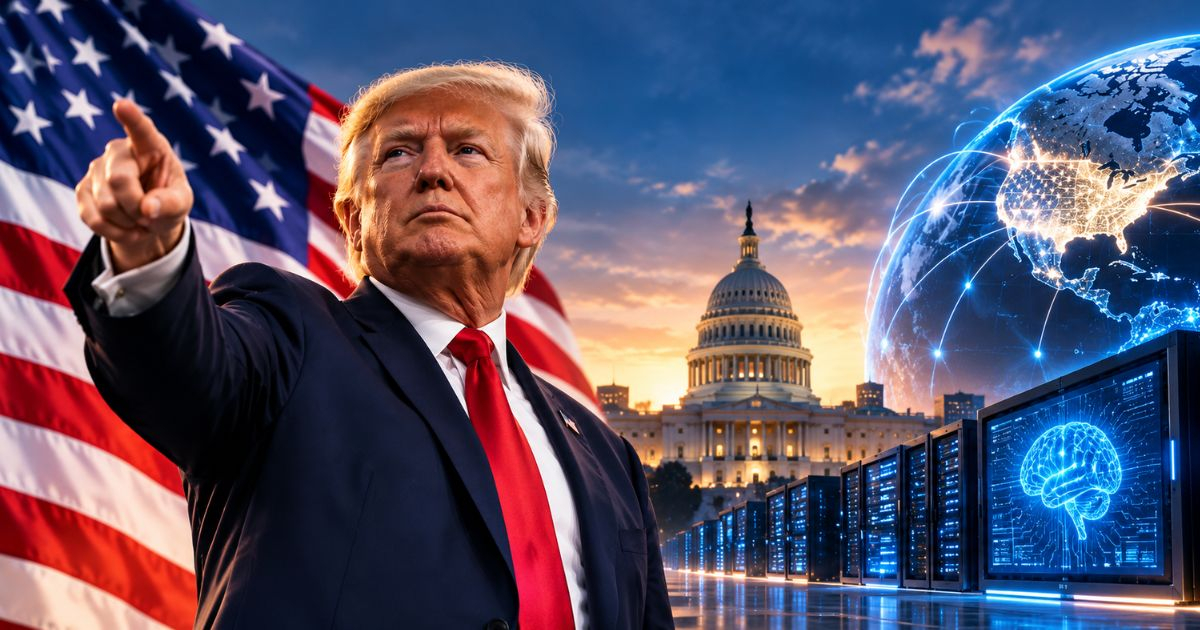
The president of the United States, Donald Trump, announced the creation of a new «Superintelligence Force» aimed at coordinating the federal government's efforts to maintain American leadership in the development of advanced artificial intelligence.
Trump announced the initiative this Sunday through his profile on Truth Social, where he presented the new framework as a continuation of the recent agreement signed at the White House with some of the largest technology companies in the world.
"I am announcing the formation of the Superintelligence Force," wrote the president, who noted that the group will be tasked with coordinating the federal government to ensure that the United States continues to lead the development of this technology.
Trump also stated that the so-called superintelligence could lead to a transformation of historic dimensions. As he expressed, "many say" that it will be bigger than the Industrial Revolution and the Internet.
The new force will have to coordinate the government's relationship with consumers, public interest organizations, religious groups, providers of critical infrastructure, and companies dedicated to the development of advanced artificial intelligence.
Trump indicated that the group will be led by the Director of National Intelligence, Jay Clayton; the Chairman of the Federal Trade Commission, Andrew Ferguson; the Under Secretary of War for Research and Engineering and Director of Technology, Emil Michael; and the Director of the Office of Personnel Management, Scott Kupor.
The Superintelligence Force will report directly to the president and to the White House Chief of Staff, Susie Wiles, according to the announcement.
The announcement comes after the signing of the White House Accord on Superintelligence, signed on September 29 by Trump and representatives from Google, Anthropic, Meta, OpenAI, xAI, and Nvidia.
The document establishes a voluntary commitment to strengthen the security and oversight of the most advanced artificial intelligence models.
The agreement outlines four levels of control: internal mechanisms to monitor the capabilities and risks of the models; an independent internal team responsible for ensuring that these controls are effective; evaluations conducted by external auditors; and oversight by an independent committee of the board of directors of each company.
The commitments include specific monitoring of risks related to cybersecurity, biosecurity, and chemical threats, as well as mechanisms designed to prevent models from accessing or interfering with technological systems in an unauthorized manner.
The pact is, for now, voluntary and primarily based on self-regulation by companies. The document itself acknowledges that, over time, some of these measures could become laws or federal regulations.
The Trump administration has also officially begun to use the term “superintelligence” to refer to technologies that until now were encompassed under the designation of artificial intelligence, although in the technological field, the concept is typically reserved for hypothetical systems capable of far surpassing human intellectual capabilities.
According to information published by The Wall Street Journal, the new Superintelligence Task Force will also have approximately 120 days to assess the risks and opportunities associated with these technologies and to make recommendations on the role that the federal government should assume.
Among the issues that the group will need to examine are the implications for national security, the protection of critical infrastructure, potential effects on employment and consumers, as well as the relationship between the government and major technology companies.
The creation of the new force is part of a series of recent decisions by the White House to reorganize its policy on artificial intelligence.
On September 29, Trump signed an executive order for the federal government to officially use the terms "superintelligence" and "SI" instead of "artificial intelligence" and "AI" in the communications covered by the measure.
The order, titled "Inaugurating the Era of Superintelligence," states that the capabilities of the most advanced systems have surpassed the original conception of artificial intelligence and also sets a deadline of 60 days to present a legislative proposal that establishes a federal definition of "superintelligence."
On that same day, Trump gathered executives from some of the leading tech companies at the White House and announced a voluntary self-regulation agreement that he described as "morally binding."
Among the participants were representatives from Anthropic, Google, Meta, OpenAI, Nvidia, and xAI.
The agreement outlines four layers of oversight for the most advanced models: internal controls, independent teams within the companies themselves, external audits, and supervision from the boards of directors.
Although Trump compared it to a sort of "constitution," the agreement is not legally binding.
Days earlier, Trump had indicated that his administration did not intend to hinder the development of these technologies and announced the creation of a federal framework dedicated to coordinating policy on artificial intelligence.
Related videos:
Filed under: