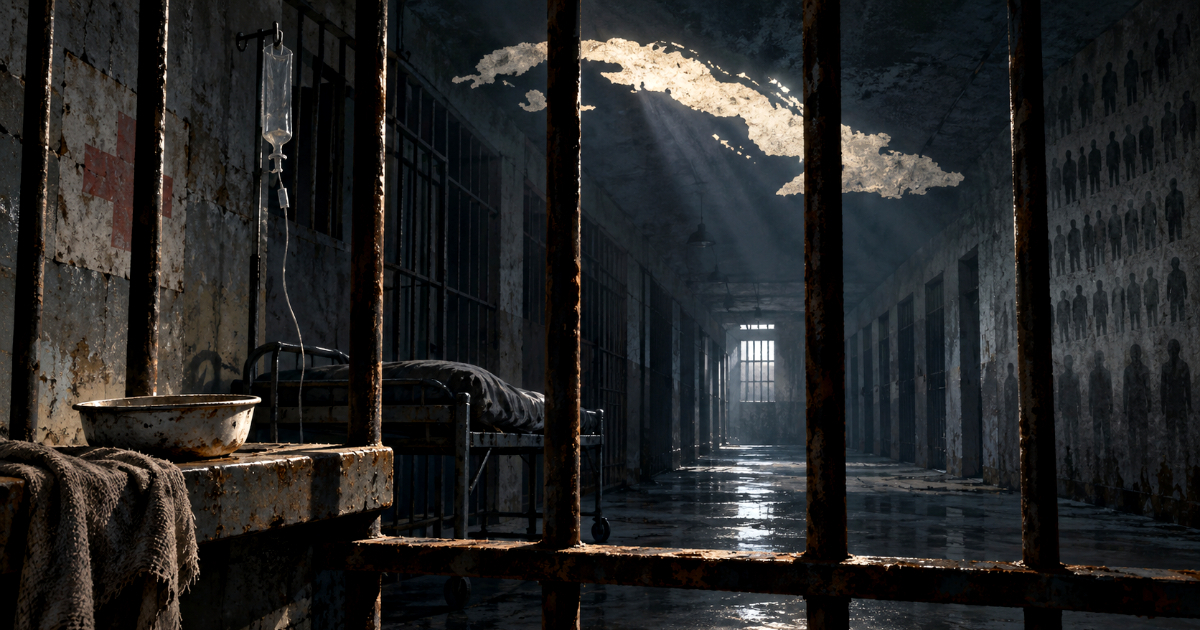
The Cuban human rights organization Cubalex recorded 115 deaths in state custody in penitentiary facilities in Cuba between February 2024 and June 2026, according to a special report published in September that updates and expands on a previous report by the organization.
No month during the analyzed period was free of deaths, with an average of four deaths per month and a peak of 10 cases in February 2026.
Negligence or denial of medical care is the predominant mechanism, identified in at least 80 out of 115 cases —approximately 70% of the total—. Within that framework, at least 21 people died from severe malnutrition or starvation and another 12 passed away due to tuberculosis.
The Boniato prison, located in Santiago de Cuba, has the highest number of deaths with 23 cases. The report indicates that this penitentiary has specific detachments for inmates classified as "malnourished" or "underweight," which Cubalex describes as "an institutional acknowledgment of the magnitude of the problem and its foreseeable nature."
Geographically, Santiago de Cuba accounts for 29 deaths (25.2% of the total), Havana has 21 (18.3%), and Mayabeque has 16 (13.9%). The Combinado del Este and the Combinado de Guantánamo each record 11 fatalities, while the Quivicán prison adds eight.
The document also reports on 12 cases of lethal direct action: nine classified as extrajudicial executions —beatings resulting in death attributed to prison guards— and three deaths of particular suspicion where the official accounts of suicide coexist with evidence of state violence.
In one such case, which occurred in the Canaleta prison (Ciego de Ávila), "a 20-year-old inmate who had staged a hunger protest was beaten and taken to a punishment cell, after which the authorities reported that he had hanged himself; inmates who documented the incident claim that he may have been strangled by the authorities themselves."
Among the deceased are nine political prisoners or members of independent civil society, several connected to the protests of July 11, 2021.
The report mentions Manuel de Jesús Guillén Esplugas, from UNPACU and Cuba Decide, who was beaten by guards at Combinado del Este after being recaptured following an escape and whose death was officially reported as suicide; Ernesto Brieva Sempé, who died from severe malnutrition and kidney complications in the same prison; and Yan Carlos González González, who died during a hunger strike he was holding in protest of his sentence.
Cubalex also identifies a pattern of "outsourcing death": seven inmates were granted extrapenal licenses when their condition was already irreversible and died hours or days after formally being released from prison.
According to the organization, this practice "artificially lowers penitentiary mortality statistics, dilutes the traceability of state responsibility, and shifts caregiving burdens onto families, at the end stage, that the state neglected throughout the entire incarceration."
Afro-descendant individuals make up 27% of the analyzed population—31 out of 115 cases—and 67.7% of them died due to structural omission. All three women who passed away during the period are Afro-descendant.
The Cuban regime does not publish official statistics on prison mortality, does not allow independent inspections, and has not ratified the Optional Protocol to the Convention Against Torture. In September, while Cubalex was preparing its report, the regime was publicly celebrating its prisons as a "just work".
The first report by Cubalex on deaths in custody, published in July 2024, documented 56 deaths between January 2022 and January 2024, including inmates in prisons, detainees in police stations, and recruits from the Military Service.
The new document doubles that figure in a shorter timeframe and is exclusively focused on the prison system. It is accompanied by a technical proposal presented to the UN Special Rapporteur on torture, which demands unrestricted international oversight and the prohibition of denying prison benefits for political reasons.
Related videos:
Filed under: