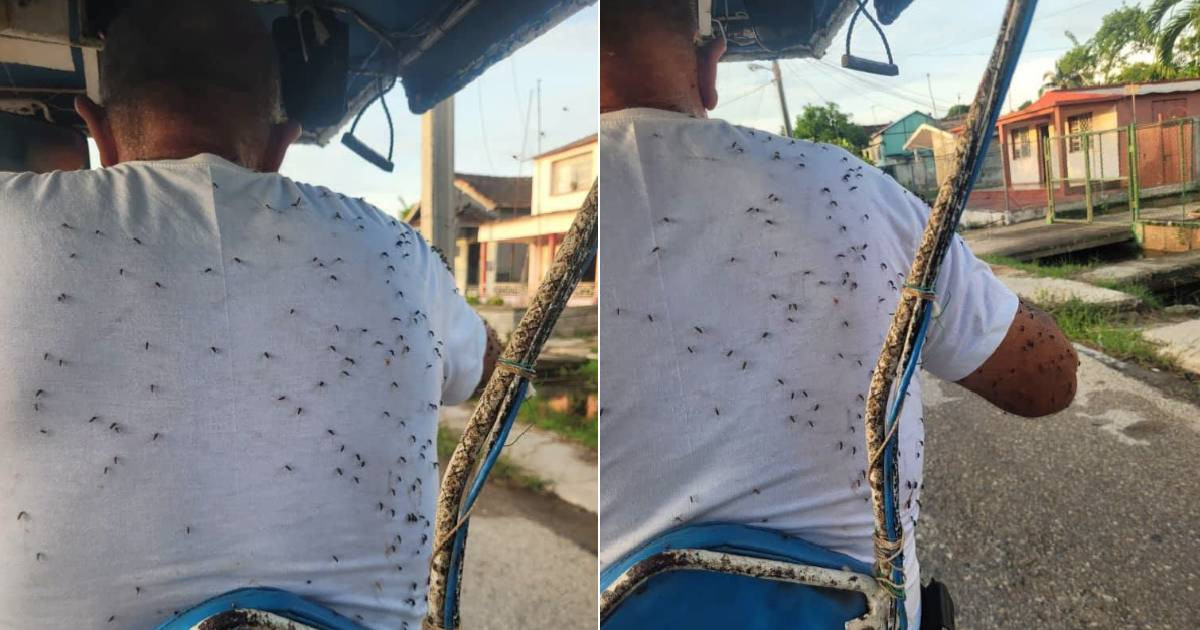
Three photographs attributed to the municipality of Batabanó, in the south of the Mayabeque province, shared on social media this Saturday, show a man with dozens of mosquitoes on his back and one of his arms, a scene that sparked alarm among Facebook users and raised questions about its authenticity.
The images, published by the page on Facebook Ojo Cuba, show the man from behind, on a rickshaw, wearing a white shirt covered in insects.
The snapshots were accompanied by a brief text: "How can they not want people to get sick in Batabanó?"
The photos contain a watermark corresponding to a Samsung Galaxy S20 FE 5G, which indicates the device that captured them, though it does not alone determine whether the images were subsequently modified.
The publication sparked an immediate debate between those who believe the photographs reflect a real situation and those who suspect they were generated or altered using artificial intelligence (AI).
"That's AI, liars, it's not like that even when you're next to a prey fishing," questioned a user. Another stated that it was "pure AI" and requested to publish content that appeared credible.
In response to those doubts, other commentators claimed to have experienced a similar presence of mosquitoes in various areas of Cuba.
"I had to do some work in that area, and honestly, it's unbearable with that swarm of mosquitoes," one of them recounted. Another person summarized the problem with a broader statement: "In Batabanó and all over Cuba."
A source from the municipality, who requested to remain anonymous, assured CiberCuba that "the presence of mosquitoes is so intense that they even get into your mouth when you speak".
The comments also mentioned Guanabo, the Zapata Swamp, Quivicán, Melena del Sur, the Isle of Youth, and Buenavista. From the latter location, a user claimed that there is "an outbreak of fever precisely because of that and the overflowing garbage," although this statement was not supported by additional information to verify it.
The lack of fumigation also emerged among the complaints. A commenter stated that in Melena del Sur, "they don’t fumigate or do anything," and linked the situation to the presence of vehicles that, in her opinion, did have fuel.
Another person questioned the restrictions on bringing insecticides into Cuba and stated that they tried to send a product to combat bedbugs to a relative, but were unable to do so.
The publication, therefore, left two distinct elements among the users. On one hand, the photographs triggered skepticism about whether the captured scene is authentic.
On the other hand, numerous comments described similar experiences with mosquitoes in various locations in Cuba, although these references also do not allow for confirmation of the origin or extent of the phenomenon depicted in the images.
According to the Global Dengue Observatory of the London School of Hygiene & Tropical Medicine, Cuba has reported over 7,100 dengue cases so far this year, a figure 7.4 times higher than the expected level for this time of year, according to a report from September.
The seasonal peak of dengue on the island usually occurs in October, according to the same international observatory, which suggests that the situation could worsen even further in the coming weeks.
The Ministry of Public Health (Minsap) confirmed the active circulation of all four serotypes of dengue and warned about the presence of chikungunya in several provinces such as Pinar del Río, Sancti Spíritus, Villa Clara, and municipalities in Havana.
Fumigations are halted in much of the country due to lack of fuel. The accumulation of garbage, prolonged blackouts that force people to keep doors and windows open, along with the collapse of the state vector control system, create conditions for infestations like the ones depicted—or seemingly depicted—in the images from Batabanó.
In the absence of official fumigation, many Cubans have turned to homemade methods. In July, a Cuban woman demonstrated how she used a can with cardboard and candles to create smoke and drive away mosquitoes after seven sleepless nights, saying, "We've gone back to the primitive era."
Related videos:
Filed under: