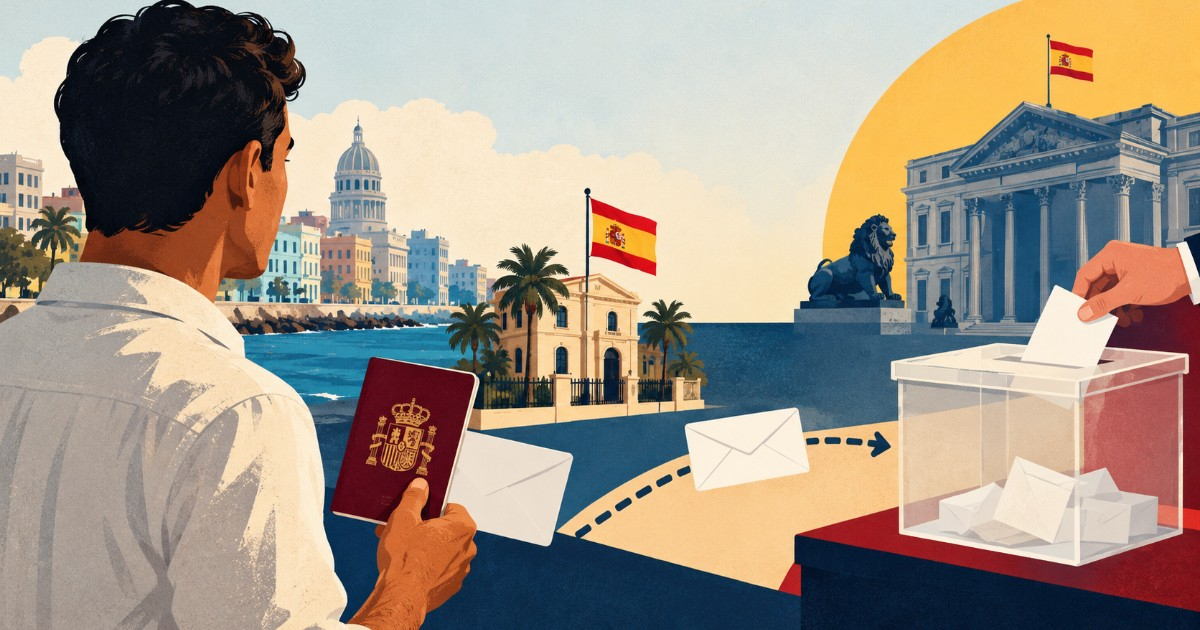
Spanish citizens residing in Cuba will be able to participate in the general elections of Spain on the upcoming November 29, but to do so it is essential to be properly registered in the Electoral Roll of Absentee Residents (CERA) applicable to these elections.
The procedure is particularly significant for the growing community of Spanish citizens on the island and, in particular, for those who recently obtained citizenship through the Law of Democratic Memory, commonly known as the Grandparents' Law.
In this last group, there is also an exceptional circumstance: the Supreme Court provisionally suspended in September certain electoral effects of the registrations in the CERA derived from this nationality route, except in cases where the status as a descendant of exiled Spaniards is proven.
Therefore, having a Spanish passport does not automatically mean that a person can vote on November 29. The essential thing will be to verify their specific situation within the electoral register.
The Ministry of the Interior explains in its official guide on voting from abroad that Spaniards who are permanently residing outside of Spain can participate in the general elections if they are registered in the CERA.
The so-called "voto rogado" no longer exists
One of the main differences compared to elections held a few years ago is that Spanish residents living abroad no longer have to request permission to vote in advance.
The so-called "voto rogado" was eliminated through a reform of the Organic Law on the General Electoral Regime (LOREG) approved in 2022.
Now, the Electoral Census Office must send ex officio the electoral documentation to individuals properly registered in the CERA.
This means that a voter residing in Cuba will not have to fill out a CERA ballot request form just to receive the documentation.
First step: check if it appears in the CERA
This will probably be the most important process for Spaniards living in Cuba.
The LOREG establishes that for each election, the electoral register closed on the first day of the second month prior to the announcement is used.
Yes, as scheduled, the Royal Decree for the call will come into effect on October 6, and the census used for this election will be that closed on August 1, 2026.
This is particularly important for those who have recently acquired Spanish nationality or modified their consular registration.
It is not enough to have received citizenship before election day; it must be verified that the person is correctly listed in the census corresponding to these elections.
There will be a period to review the census and report any errors
After the electoral call, consulates must enable a service for consulting the electoral lists for eight days.
The law establishes that this period begins on the sixth day following the call.
If the decree comes into force on October 6, the legal consultation period should extend approximately between October 12 and 19, although the times, channels, and specific details will need to be confirmed by the Consulate General of Spain in Havana.
During that period, claims can be made related, among other matters, to errors in personal data or to an improper exclusion from the census when the person had the right to be included.
Claims can be processed through the consulates, which forward them to the appropriate Provincial Delegation of the Electoral Census Office.
What happens to those naturalized under the Grandchildren's Law?
For thousands of Cubans who recently obtained Spanish citizenship through the Law of Democratic Memory, there is an additional element.
In September, the Supreme Court decided as a precautionary measure to suspend certain electoral effects and new registrations in the CERA associated with this nationality route, except when it is proven that the applicant descends from Spaniards who suffered exile.
The decision was made while the high court resolves the substantive issues of the appeals filed against the procedure used for certain registrations.
The measure is precautionary: it does not revoke the Spanish nationality of these individuals, but it may temporarily affect their ability to participate in elections.
Therefore, a Cuban who has recently obtained citizenship through the Law of Democratic Memory should not assume that they will be able to vote automatically on November 29.
You should verify your registration status and, when applicable, whether your enrollment is impacted by the court ruling or if you fall within the recognized exceptions.
CiberCuba reported in September on the precautionary suspension agreed upon by the Supreme Court and its potential impact on numerous Spanish nationals residing in Cuba.
The documentation will automatically be sent to the CERA address
Those who are finally listed as valid voters in the CERA will receive the electoral documentation at the address registered in their enrollment.
The system operates through multiple shipments.
In the initial phase, the Electoral Census Office must submit, among other documents:
The envelopes needed to vote.
Two registration certificates in the CERA.
An envelope addressed to the corresponding Electoral Board.
Another one addressed to the consular office.
A sheet with instructions.
Information about the centers where votes can be cast in person.
The law states that this initial documentation must be submitted between the 18th and 24th days following the announcement.
With a call on October 6, that period would correspond roughly to October 24 to 30.
The ballots will arrive later
The official ballots are sent later, once the candidacies are announced.
In provinces where there are no challenges, they must be sent between days 29 and 33 following the call.
In this case, that would place the shipment approximately between November 4 and 8.
When there are appeals against the declaration of candidacies, the deadline may be extended until approximately November 14.
There is also the possibility of downloading the electorally valid ballots once the appeals have been resolved and officially published.
Two ways to vote from Cuba
Electors of the CERA have basically two options: cast their vote in person at the centers designated by the Consulate or send it by mail.
In-person voting: from November 21 to 26
The LOREG allows voters to personally submit the ballot envelope between the eighth and third day before the election, inclusive.
For an election held on November 29, that period would correspond to November 21, 22, 23, 24, 25, and 26.
The Spanish Consulate General in Havana will need to announce which departments will be operational, their hours, and whether other consular points will be used within Cuba.
The voter must identify themselves with a Spanish passport or ID card. The law also provides, in certain cases, for nationality certificates or registration in the Consular Register.
The procedure does not exactly involve going to an ordinary polling station as in Spain: the voter hands over the envelope addressed to the Electoral Board to be subsequently sent to Spain and counted there.
Mail-in vote: no later than November 24
Those who prefer to send their vote by mail may do so to the corresponding Consular Office.
The LOREG stipulates that the submission must be made no later than the fifth day before the elections.
For the voting on November 29, the last legal day would therefore be November 24.
Additionally, the mail-in ballot must arrive at the consular office within the deadlines set by the legislation. Envelopes that arrive after the second day before the election will not be valid.
This sets the reception deadline, in principle, on November 27.
What documents must accompany the mail-in ballot?
The envelope intended for the Electoral Board must include:
The ballot envelope with the chosen ballot.
One of the registration certificates in the CERA.
The signature and the passport or ID number on the certificate when voting by mail.
Photocopy of the passport or Spanish DNI, or, in the accepted cases, a certificate of nationality or consular registration.
Subsequently, that envelope is placed inside the one designated for the Consulate, along with the second certificate of registration in the CERA.
Where will it be possible to vote in Cuba?
The main Spanish consular office is currently located in Havana, but the Consulate has not yet published specific instructions for the general elections on November 29.
The official electoral information will determine which centers are authorized to accept ballots and their hours of operation.
Spain also has honorary consular representations in other Cuban provinces, but their use in this process must be expressly confirmed for this election.
Therefore, it is not advisable to assume that any consular office will allow the vote to be cast.
What happens if a CERA voter is temporarily in Spain?
A person who normally resides in Cuba and is registered in the CERA but is temporarily in Spain during the electoral process has another option.
You can request a mail-in ballot from Spain without having to deregister from the CERA.
The Ministry of the Interior states that this application can be made up to the tenth day before the elections.
For the elections on November 29, that deadline would end on November 19.
That voter will not be able to later go to a Spanish polling station to vote in person.
Do not confuse CERA with someone who is temporarily in Cuba
The procedure is different for a citizen who usually resides in Spain but is temporarily in Cuba.
Those voters do not belong to the CERA simply because they are outside the country.
They use the procedure for residents temporarily abroad, known as ERTA, which requires a specific application within the electoral deadlines.
Therefore, before starting any procedure, it is important to distinguish between:
Permanent resident in Cuba: usually CERA.
Resident in Spain temporarily in Cuba: ERTA procedure.
Spanish nationality and the right to vote are not exactly the same process
This point will be especially important in Cuba.
Acquiring Spanish nationality grants numerous rights, but in order to participate in specific elections, electoral legislation must also be followed and one must be correctly registered in the corresponding census.
In this election, the exceptional situation created by the precautionary measures of the Supreme Court concerning certain registrations of beneficiaries of the Law of Democratic Memory is also a factor.
For this reason, the main recommendation for new Spanish residents in Cuba is not simply to wait for the ballots to arrive: they must first verify that they are listed as valid voters in the CERA for the elections on November 29.
Pedro Sánchez announced this Monday the advance of the general elections to November 29, following the parliament's rejection of the two housing decrees put forward by his Government.
Dates that Spaniards in Cuba should watch out for
October 6: scheduled publication of the electoral call.
October 12 to 19: estimated period for consultation and claims regarding the census.
October 24 to 30: legal period designated for the first submission of CERA documentation.
November 4 to 8: expected dispatch of official ballots when there are no challenges.
Until approximately November 14: possible shipment in districts with resources regarding candidacies.
November 21 to 26: in-person voting deposit at the authorized consular centers.
November 24: last legal day to mail the CERA ballot.
November 29: general elections.
These dates are calculated by directly applying the deadlines set by LOREG to a call that comes into effect on October 6. The calendar will need to be confirmed once the Royal Decree is published and when the Electoral Census Office and the Spanish Consulate General in Havana disseminate the specific instructions for the process.
Related videos:
Filed under: