A retired U.S. Army officer with decades of experience in military intelligence described in technical detail how Washington could neutralize the air defenses of the Cuban regime in a matter of minutes and force its collapse without the need to enter Havana.
The statements of Lieutenant Colonel Octavio Pérez were featured in episode 10 of the investigative podcast The Havana Files, published on Thursday, October 2, and hosted by the Cuban journalist Gelet Martínez Fragela, founder and editor-in-chief of the independent media outlet ADN Cuba.
Pérez, a Cuban-American military analyst whose career included the Defense Intelligence Agency (DIA), U.S. Southern Command (SOUTHCOM), and the School of the Americas—where he trained officers from 17 Latin American countries—was emphatic about the military fragility of the regime.
The radar system in Cuba dates back to the Soviet Union era, prior to 1999. They have air defense systems that are also very outdated. With the stealth technology we have with the F-22, the F-35, and many of our bombers, they don't even see them," said the expert.
According to the analyst, Cuba has fewer than 12 operational aircraft, making its air force almost defenseless. "You can destroy their air force in minutes. You can take out their air defense radars in minutes. That would be the first message," he stated.
The scenario described by Pérez does not involve a conventional invasion or urban combat in the capital. "You don’t need to enter Havana. One thing that the military hates to do is fight in areas or large cities. That’s a deadly trap," he explained.
Instead, it proposes to establish civic-military zones —G5 operations— in strategic locations: the Isle of Youth, the East (near Guantánamo), Nuevitas in Camagüey, and Pinar del Río.
In the face of such a display, the regime would be left without any capacity to respond. «The government either boards the plane and leaves, because they have... They have no way to respond to something as massive as that», Pérez stated.
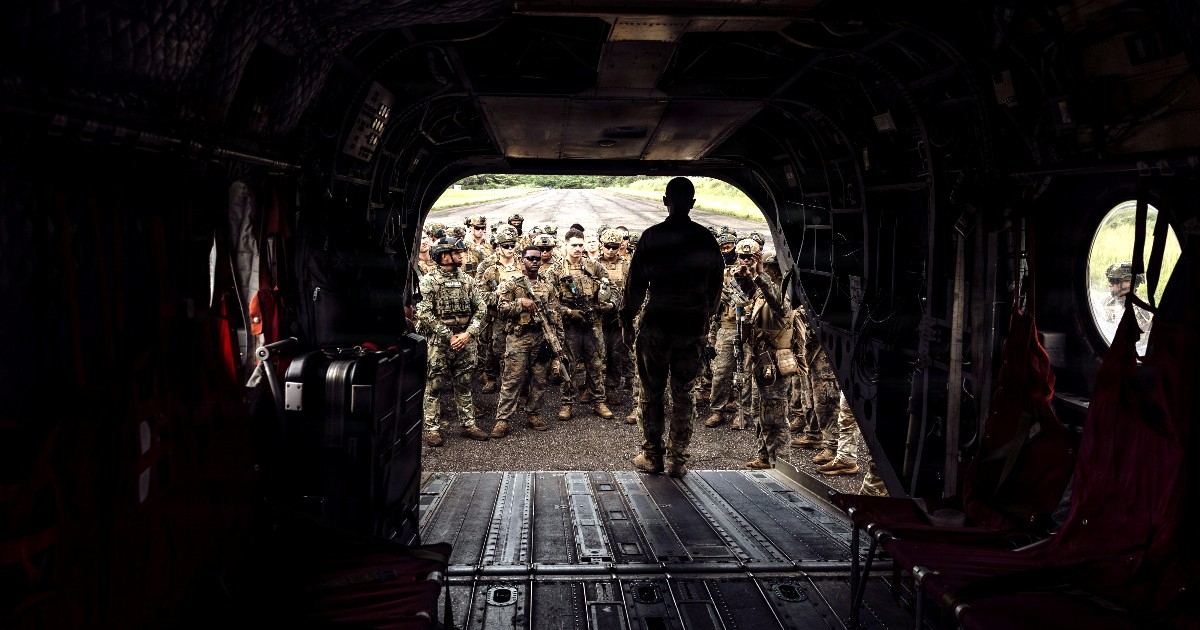
The 101st Airborne Division, an air mobile unit with Apache helicopters and infantry brigades, has been identified as the preferred force for a potential operation.
Pérez provided a specific signal to predict a movement: «If you see those helicopters starting to head to certain airfields in Florida, something is going to happen».
The analysis comes at a time of maximum U.S. pressure on the Cuban regime. On September 22, President Trump stated before the United Nations General Assembly that Cuba is an “absolutely failed state” that “will fall,” as the regime's delegation left the room.
CBS News revealed in July that Pentagon planners had studied intervention scenarios involving the 101st Division, and in September it reported that the Army Reserve assessed whether it could provide units to SOUTHCOM within 90 to 120 days.
Pérez also pointed out that surveillance flights over Cuba have intensified since August 2025, initially as support for the operation that led to the capture of Nicolás Maduro and later to map the island's defenses. "They are really in the dark, just as Maduro was on January 3 of this year," he compared.
Beyond the military option, the analyst mentioned other pressure points that have yet to be activated: confiscating the regime's bank accounts in tax havens and cutting off the supply of liquefied petroleum gas that powers electricity generation, which would leave the country without potable water or the ability to respond. "People forget everything that electricity does," he warned.
Martínez Fragela summarized the scope of the analysis at the program's conclusion: «An attack is not a movie. Low-intensity warfare is not a slogan. It is doctrine, geography, alliances, and the patient work of a regime that never confused theater with strategy».
Related videos:
Filed under: