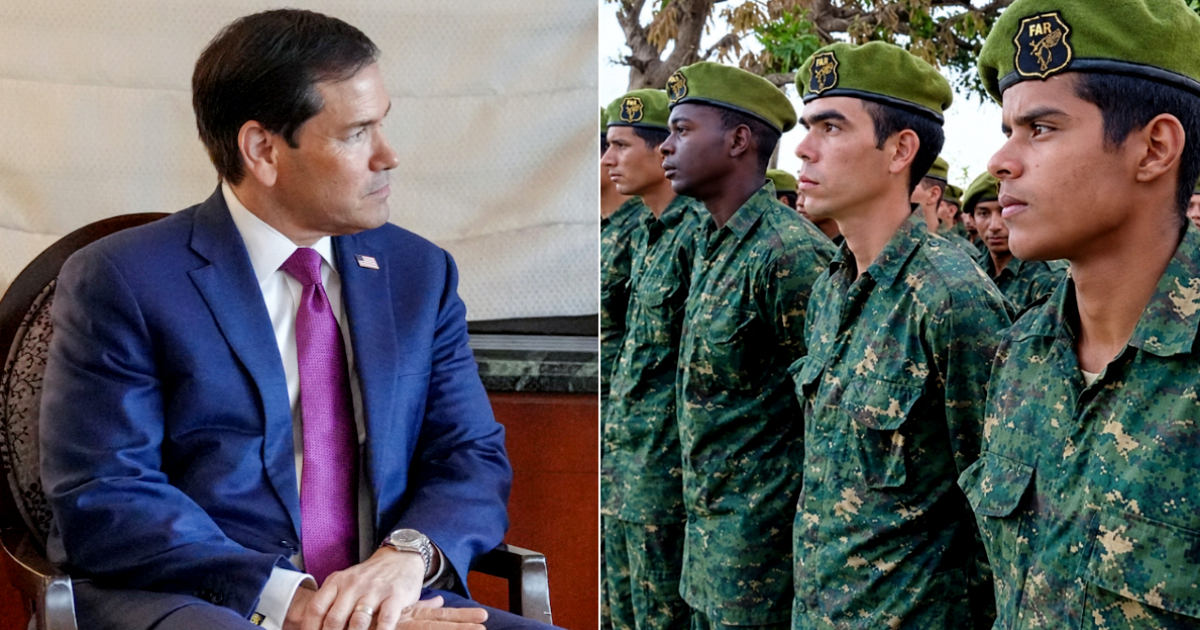
The U.S. Secretary of State, Marco Rubio, spoke again about Cuba, but this time the central message was not aimed at the formal government of Miguel Díaz-Canel nor did it emphasize the failure of Castroism; instead, it targeted another recipient: the military, the security organs, and the internal sectors that uphold the real power of the regime.
«We hope that those who currently control the weapons and the repressive regime will have individuals among them who open their eyes to the reality they face,» said the head of U.S. diplomacy during an interview with Sean Hannity from Fox News.
The phrase is significant. Rubio did not speak only of reforms, nor of dialogue, nor of a potential economic opening. He spoke of those who "control the arms" and "the repressive regime," a reference that highlights the military leadership, the Armed Forces, the Ministry of the Interior, State Security, and the economic structures linked to the apparatus of power.
In other words: Washington seems to be sending a signal to the Cuban uniformed personnel to assess whether to continue protecting an increasingly isolated, impoverished, and pressured leadership, or to facilitate a transition that paves the way for profound political and economic changes.
A message to those who hold real power
Rubio's statement aligns with a stance that the Trump administration has been developing for months: the Cuban issue cannot be resolved through minor economic adjustments or a controlled internal succession by the Communist Party, but rather through a real transition that includes political freedoms, economic openness, and a new relationship with the United States.
In September, Rubio had already opened the door to working with certain figures of the Cuban regime, as long as they were willing to commit to a genuine transition and not just superficial adjustments.
That distinction marked an important point: Washington does not view the entire Cuban state apparatus as a homogeneous block, but rather differentiates between those who have direct responsibility for repression — "blood on their hands" — and those who could facilitate a way out.
Months earlier, the Chargé d'Affaires of the United States in Havana, Mike Hammer, confirmed that Washington was maintaining “communications with certain individuals” within the Cuban regime to explore a “peaceful” and “less chaotic” exit.
Those statements already hinted that the White House is not only applying pressure from the outside but is also looking within the system for interlocutors capable of shifting the dynamics.
Rubio's statement before Hannity seems to go a step further. It does not limit itself to discussing technocrats, officials, or potential interlocutors. It addresses those who hold the power of force.
Uniformed under pressure
The call occurs in a particularly sensitive context for the Cuban military.
In recent months, CiberCuba has documented a noticeable increase in U.S. military pressure in the Caribbean, with exercises, naval presence, intelligence operations, and leaks about potential contingency scenarios regarding Cuba.
In April, the United States activated the FLEX2026 exercise in Key West, while drone flights, intelligence aircraft, and naval presence near the island intensified. According to the published information, these maneuvers rehearsed a complete chain of detection, tracking, and interception of targets in the Caribbean Sea.
Training exercises of Marines have also been reported in the Caribbean, maritime interdiction drills, and movements related to Operation Southern Launch, portrayed as a military campaign by Southern Command against drug trafficking and transnational illicit networks, but interpreted by analysts as part of a broader strategic pressure on Cuba.
Amid this pressure, reports surfaced regarding military planning exercises in case Cuba descends into chaos, revealed by Axios and reported by CiberCuba, along with information from CBS News about contingency preparations for a possible military action.
None of those reports prove that Washington has made a decision to intervene, but they do show that the military factor is part of the pressure environment surrounding the regime today.
In this context, Rubio's statement takes on a new dimension. It's not just a moral appeal for some within the regime to "open their eyes." It's a political message delivered at a time when Cuban security forces are facing sanctions, isolation, economic pressure, military movements in the Caribbean, and an increasingly explicit discourse from Washington.
The strategy: pressure, offer, and transition
The Trump administration has combined warnings with conditional offers. Rubio revealed in July that the United States offered economic aid, assistance for reconstruction, and a new bilateral relationship if the regime accepts real political and economic reforms.
He also emphasized that Washington will use "all the tools" available to promote changes in Cuba, demand the release of political prisoners, and pressure the elites that obstruct any meaningful reform.
This is the context in which the message to those who control the weapons should be understood.
Rubio is not asking the military to save the regime with a superficial reform. He is telling them, in diplomatic but unequivocal terms, that the current model has no way out and that those who support it must decide which side they will be on when the outcome accelerates.
The U.S. pressure does not seem aimed solely at punishing the leadership, but rather at provoking internal calculations.
Who within the apparatus is willing to bear the full cost of repression, national misery, and international isolation until the end? Who understands that an orderly transition could be less costly than a chaotic break? Who is willing to stop acting as a buffer for a discredited elite?
A social majority demanding change
Rubio's call also coincides with a political fact that the regime is trying to ignore: a significant portion of Cuban society wants a deep change of system.
The independent survey "Cuba: Political and Social Perspectives," driven by more than 20 independent digital media outlets, revealed an overwhelming rejection of the current model.
According to results collected by CiberCuba, 75.1% of participants supported a transition to a liberal democracy with a market economy, while over 91% endorsed some form of deep structural change in the country.
Other results from the same survey pointed in the same direction: 94% of respondents expressed being very dissatisfied with the current system, and 95% deemed a political change to be extremely urgent.
Although this is an independent digital survey and not a state poll, its political value lies in breaking the official narrative of unanimity. It also helps to understand why Rubio's message to the uniformed services carries a particular weight: if the social majority wants change, the military faces the dilemma of continuing to repress a country that demands a way out or facilitating a transition that prevents further suffering.
The dilemma of the military
For decades, the Armed Forces and security agencies have been portrayed by the regime as guarantors of national sovereignty. However, in practice, they have ended up being guarantors of the continuity of a political and economic elite that has failed to provide food, electricity, transportation, decent wages, or a future for millions of Cubans.
That’s why Rubio's phrase is so relevant.
When speaking of those who control "the weapons and the repressive regime," the Secretary of State is not addressing an abstraction. He is speaking about specific individuals within a concrete structure: leaders who are aware of the true state of the country, officials who understand the extent of the decline, and operators who recognize that blind obedience to the leadership can also become a historical responsibility.
The message from Washington appears clear: there may still be a diplomatic and orderly exit, but that exit requires someone within the apparatus to understand that the time for waiting is running out.
Rubio summarized it in the interview by pointing out that some Cuban leaders believe they can endure without making changes until the Trump administration is over. “They are mistaken and will learn the lesson the hard way if they do not make corrections,” he stated.
The phrase was not just a warning to the regime. It was also an invitation to the military to look at reality without slogans: a country in ruins, a population calling for change, a leadership with no answers, and a U.S. administration that no longer seems willing to accept that Havana continues to buy time.
In that scenario, Rubio did not only speak about Cuba. He addressed those who hold the weapons. And he publicly urged them to open their eyes.
Related videos:
Filed under: