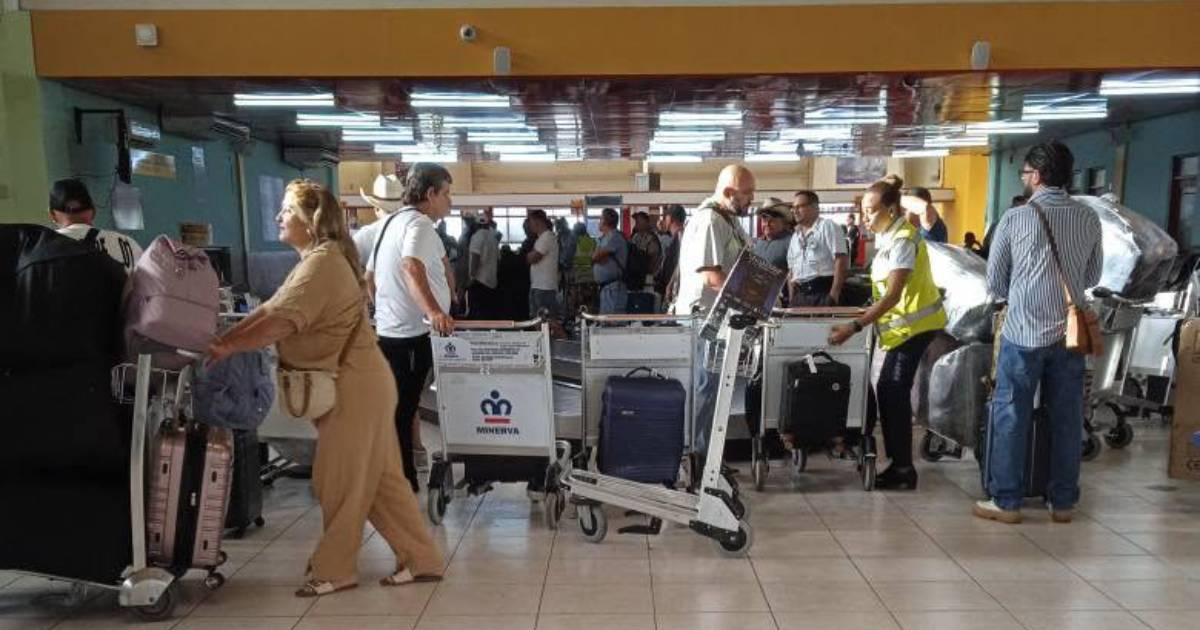
The new customs regulations that will come into effect in Cuba on October 12 do not remove the limits on the goods that travelers can carry or that recipients of shipments can receive. The main change concerns what will happen when Customs determines that there are excessive quantities or that an import has a commercial nature.
So far, , which regulated non-commercial imports by individuals, established the seizure of excess goods in many cases. The new maintains several of the existing limits but introduces an alternative: that those goods can be transferred to a second shipment with a commercial nature and imported by paying tariffs and fees in dollars.
The new regulation, published this Monday in the , repeals Resolution 175 of 2022 and its subsequent amendments from 2024 and 2026.
But, in practical terms, what changes regarding the rules that were in effect?
Previously, the surplus would be confiscated; now it can be paid for to import it
This is probably the most important difference.
Resolution 175/2022 stipulated that when Customs determined a commercial nature due to the quantities of a product, it would allow the authorized amount to enter and would administratively confiscate any excess.
The new Resolution 340 alters that process. First, shipments that comply with the rules for non-commercial imports will be dispatched, and subsequently, the traveler or recipient may accept a new shipment for the excess, paying the corresponding duties and services in USD.
In other words, the essential change is not that the limits disappear, but rather that surpassing them no longer necessarily leads to the confiscation of what is left over.
The "five or three articles" rule already existed
The new resolution states that for certain products valued through declaration, invoice, or reference value, up to five units of each type may be admitted if their value does not exceed 50 dollars, and up to three units when it does.
But that amount is not new.
Resolution 175/2022 already contained exactly the same rule. The difference was the fate of the surplus: the previous regulation ordered its confiscation.
Now, after admitting the corresponding five or three units, the surplus may be submitted for commercial clearance in dollars.
The regulation itself uses the same example of the five toilet bowls valued at 55 dollars each. Under the previous rules, three were allowed, and the other two were confiscated; with the new system, those two units can be transferred to commercial dispatch.
Some limits on cell phones and appliances also do not change
Something similar happens with several of the boundaries that may catch the attention of travelers.
The possibility of importing up to two appliances of the same type was already included in Resolution 175/2022, as well as the limit of two power generators.
They were also authorized to have up to three computing devices of any type, and up to five mobile or smart phones.
Resolution 340 upholds those maximums.
Therefore, for those traveling with two appliances or five cell phones, the novelty does not necessarily lie in the allowed quantity, but rather in the possibility of treating any excess as commercial when applicable.
The 90 Kilograms of Shoes: Same Limit, Different Outcome
The change is particularly clear in the case of what is called miscellaneous items, which include clothing, footwear, food, toiletries, perfumes, and other products.
The previous regulation already stipulated that when Customs detected a commercial nature due to the excessive repetition of the same item, it could allow up to five kilograms and seize the remainder.
He even used the example of a traveler with 90 kilograms of women's shoes: five kilograms could get through, and the other 85 were confiscated.
The new regulation retains the five kilograms but replaces that outcome: the rest can go to the commercial office and be imported by paying in dollars.
The rule also remains that when five kilograms represent a disproportionate amount due to the items being very small—such as watch batteries or matchstick stones—the Customs may only allow one kilogram. Previously, the rest would be confiscated; now, the new commercial procedure can be applied to them.
It also changes the treatment of goods considered commercial by their nature
The previous resolution allowed Customs to determine that an item was of a commercial nature not only based on its quantity but also on its characteristics and functions. In such cases, it could proceed with administrative seizure or apply another appropriate measure.
The new regulation maintains that authority but establishes that when the equipment's features indicate it is intended for commercial, industrial, or manufacturing activities and the other conditions are met, Customs may accept it through the new commercial clearance procedure.
How much will it cost to preserve the surplus?
For travelers who choose the new commercial customs clearance, the duty will be progressive: 15% up to $2,000; 20% on the excess from $2,000 to $4,000; 25% on the excess from $4,000 to $6,000; and 30% on the excess over $6,000.
In the shipments, the fee will be 30%.
Additionally, customs services are charged, and payments must be made in dollars using international or national cards in USD. Cash will only be accepted at authorized entities in the airports.
What happens if the traveler doesn't want to pay?
The new regulation allows the individual to refuse the commercial dispatch and request the re-shipment of the goods.
If payment is not made in USD and re-shipment is not carried out, Customs will apply the corresponding administrative measure.
The mechanism also does not allow for the regularization of any product through payment. Prohibited goods, fraudulent declarations, and other violations remain subject to the measures outlined in the legislation.
The new scheme implements a measure that the government announced in June as part of its 176 "economic and social measures."
Related videos:
Filed under: