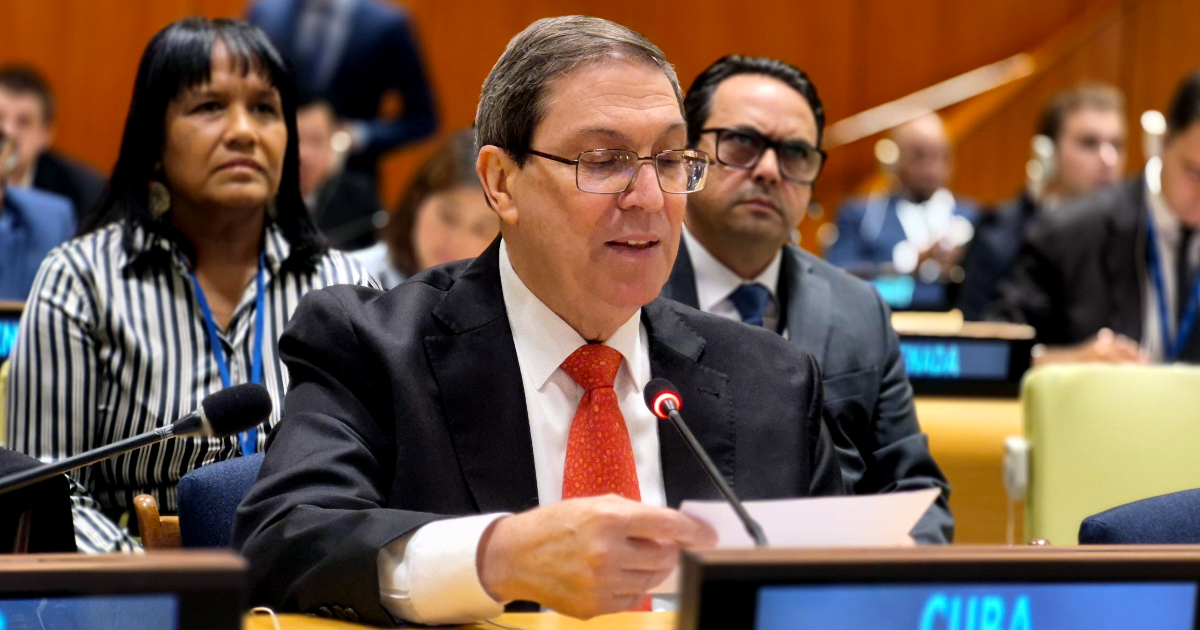
The Cuban Minister of Foreign Affairs, Bruno Rodríguez Parrilla, published a quote from Raúl Castro on his X account this Sunday, in which he proposes a formula to overcome "these difficulties," circumventing the euphemism of naming the economic and social debacle caused by 67 years of dictatorial rule and communist totalitarianism.
According to the regime's chancellor, to "overcome these difficulties," the Cuban people must fight "with the same determination as Baraguá, Moncada, Granma, and Girón." The post, accompanied by the hashtag #RaúlEsRaúl, unsettlingly summarizes the comatose state of the Cuban regime's propaganda in 2026.
Rodríguez Parrilla reproduced verbatim the words of the dictator in his post: "History has taught us abundantly where resignation and defeatism lead. Let us not limit ourselves to merely resisting."
Y he added: "We will overcome these difficulties, just as we always have, by fighting!, with the same determination of Baraguá, of Moncada, of Granma, of Girón, and with the strong convictions instilled in us by the Commander in Chief."
The message arrives at the worst economic moment the island has experienced in decades, and when Cubans are more fed up than ever with the propaganda and messages calling for "creative resistance," appealing to "heroism," or trying to sanctify the historical "battles" of Castroism and its outdated narrative.
In the national economic landscape, the Cuban GDP fell by approximately 5% in 2025 and the CEPAL projects a contraction of up to -10.3% for 2026. The year-on-year inflation reached around 25% in August.
Eight out of ten Cubans skip daily meals due to shortages, the electrical system is in collapse, and the UN warned that blackouts threaten the vaccination of 70,000 children. The magazine Foreign Affairs warned in September that Cuba is approaching a "point of no return".
In that context, the solution offered by the regime is to recycle episodes from revolutionary mythology: Baraguá —the protest by Antonio Maceo in 1878 against a peace without full independence—, the assault on Moncada in 1953, the Granma landing in 1956, and the defeat of the Bay of Pigs invasion in 1961.
These four milestones that the regime's narrative has linked for decades represent for Havana proof that the so-called "revolution" and its heirs and successors "never" accept defeat, regardless of what the people endure.
This is not the first time Rodríguez Parrilla has turned to this manual.
At the end of September, he celebrated the Committees for the Defense of the Revolution from New York while Cuba was on the brink of collapse. Weeks earlier, he dusted off another quote from General Castro, without providing the date or original context, proclaiming that “the Revolution dignified Cuba and Cubans.”
On September 4, the chancellor himself acknowledged that Cuba has "been in its current situation for too long," without providing any explanation about who caused it.
The external context exacerbates the irrelevance of the message. The Trump administration imposed over 240 sanctions against Cuba in 2026.
On September 22, Trump referred to Cuba as a "failed state" at the UN General Assembly and warned that "Cuba will fall, freedom will come."
Four days later, he ruled out immediate military action but did not completely dismiss that option, while reports circulated about evaluations by the U.S. Army to reinforce Southern Command.
Faced with this unprecedented pressure and an internal collapse that can no longer be concealed, the official response from the regime is to invoke Raúl Castro, appeal to the spirit of Baraguá, and call upon Cubans to fight. What it does not explain is against what, nor with what.
Related videos:
Filed under: