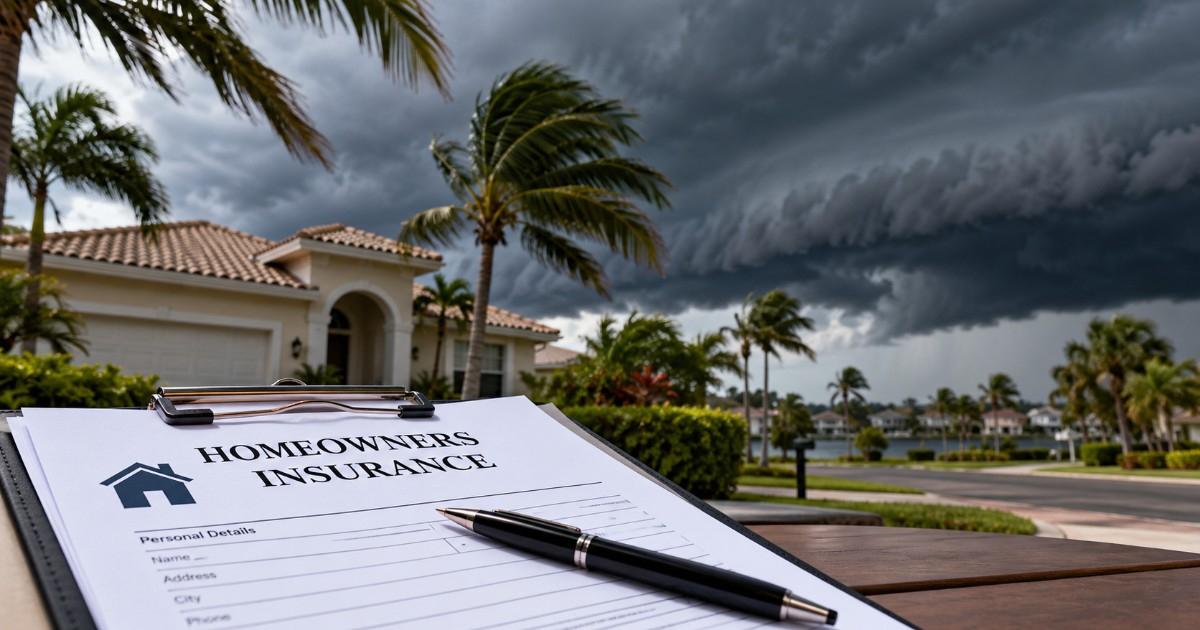
Waiting until a storm threatens Florida to purchase homeowners insurance or increase coverage may be too late.
The Florida Department of Financial Services itself warns that when the National Weather Service issues a tropical storm or hurricane watch or warning for any part of the state, many companies temporarily stop issuing new homeowners or renters policies and accepting increases in coverage.
When an insurer activates this type of suspension, coverage may not become available again until 72 hours after the last monitoring or notice has been lifted.
The warning takes on particular significance during the hurricane season and at times like the present, when the National Hurricane Center is monitoring systems that could approach the U.S. Gulf Coast.
CiberCuba reported on Tuesday about system 92L in the Gulf of Mexico, which is showing conditions for development and whose evolution should be monitored by residents along a broad stretch of the northern Gulf coast, including northwest Florida.
This does not mean that there is currently a general suspension of insurance in Florida, nor that 92L will necessarily affect the state. The restriction comes into play when the relevant weather alerts are issued and also depends on the rules of each insurance company.
It does not mean that all insurance companies in Florida will close automatically
This is the main consideration that an owner should keep in mind.
The Financial Services Department does not assert that there is an automatic prohibition applicable to all companies. Their warning indicates that many insurers cease to bind new coverages or increases in coverage when a watch or tropical warning affects any part of Florida.
In practice, this can prevent a person from waiting to see where a hurricane is headed before purchasing protection at the last minute.
The suspension primarily affects operations such as:
Contract a new homeowner's policy.
Take out a new renter's insurance policy.
Increase certain coverage limits.
Add additional protection to a policy when the company has suspended such changes.
A policy that was already in effect before the suspension is not automatically canceled simply because a tropical watch or warning is issued. What is restricted is the purchase of new coverage or certain changes that increase the exposure for the insurer.
Citizens does have an explicit suspension rule
The case of Citizens Property Insurance Corporation, Florida's last resort state insurer, is particularly clear.
Citizens establishes that its agents cannot link new applications or changes that increase coverage when a tropical storm watch, tropical storm warning, hurricane watch, or hurricane warning has been issued for any part of Florida.
The company implemented this rule, for example, in July 2026, when it temporarily suspended the issuance of new coverage statewide due to a tropical threat.
The suspension was state-wide even though the weather threat did not directly affect all the cities in Florida.
Therefore, a resident of Miami may temporarily encounter restrictions on contracting or expanding certain coverages even if the weather advisory has been issued for another area of the state.
What is the difference between a watch and a warning?
The alerts do not mean the same thing.
According to the definitions from the National Weather Service:
A Tropical Storm Watch indicates that tropical storm conditions are possible generally within the next 48 hours.
A Tropical Storm Warning indicates that such conditions are generally expected within the next 36 hours.
A Hurricane Watch indicates that sustained winds of at least 74 mph are possible in the specified area, typically within the next 48 hours.
A Hurricane Warning is issued when those conditions are expected in approximately 36 hours or less.
For property owners, the important detail is that an insurer may begin to impose restrictions before the cyclone arrives and before there is certainty that a specific property will suffer damage.
Florida allows temporary suspensions during hurricanes
Florida legislation also explicitly addresses these situations.
The statute 624.4301 of Florida regulates the temporary suspension of new residential policies.
Typically, an insurance company that decides to temporarily stop issuing new residential policies must communicate this to the state's Office of Insurance Regulation.
However, the law establishes an exception for suspensions adopted in response to a hurricane that may make landfall in Florida, as long as that suspension ends within the allowed period after the hurricane conditions have dissipated.
The goal is to prevent a company from having to take on a new risk just when a potential disaster is already imminent.
The 72 hours can begin once the storm has moved away
One of the details that may surprise consumers is that the problem does not necessarily end once the immediate danger disappears.
The Florida Office of the Insurance Consumer Advocate warns that when this type of restriction is activated, it may not be possible to obtain coverage again until 72 hours after the last surveillance or notice is lifted.
This means that a person who was finalizing the purchase of a home, switching insurance providers, or trying to increase their coverage may have to wait several days even after the tropical system has ceased to pose an immediate threat.
Specific deadlines should always be confirmed directly with the company or the agent, as underwriting policies may vary.
Do not confuse home insurance with flood insurance
There is also another coverage that is advisable to purchase well in advance: flood insurance.
A standard homeowners insurance policy typically does not cover flooding caused by the entry or accumulation of water.
In new policies from the National Flood Insurance Program (NFIP), coverage typically has a 30-day waiting period before it goes into effect, although there are some exceptions.
Official information can be accessed on the National Flood Insurance Program portal.
This means that someone trying to purchase flood insurance when a hurricane is already approaching will likely not have coverage for that event either.
CiberCuba recently explained that certain residents of unincorporated areas of Miami-Dade can receive up to a 35% discount on eligible NFIP policies, but also that the waiting period makes it particularly important to obtain coverage before there is an immediate threat.
Citizens will also undergo an important change in 2027
For Citizens' customers, there is another element that is advisable to review in advance.
From January 1, 2027, most new residential policies and renewals from Citizens that include wind coverage must also maintain flood insurance regardless of the insured value of the home.
CiberCuba detailed the requirements and exceptions for this change, which will expand the obligation to numerous property owners who are currently not subject to it.
Therefore, those with an upcoming renewal should not wait for the hurricane season or the emergence of a tropical system to review their coverage.
Cuidado con quien ofrezca cobertura cuando nadie más puede venderla
The official warning from Florida also includes a component against fraud.
The Department of Financial Services advises being cautious of unsolicited calls or messages from supposed agents who promise to sell or immediately increase coverage during a weather event.
If legitimate insurers have temporarily suspended new coverage due to a storm, an unexpected offer promising to bypass those restrictions should raise suspicions.
The consumer should either purchase or modify a policy directly with their insurer or through a properly authorized agent and avoid providing personal, banking, or insurance information to individuals who reach out without being requested.
What should be checked before a storm appears?
Check your policy limits now and not when there is an immediate threat.
Check the hurricane deductible and how much you would have to pay out of pocket.
Confirm if you need to increase Coverage A or any other coverage.
Ask your insurer what their binding policy is during tropical watches and warnings.
Review the flood insurance separately, as the standard homeowners policy typically does not cover that protection.
Don't wait for a trajectory cone to exist over your city to make important modifications.
Be wary of unexpected offers to sell coverage during an emergency.
The conclusion for Florida homeowners is simple: the time to review and purchase insurance is before the threat appears.
A weather alert issued even for another part of the state can trigger suspensions of new policies, and when that happens, waiting for the storm to pass is not always enough: some coverages may remain unavailable for several days.
Related videos:
Filed under: