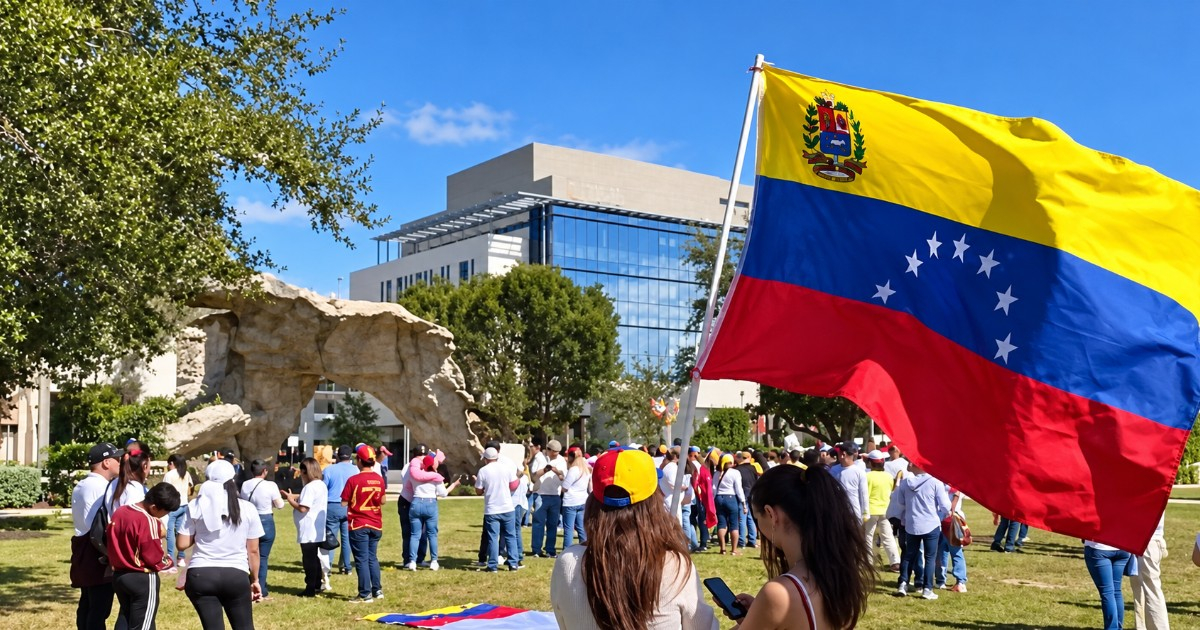
The Supreme Court of the United States took a new turn on Monday in the litigation over the Temporary Protected Status (TPS) for Venezuelans by overturning a lower court ruling that had favored the beneficiaries and sending the case back for reconsideration under a precedent that limits judicial review of government decisions regarding this immigration program.
The decision was issued coinciding with the start of the new session period of the highest court.
According to reported by Univision, the judges granted the Government's request, overturned the previous ruling, and referred the case back to the lower court for review in light of Mullin v. Doe.
The official Supreme Court docket, identified as 26-48, Mullin v. National TPS Alliance, records this Monday's decision with the procedural formula: petition granted, judgment overturned, and case remanded for reconsideration in light of Mullin v. Doe, 609 U.S. 324 (2026).
The official list of court orders dated October 5 also includes the proceedings from the first day of the new judicial term.
The measure is important, but does not represent a new substantive decision that by itself declares the end of the Venezuelan TPS.
Technically, the Court used the procedure known as grant, vacate and remand: it agreed to review the case, voided the previous ruling, and instructed the lower court to reconsider it under the new legal framework.
This framework comes from Mullin v. Doe, decided by the Supreme Court on June 25, 2026. In that ruling, related to the terminations of the TPS for Syria and Haiti, the majority concluded that the TPS law prohibits courts from reviewing certain decisions made by the Secretary of Homeland Security regarding the termination of a country's designation.
The examined legal provision establishes that there is no judicial review of a “determination” by the secretary regarding the designation, extension, or termination of TPS.
This criterion significantly reduces the margin that federal courts have to keep the cancellations of the program blocked through lawsuits based on non-constitutional claims.
The decision made this Monday comes just three days after who held documentation related to TPS with that expiration date ended last Friday.
That group was made up of individuals who had received certain immigration documents before February 5, 2025, with an expiration date of October 2, 2026. During the lengthy legal battle, those authorizations had been temporarily protected.
The figure of approximately 5,000 people is an estimate and not a definitive count. Telemundo reported that experts estimated this was roughly the number of Venezuelans who still held work permits linked to TPS until that date.
For those who relied exclusively on TPS to remain and work legally in the United States, expiration may mean the loss of both protection against deportation and employment authorization.
However, the order issued this Monday by the Supreme Court does not mean that all employment authorization cards have been automatically canceled.
The status of each permit depends on the immigration category under which it was issued, its validity date, and whether the holder has another independent legal basis to work or remain in the country.
For that reason, a person whose Employment Authorization Document (EAD) still shows a seemingly valid date should not assume that they are still authorized to work solely based on what is printed on the card. The validity of the document must be assessed alongside the immigration status that gave rise to the permit.
The complexity dates back to January 2025, when the previous government announced an extension of the TPS for Venezuela until October 2, 2026
Subsequently, the Department of Homeland Security (DHS) under the Trump administration reversed that decision and moved forward with the termination of the Venezuelan designations.
An official document from USCIS and DHS detailed that the revocation affected the extension for 2025, the unification of the processes for the designations of 2021 and 2023, and certain automatic extensions of work permits.
The legal battle allowed the small group with documentation expiring on October 2, 2026, to temporarily retain their rights, even after the Supreme Court had previously permitted the Government to move forward with the cancellation of TPS for hundreds of thousands of Venezuelans.
In June, the Supreme Court had already set important limits on the ability of federal judges to block TPS cancellations in Mullin v. Doe, specifically in cases related to Haiti and Syria.
The precedent is now decisive for the Venezuelan litigation: the lower court will have to reevaluate the case, taking into account that the Supreme Court considers that TPS legislation expressly restricts judicial review of certain decisions made by the DHS.
For South Florida, where there is a large Venezuelan community in cities and areas such as Doral, Weston, and Kendall, the change has immediate practical consequences for families, workers, and employers who must determine whether the affected individuals' work permits remain valid through any means other than TPS.
Specialists recommend reviewing the EAD, the I-797 and I-94 forms, and any pending immigration procedures individually, in addition to consulting with an immigration attorney before continuing to use documentation that may rely solely on TPS for its validity.
The loss of TPS does not necessarily mean that all affected individuals can be deported immediately: some Venezuelans have asylum applications, family petitions, or other open processes that may provide them with a different basis for immigration. However, those without other protections could be exposed to detention and deportation proceedings.
The case adds to a particularly intense immigration agenda in the Supreme Court. The new judicial period also includes disputes over deportations to third countries and immigration detention without automatic access to bail, issues that can directly impact thousands of immigrants, including Cubans.
Related videos:
Filed under: