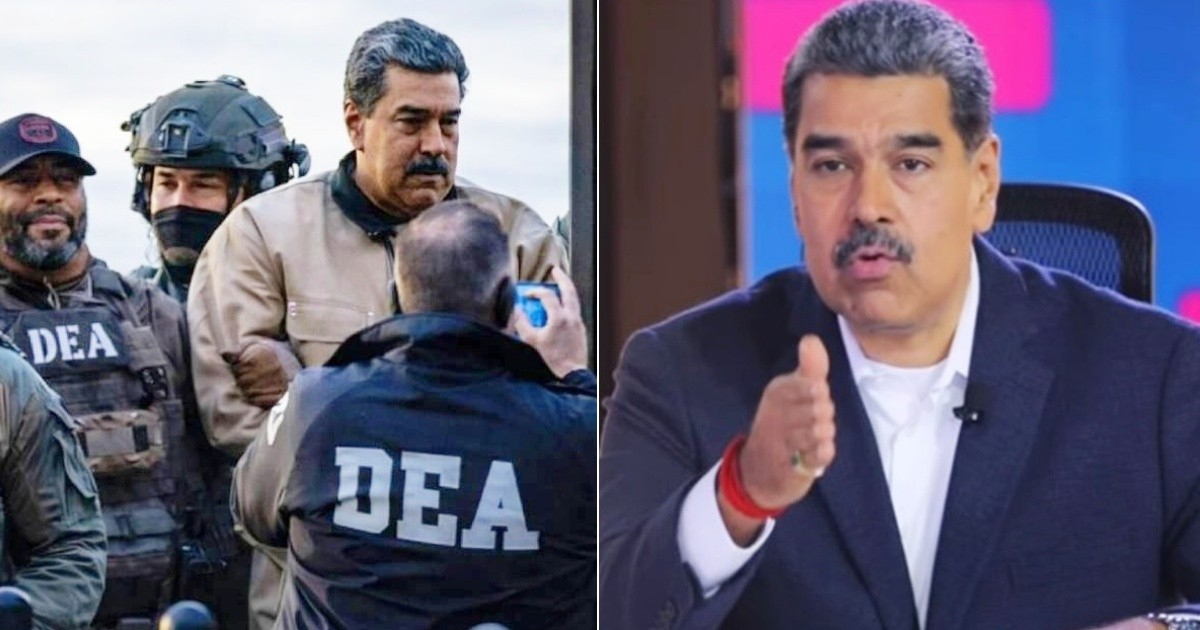
The U.S. Board of Immigration Appeals (BIA) established a precedent that could have significant implications for Venezuelans seeking asylum due to fears of political persecution: Nicolás Maduro's departure from power and the subsequent transfer of executive authority represent a change in the conditions of Venezuela that must be considered when assessing whether the danger of returning to the country still exists.
The decision, adopted on September 4 and published by the Executive Office for Immigration Review (EOIR) of the Department of Justice, corresponds to Matter of A-E-V-M-, 30 I&N Dec. 20 (BIA 2026), Interim Decision #4241.
The ruling gained special attention this Thursday after journalist David Alandete, correspondent at the White House, pointed out a paradoxical consequence for the Venezuelan exile: the fall of Maduro, celebrated by his opponents, may now become an argument for the U.S. government to question whether some asylum seekers still face a real risk of persecution.
The case that set the precedent involves a Venezuelan woman who entered the United States as a student in 2014 and, along with her husband, participated in pro-democracy groups and opposition activities in Venezuela.
According to the resolution, both were threatened and intimidated by individuals they identified as supporters of the Maduro government and by an official from the University of Carabobo. Her husband was also physically assaulted. In October 2025, when she was already in the United States, Venezuelan authorities canceled her passport.
An immigration judge granted her asylum in April 2026 after considering her testimony credible and concluding that she had a well-founded fear of future persecution due to her political views. The judge determined, however, that the woman had not shown that she had suffered persecution in the past.
The Department of Homeland Security (DHS) appealed the decision and argued, among other points, that conditions in Venezuela had changed following Maduro's departure.
The BIA acknowledged that this political change should carry more weight in the analysis, revoked the asylum grant, and returned the case to the immigration judge for a new evaluation.
The court questioned the judge's general assertion that "the architecture of Maduro's Government remains" and that "the Maduro regime has not disappeared." For the Board, these statements are insufficient to determine the individual risk the applicant would face if she returned to Venezuela.
The new analysis should consider whether the individuals or institutions that allegedly pursued her still have the power, capacity, and intention to do so under the current political circumstances.
The BIA took into account, among other elements, the reopening of the United States Embassy in Caracas, the influence of Washington over the interim Venezuelan Government, the announced steps towards an institutional and democratic transition, and the oil agreement announced by Trump at the end of August.
The decision does not mean that Venezuelans have lost the right to apply for asylum, nor does it declare that Venezuela is a safe country. However, it establishes that judges cannot assess applications based on persecution by chavismo as if Maduro were still in power.
This requires giving special attention to a key question: whether the danger claimed by each applicant continues to exist after the political change that occurred in January.
The precedent comes in a still contradictory scenario. Although hundreds of political prisoners have been released since the beginning of the year, international organizations and human rights groups have documented new political arrests and have warned that structures linked to the Venezuelan repressive apparatus continue to operate.
The ruling adds to the uncertainty faced by numerous Venezuelans in the United States since Maduro's capture. In January, many expressed fear for their migratory future amid changes to the protections that have been granted to citizens of that country for years.
As Alandete summed up, Maduro's continued hold on power, which for years has been part of the argument to protect those fleeing his government, has ceased to be a current circumstance and may now become a factor requiring applicants to prove that the risk of persecution persists under the new Venezuelan reality.
Este fallo de la BIA podría tener consecuencias para miles de venezolanos en proceso de asilo. Sigue toda la actualidad sobre para estar al tanto de los cambios que pueden afectar tu situación migratoria.
Related videos:
Filed under: